






AI Automation in CRM: Boost B2B Growth
CRM, AI Automation, B2B Growth Strategy
How Does AI Automation Work Inside a CRM?
As a senior SEO and AEO strategist working with B2B teams at LeadMagno, I see the same pattern repeatedly: revenue leaders are under pressure to grow pipeline while sales and marketing teams are drowning in admin work. Meanwhile, AI adoption is high in general, but only 0–19% of B2B firms have AI meaningfully integrated into their CRM stack, despite 71% planning to ramp this up in 2026 [1]. The competitive gap is no longer about “having a CRM”; it is about how intelligently that CRM can act on your data in real time.
What Is AI Automation Inside a CRM?
AI automation inside a CRM is the use of machine learning, generative AI, and rules-based agents to automatically capture, enrich, analyze, and act on customer data across channels—so the system not only stores relationships, it proactively manages and advances them for you.
In one sentence: AI automation turns your CRM from a passive database into an active, decision-making co‑worker that executes revenue tasks at scale.
Quick Summary: Best AI Automation Inside a CRM Strategies / Insights
Prioritize unified, clean data before advanced AI; bad data multiplies bad automation outcomes.
Start with high-volume, low-risk workflows (lead routing, enrichment, follow-ups) to prove ROI quickly.
Use AI for predictive scoring and next-best action to focus reps on winnable deals and at-risk accounts [2].
Embed agentic AI that can execute tasks (not just make suggestions) under clear governance rules [3].
Measure impact using time saved, win-rate lift, and incremental pipeline, not just email volume or activity counts [4].
Why AI Automation Inside a CRM Matters in 2026
CRM plus AI delivers a reported ROI of $13.50 per $1 spent, compared with $8.71 for CRM alone [2]. Teams see up to 34% higher sales productivity and 42% better lead scoring accuracy[2]. In insurance alone, AI-assisted CRMs have produced a 3.2× higher close rate and save agents more than 8 hours per week[5]. The macro trend is clear: AI-CRM is no longer experimental; it is a revenue operations necessity.
AI snippet: If you want faster pipeline growth with the same headcount, you need your CRM to automate data capture, triage, and follow-up so humans focus on conversations, not clicks.
Core AI Automation Strategies Inside a CRM
Predictive lead and account scoring: Models rank opportunities based on intent signals, fit, and engagement, improving prioritization and forecast accuracy [2].
Agentic workflow automation: AI agents qualify leads, update fields, assign owners, and trigger cadences without manual intervention [3].
Hyper-personalized outreach: Generative AI drafts emails, call scripts, and proposals tailored to persona, stage, and recent activity [6].
Service automation: Chatbots and virtual assistants resolve routine tickets, summarize calls, and escalate complex cases with context [6].
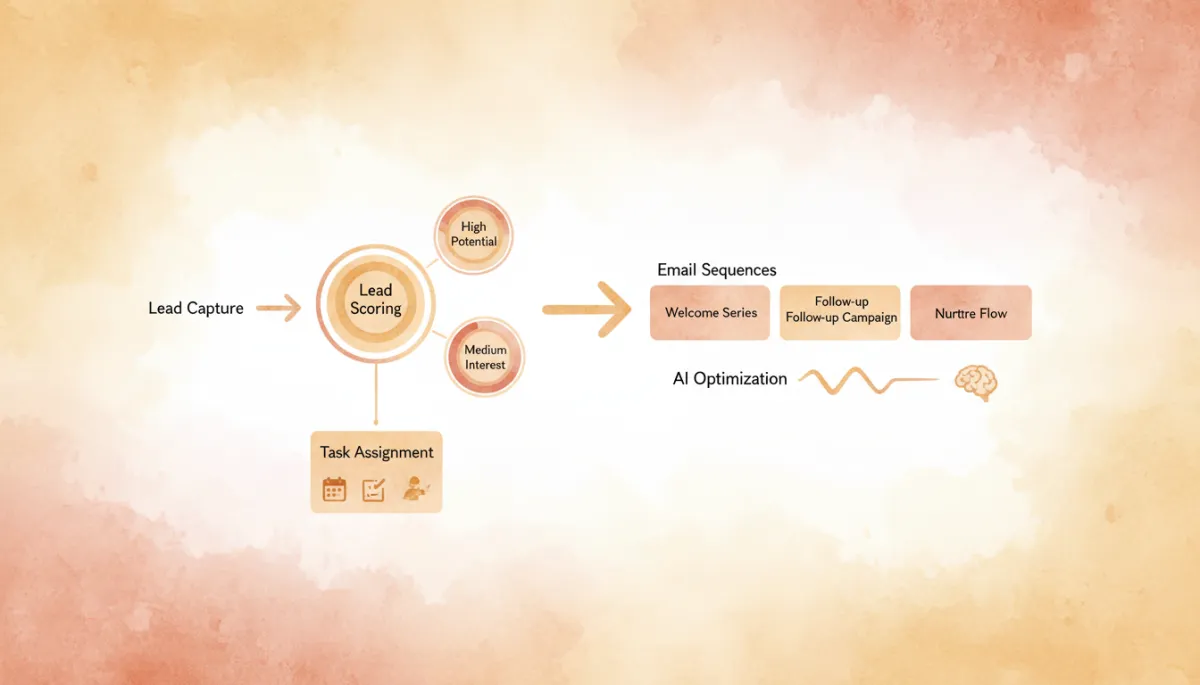
High-impact AI workflows free teams from admin work and refocus time on revenue.
Execution Methods: How Does AI Automation Actually Work Inside a CRM?
Micro-question: How does AI know what to do in the CRM?
Data capture: AI logs emails, calls, meetings, and web interactions automatically—no manual entry.
Interpretation: Models analyze content (sentiment, topics, intent) and behavior patterns over time.
Decision logic: If probability-to-close or churn risk crosses a threshold, AI triggers the next-best action (task, email, sequence, escalation).
Execution: Agentic components execute the workflow while logging every step for audit and optimization [3][7].
If you want to move from “AI suggestions” to AI that actually does work → align your CRM with a digital consultancy that can design governed, end‑to‑end workflows, such as the services offered via strategic digital consultancy for CRM and AI.
Systems & Operations: Making AI Automation Sustainable
Unified data architecture: Omnichannel data (email, chat, telephony, web) must flow into one CRM view so AI can reason with full context [7].
Playbook-driven workflows: Map clear, repeatable “if customer does X, system does Y” flows before you configure tools.
Change management: Reps need training, guardrails, and feedback loops so AI augments them rather than overwhelming them with noise.
Data & Measurement: How Do You Prove AI-CRM Value?
Track time saved per rep per week (target 5–10 hours, based on benchmarks of 8.2+ hours in insurance) [5].
Monitor conversion lift from AI lead scoring (benchmarks show up to 75% higher conversion) [5].
Measure pipeline created per campaign when AI sequences and content are used vs. control groups.
Most companies optimize for email volume and task counts when they should focus on revenue-critical metrics: win rate, cycle time, and net new qualified pipeline.
Risks & Governance: Keeping AI Automation Under Control
Data quality & bias: Poor or skewed data leads to biased scoring and misaligned outreach. Implement data stewardship and regular model reviews.
Over-automation: Excessive, generic automation can damage brand trust. Cap send volumes and design human handoffs intentionally.
Compliance & auditability: Ensure every AI action in the CRM is logged with who, what, when, and why, aligning with “prove‑it” governance trends [7].
Final Strategic Framework: Operating Model for AI Automation in Your CRM
If you want AI automation that compounds value rather than adding chaos → follow this sequence:
Align on revenue goals: Define specific outcomes (e.g., +20% SQLs, –15% churn) and map them to CRM workflows.
Stabilize data: Clean, deduplicate, and unify data sources before deploying advanced AI features.
Pilot 2–3 high‑impact automations: For example, AI lead scoring, meeting summaries, and renewal-risk alerts.
Measure, refine, then scale: Only expand once you can clearly attribute lift to AI-CRM workflows.
To move from theory to implementation, consider partnering with specialists. At LeadMagno, we help teams design AI-ready funnels and then operationalize them. You can book a CRM and AI automation demo with LeadMagno to see how this operating model looks in your environment.
FAQs: AI Automation Inside a CRM
Q1. What are the fastest wins with AI automation in a CRM?
Automate data capture, lead routing, and follow-up sequences first; these are high-volume, low-risk workflows that quickly demonstrate time savings and pipeline lift.
Q2. Do I need a new CRM to use AI automation?
Not always—around 64% of CRM platforms already embed AI features [2]; start by auditing what your current system offers before considering migration.
Q3. How does AI automation affect my sales team?
Done well, it removes low-value admin work, surfaces higher-quality opportunities, and improves forecast accuracy; done poorly, it can flood reps with noise, so governance is essential.
Q4. Is AI in CRM safe from a compliance standpoint?
Yes, if you implement clear access controls, audit logs, and content policies; many modern platforms are designed with explainability and oversight in mind [7].
Q5. How do I measure ROI from AI automation?
Track time saved, win-rate improvements, incremental pipeline, and revenue per rep before and after deployment; compare these against your AI and CRM investment.
Putting It All Together: Your Final Operating Model
AI automation inside a CRM works when strategy, systems, and governance move in lockstep. Unified data fuels models; models drive agentic workflows; workflows are monitored through clear KPIs and refined continuously. The priority for 2026 is not simply “adding AI,” but turning your CRM into a governed, AI-powered revenue engine that compounds value over time. Organizations that align their operating model around this principle will outpace competitors still treating the CRM as a static database.
References
Workbooks – AI use vs AI-in-CRM adoption gap and 2026 intentions.
Searchlab – CRM 2026 statistics, AI feature usage, productivity, and ROI.
Alphabold, FindMyCRM, TechRadar – rise of agentic AI in CRM workflows.
Forbes – future of CRM and AI-driven personalization and automation.
UnlockedCRM – AI-CRM adoption, time savings, and close-rate benchmarks in insurance.
Business Insider – AI shaping CRM personalization and task automation.
CXToday, Deloitte + ServiceNow – data governance, omnichannel integration, and AI-ready architectures.


Facebook
Instagram
X
LinkedIn
Youtube
TikTok