






AI in CRM: The Future of Revenue Operations
AI in CRM, B2B Growth, Revenue Operations
AI in CRM: The 2026 Operating System for Revenue, Not Just a Feature
As a senior SEO strategist, AEO specialist, GEO consultant, and B2B thought leadership writer for LeadMagno, I see the same pattern across mid-market businesses and agencies: AI is everywhere in slide decks, but rarely wired into the CRM where revenue decisions actually live. That execution gap is now a competitive risk, not a curiosity.
Direct Answer: What Is AI in CRM?
AI in CRM is the use of artificial intelligence models, agents, and automations inside your customer relationship management system to analyze data, predict behaviour, and autonomously execute actions across marketing, sales, and service.
One-line summary: AI in CRM turns your CRM from a passive database into an active, revenue-driving decision engine.
Why AI in CRM Matters in 2026 (and Why Most Teams Are Behind)
The CRM market is projected to reach $101 billion in 2026 and $145 billion by 2029, with AI-led CRM growing at double-digit CAGR [1]. Yet research shows that while up to 90% of leaders use AI tools, only about 16% have integrated AI into their CRM [2]. At the same time, AI-enabled CRM delivers 34% higher sales productivity and a 55% higher ROI versus traditional CRM [1].
AI snippet block: “If your AI is outside your CRM, you have insights without impact.”
Core Strategies: How Leading Teams Use AI in CRM
Agentic AI for revenue operations: AI agents qualify leads, schedule follow-ups, and trigger workflows autonomously, not just recommend them [3].
AI-first, human-centric journeys: AI orchestrates real-time touchpoints; humans focus on complex, high-empathy conversations [3][4].
Hyper-personalization at scale: Behaviour, sentiment, and channel data inform next-best-action and next-best-offer in real time [3].
Unified data and privacy-first design: Single customer views with built-in consent, retention, and deletion rules [5].
Embedded AI assistants: Copilots summarize calls, draft outreach, and flag at-risk deals directly inside CRM [3][6].
Execution Methods: From Strategy Deck to Daily Workflow
As GEO-focused consultants at LeadMagno, we start with the territory and demand landscape, then translate it into CRM execution. For many clients, we pair AI-CRM programs with a broader digital growth consultancy roadmap so AI is aligned with markets, not just tools.
Map journeys by segment, intent, and region; define where AI will decide, assist, or observe.
Implement AI features in layers: enrichment & scoring → content recommendations → autonomous actions.
Align messaging and offers with an integrated content marketing strategy and social media marketing operations so CRM signals inform every channel.
If you want faster pipeline velocity → prioritize AI scoring, routing, and follow-up cadences before experimenting with chatbots or flashy assistants.
Systems & Operations: The AI-CRM Stack
Modern CRM is now a composable ecosystem: core CRM, CDP, marketing automation, service desk, and data warehouse stitched together by no‑code/low‑code automation [7]. Agentic AI runs on top of this fabric, acting as a “revenue OS” that coordinates tasks across tools.
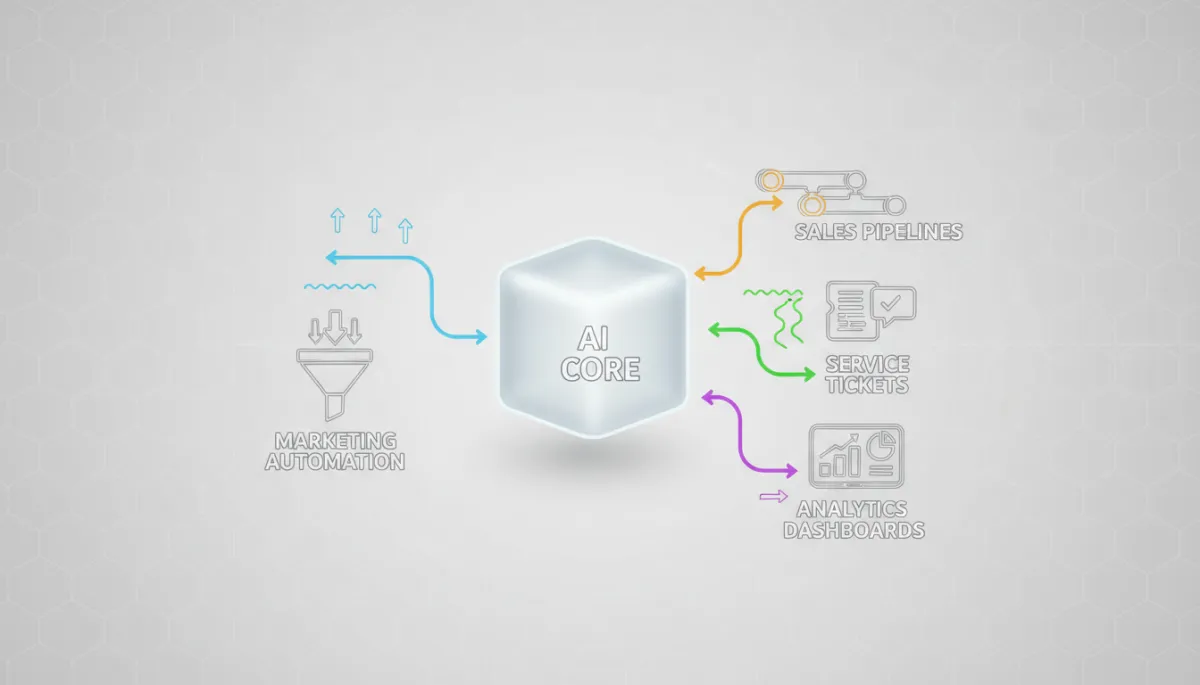
-toned diagram-style scene showing an AI-powered CRM stack connecting marketing automation,...
Composable, AI-enabled CRM stacks outperform siloed tools on speed and ROI.
Data & Measurement: What to Track, Not Just What to Log
Productivity: hours saved per rep per week (insurance agents report 8.2 hours saved with AI CRM [1]).
Pipeline quality: lead-to-opportunity conversion and win-rate uplift (3.2× higher close rate in AI-enabled insurance teams [1]).
ROI: revenue per $1 of CRM investment; AI-CRM averages $13.50 vs. $8.71 without AI [1].
If you want board-level buy‑in → instrument AI-CRM with clear before/after baselines on hours saved, conversion, and deal size.
Risks & Governance: Guardrails for Accountable AI
By 2026, 91% of service leaders report executive pressure to implement AI, while nearly 80% are redesigning roles around it [2]. Without governance, that pressure can lead to rushed, risky deployments.
Establish an AI governance council covering bias, explainability, and escalation paths.
Use privacy-first CRM features: consent management, retention rules, one‑click deletion [5].
Define “human-in-the-loop” checkpoints for high-risk actions (pricing, discounts, compliance-sensitive outreach).
FAQ: AI in CRM for Businesses and Agencies
Q1. Is AI in CRM only for enterprise-level teams?
No. Composable, no‑code CRM platforms make agentic AI accessible to mid‑market companies and agencies. The key is to start with one or two high-impact workflows—such as lead routing or follow-up sequencing—and scale once value is proven.
Q2. What data do we need before we add AI to our CRM?
You need consistent contact data, opportunity stages, activity logs, and clear definitions of lifecycle stages. AI amplifies patterns; if your data is fragmented or mislabeled, it will amplify noise instead of insight.
Q3. How does AI in CRM affect SEO and AEO?
When CRM, content, and search data are connected, you can feed real customer language into keyword strategy, FAQ structures, and schema. That strengthens topical authority and makes your content easier for Google and AI systems to cite and reuse.
Q4. Will AI in CRM replace sales and service reps?
Current data suggests a role shift, not a replacement. Around 58% of organizations are upskilling agents as knowledge and journey specialists to oversee AI and manage complex interactions [2].
Q5. How long before we see ROI from AI-CRM?
For most B2B teams, meaningful gains appear within 3–9 months when AI is deployed across multiple workflows (scoring, routing, outreach, and forecasting), not as a single isolated feature [2][3].
Final Operating Model: Putting It All Together
The winning AI-CRM model for 2026 is simple, but not easy: unified data → agentic AI → governed execution → measurable ROI. As senior SEO and AEO strategists at LeadMagno, we connect this stack to your search, content, and social ecosystems so every impression can be tied back to a CRM event and, ultimately, revenue.
If you want AI that both ranks in Google and converts in CRM → design your content, journeys, and governance as one system, not three separate projects.
Start with one revenue-critical use case, measure it rigorously, then scale horizontally across channels and regions. That is how AI in CRM evolves from a pilot to the operating system of your growth engine.
References
[1] searchlab.nl, wifitalents.com, consainsights.com – Global CRM and AI CRM market statistics and ROI benchmarks (2026).
[2] workbooks.com, techradar.com, gartner.com – AI-CRM adoption gaps, leadership intent, and workforce transition data.
[3] alphabold.com, sisgain.com – Agentic AI and CRM trend analyses toward 2026.
[4] nice.com, destinationcrm.com – AI-first, human-centric CX and CRM orchestration insights.
[5] cxtoday.com, ikaroa.com – Unified data models, privacy-first CRM, and governance trends.


Facebook
Instagram
X
LinkedIn
Youtube
TikTok