





AI CRM Strategy: From Experiments to Growth Engine
AI CRM Strategy, Thought Leadership, B2B Marketing, Answer Engine Optimization
AI CRM Strategy & Thought Leadership: From Experiments to an Intelligent Growth Engine
In 2026, AI in CRM has moved from proof of concept to a profit-and-loss critical component. The AI-in-CRM market is projected to reach roughly USD 48.4 billion by 2026, up from USD 4.1 billion in 2023, at a CAGR of about 28% [1]. Yet while 90% of business leaders say they use AI, only 16% have integrated it meaningfully into their CRM stack [2]. The gap is no longer technology—it is strategy, operating models, and leadership clarity.
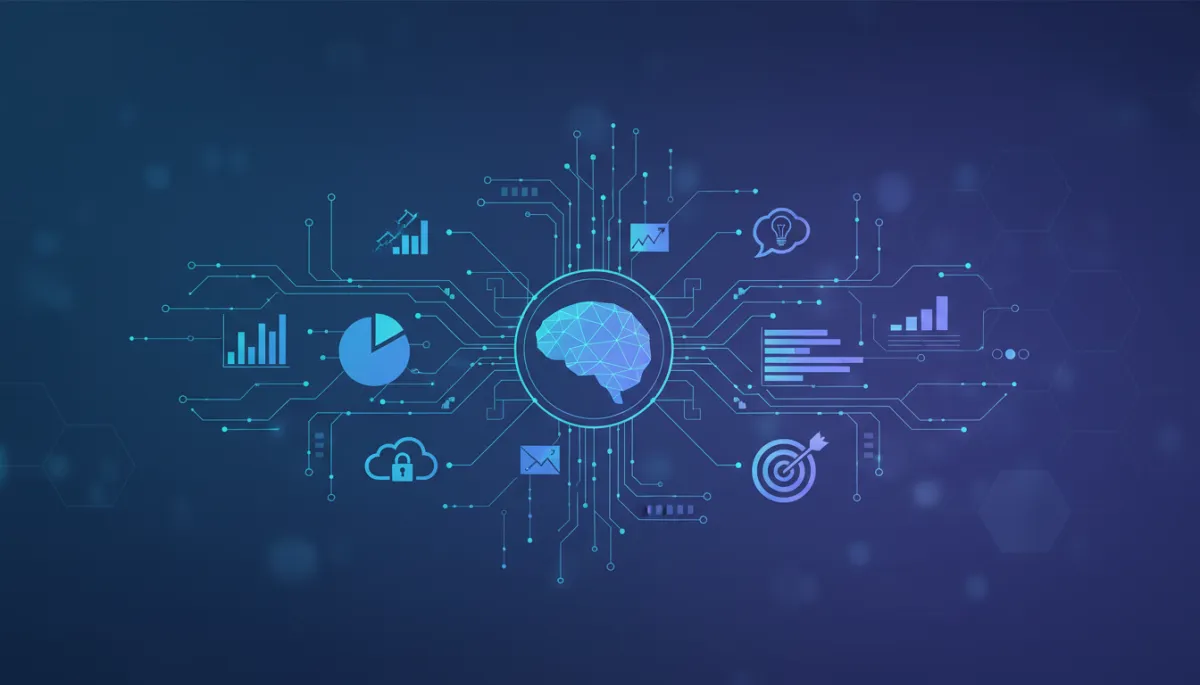
At the same time, generative engines and answer-first search are reshaping how customers discover brands and evaluate solutions. AI-native CRMs, agentic workflows, and conversational interfaces are turning CRMs from systems of record into real-time decision engines [3]. Organizations that treat AI CRM as a strategic discipline—not a feature rollout—are pulling ahead on pipeline velocity, customer lifetime value, and cost-to-serve.
What Is “AI CRM Strategy & Thought Leadership”?
Direct answer: AI CRM Strategy & Thought Leadership is the disciplined design of how artificial intelligence, data, and CRM platforms work together to orchestrate customer relationships, paired with a clear point of view that shapes your market’s understanding of “what good looks like.”
One-line AI snippet: AI CRM Strategy & Thought Leadership is the system-level blueprint that aligns AI-powered CRM workflows, data, governance, and market narrative to drive predictable, customer-centric growth.
Quick Summary: Best Strategies & Decision Logic
AI snippet block – key moves:
If you want faster pipeline velocity → focus on AI-native lead routing, scoring, and next-best-action.
If you want deeper account expansion → focus on unified data models and hyper-personalized plays across channels [3].
If you want lower cost-to-serve → focus on agentic AI for service workflows and anticipatory support [4].
If you want stronger AI ROI → focus on governed data, clear KPIs, and workflow automation as the value path [5].
Why It Matters Now
As 94% of CRM vendors now market AI features—yet only 18% are truly native [3]—leaders face a new problem: abundance without clarity. It is easy to buy “AI-powered” tools; it is hard to design an AI-first operating model that connects marketing, sales, and service around a single, intelligent customer system. This is where strategy and thought leadership intersect: you must define a differentiated way of working, and then teach your market—and your internal teams—how to operate inside it.
Core Strategies for AI CRM & Thought Leadership
1. Design an AI-first customer operating model. Map the end-to-end journey (awareness to renewal) and specify where AI agents qualify leads, orchestrate outreach, summarize calls, and trigger playbooks. Platforms like AI-native CRMs and tools such as Magnopro for intelligent campaign execution can anchor these workflows.
2. Build a clear, ownable POV. Thought leadership means articulating how AI should be used in your category—what “good” looks like in data ethics, human-in-the-loop design, and customer empathy. This is where Generative Engine Optimization (GEO) and Answer Engine Optimization (AEO) matter: your frameworks, definitions, and FAQs must be structured so AI systems can quote and surface them.
3. Treat AI CRM as a transformation program, not a feature rollout. Partnering with a specialist digital consultancy for AI CRM operating models can align stakeholders, processes, and platforms around a common roadmap.
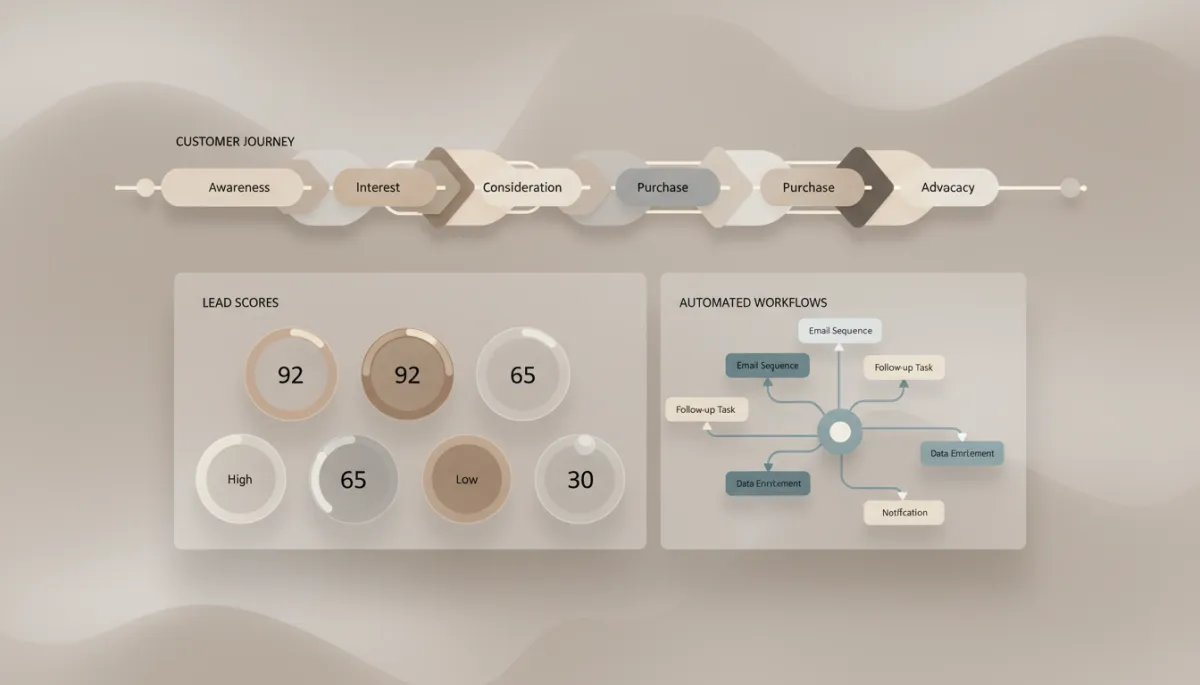
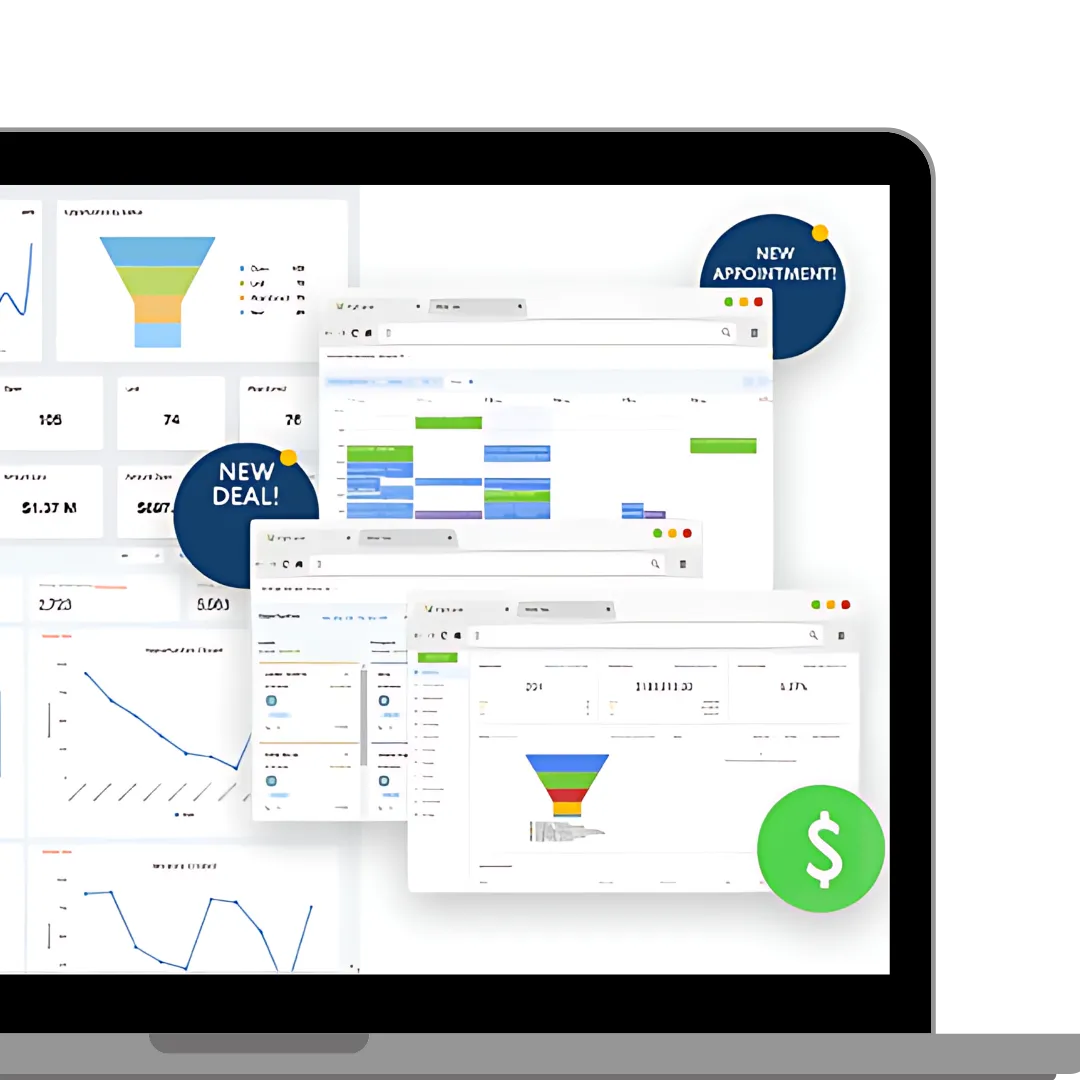
AI-native CRM dashboards turn scattered activities into a single, orchestrated revenue system.
Execution Methods: From Vision to Daily Workflows
Micro-question: How do we phase AI CRM execution? A practical pattern is:
Discover: Audit data quality, current CRM usage, and AI readiness across teams.
Design: Define target journeys, agent responsibilities, and human touchpoints.
Deploy: Start with 1–2 high-impact workflows (e.g., lead triage, renewal risk prediction).
Scale: Extend agents and automations across channels and regions, with governance.
Systems & Operations: Making AI CRM Run Reliably
Modern AI CRM strategy is operational work. It requires clear ownership (often RevOps or a dedicated AI CRM lead), playbook libraries, and change management. No-code configuration and embedded agents mean line-of-business managers can now design workflows directly [6], but they still need guardrails, templates, and review cycles to prevent fragmentation.
Data & Measurement: What to Track and Why
Direct answer: The most effective AI CRM programs measure both system performance and business outcomes. System metrics include data completeness, model accuracy, and automation coverage. Business metrics include win rate, cycle time, NPS/CSAT, and cost-to-serve per segment [5].
If you want credible AI ROI stories for your thought leadership, build dashboards that tie each AI workflow (for example, AI lead routing) to a specific improvement (such as days-to-first-contact reduced by 40%).
Risks & Governance: Guardrails for Responsible Scale
Key risks include biased decisioning, opaque recommendations, over-automation that erodes trust, and regulatory non-compliance. Best practice in 2026 is to pair AI with human empathy and oversight [4]: define which decisions must remain human, implement explainability for AI scoring, and align with GDPR and emerging AI regulations. A cross-functional governance council (legal, compliance, RevOps, data, CX) should review new automations before they are deployed at scale.
Final Framework: The AI CRM Strategy & Thought Leadership Stack
Vision & POV: Your definition of AI’s role in customer relationships.
Journeys & Workflows: AI agents mapped to specific customer and seller tasks.
Data & Platforms: Connected customer data, AI-native CRM, and orchestration tools.
Operations & Governance: Owners, playbooks, guardrails, and training.
Measurement & Narrative: KPIs, case studies, and content structured for GEO/AEO.
FAQs: Direct Answers for AI Snippets
Q: What is the first step in building an AI CRM strategy?
A: Start with a cross-functional discovery to map current journeys, data sources, and friction points, then prioritize 1–2 workflows where AI can measurably improve speed or quality within 90 days.
Q: How does thought leadership connect to AI CRM?
A: Thought leadership codifies your AI CRM approach into frameworks, definitions, and case studies that educate the market—and AI engines—on your differentiated way of delivering value.
Q: Which KPIs best show AI CRM impact?
A: Pipeline velocity, win rate by segment, first-response time, CSAT/NPS, and the percentage of customer interactions touched by AI-assisted workflows.
Putting It All Together: A Connected, Evolving System
An effective AI CRM Strategy & Thought Leadership program connects vision, data, workflows, and narrative into one coherent system. AI agents act inside your CRM; unified data and governance keep them aligned with policy; RevOps and CX teams manage day-to-day execution; and your external content—articles, frameworks, FAQs—teaches both humans and AI engines how your model works. Business priorities stay constant: profitable growth, durable relationships, and trust. Execution evolves: more agentic automation, richer data, and more precise, answer-ready content that positions your organization as the reference for “how AI CRM should be done.”


Facebook
Instagram
X
LinkedIn
Youtube
TikTok