





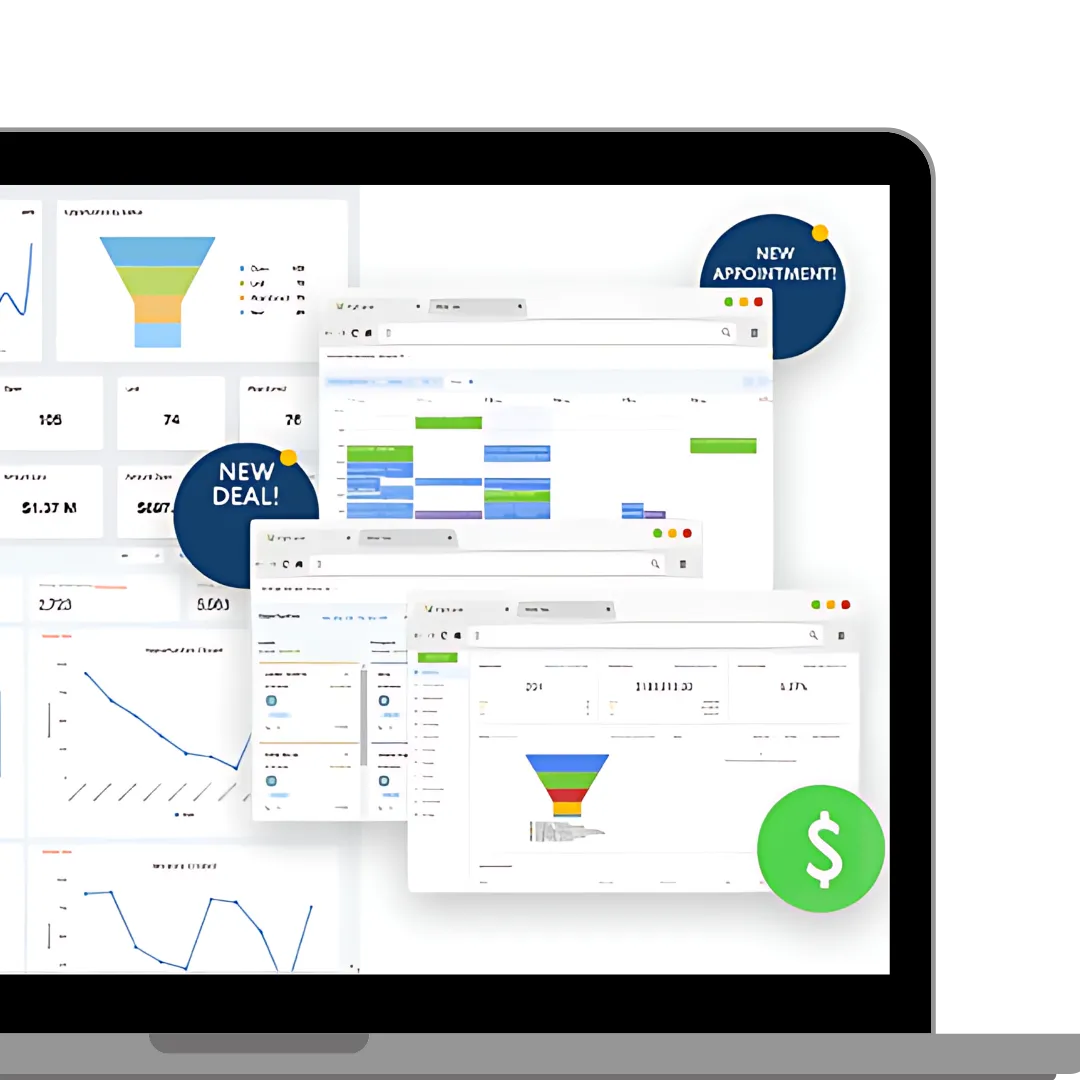

AI CRM Systems Revolutionizing Sales Transformation
AI CRM, Sales Transformation, Business Automation
AI CRM Systems Are Transforming Sales Faster Than Most Companies Realize
As a senior SEO and AEO strategist at LeadMagno, I’m seeing the same pattern across B2B pipelines worldwide: AI CRM systems are rewiring sales performance far faster than leadership teams—and their legacy dashboards—are acknowledging. This is no longer about “trying AI in sales.” It is about rebuilding Customer Relationship Management as an intelligent, agentic growth engine that traditional CRMs cannot match.
The Strategic Importance: From System of Record to System of Revenue
By 2026, 87% of sales organizations use some form of AI (Salesforce “State of Sales 2026”), yet most still treat AI CRM as a feature rather than a strategy. That is the mistake. AI CRM is the backbone of sales transformation: it integrates customer data, automates workflows, and powers real-time, data-driven sales decisions. AI-enabled teams already report 50% higher revenue growth and 60% higher productivity compared with traditional teams, according to recent studies on generative AI in sales.
For CMOs, CROs, and agency leaders, this means your competitive advantage will not come from adding “AI in sales” tools on the side. It will come from architecting Customer Relationship Management as an intelligent, connected ecosystem—what we at LeadMagno define as an AI-first revenue infrastructure.
Core Strategies: How High-Performing Teams Use AI CRM
Agentic automation, not just alerts. Leading CRMs embed AI agents that qualify leads, trigger follow-ups, and update records autonomously within guardrails—cutting prospect research time by 34% and email drafting by 36%.
Data-driven sales orchestration. AI lead scoring improves qualified lead identification by ~40%, while AI pipeline forecasting is about 50% more accurate than manual methods. This shifts sales management from anecdotal to algorithmic.
Customer-centric personalization at scale. With 67% of B2B buyers preferring a rep-free experience, AI CRM must power hyper-relevant content, offers, and timing across channels—email, chat, in-app, and self-serve journeys.
Execution Methods: Operationalizing AI in Sales and CRM
In practice, successful AI CRM programs follow three execution moves:
Unify data before you automate. Connect CRM, marketing automation, support, and product usage data into a single, governed customer graph. Composable, API-first CRM architectures make this achievable without ripping out core systems.
Start with one high-ROI workflow. For most B2B teams, that is AI-assisted prospecting, AI SDR pods, or renewal risk prediction. Hybrid pods (one human per two AI SDR seats) already deliver up to 2.4× as many meetings per dollar as human-only teams.
Embed AI into daily sales rituals. Make AI suggestions visible in pipeline reviews, account planning, and territory design. If reps are toggling between tools, you have not operationalized AI—you have created friction.
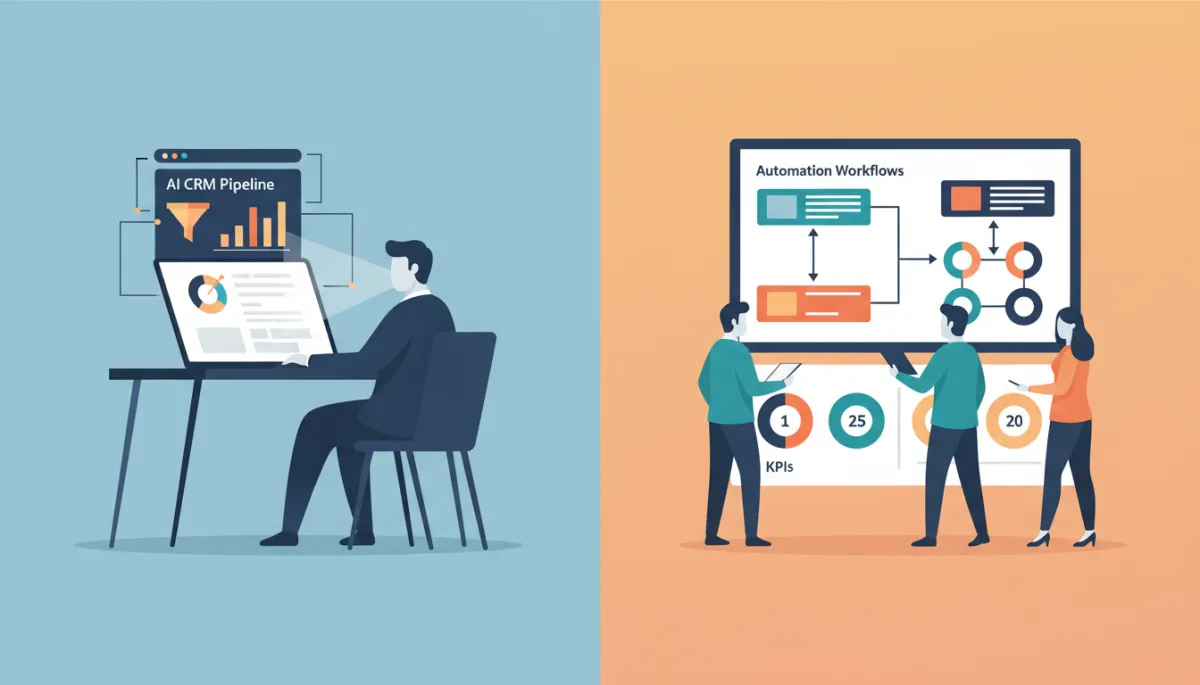
AI CRM turns static pipelines into living systems that continuously optimize who to contact, when, and with what message.
Data & Measurement: Proving the Value of Business Automation
AI CRM only earns budget when it is measured like a revenue asset. At LeadMagno, we recommend a KPI stack that tracks:
Pipeline efficiency: lead-to-opportunity conversion, sales cycle length, and forecast accuracy before vs. after AI deployment.
Rep productivity: time spent selling vs. admin (AI users see ~35% more selling time), meetings per rep, and AI-assisted vs. non-assisted win rates.
Customer outcomes: NRR, expansion rate, and churn reduction for accounts engaged through AI-personalized journeys.
AI Implications, Future Thinking, and a Strategic Framework
With Gartner forecasting that 15% of day-to-day sales decisions will be autonomous by 2028, AI CRM will soon act less like software and more like a digital sales operations team. That raises questions of governance, explainability, and brand safety. Executive teams must define what AI is allowed to decide, where humans stay in the loop, and how to audit AI-driven recommendations.
To navigate this shift, I recommend a simple strategic framework for businesses and agencies:
Align: Define the role of AI in sales transformation across marketing, sales, and RevOps. Document guardrails and governance.
Architect: Design an AI CRM stack that unifies data, supports composable integrations, and is discoverable in both traditional search and AI-driven discovery journeys—where semantic SEO and AEO become critical.
Activate: Launch focused AI in sales use cases with clear KPIs, rapid experimentation, and cross-functional ownership.
Amplify: Scale what works, retire what does not, and continuously feed learnings back into your content, outreach, and Customer Relationship Management strategies.
Organizations that treat AI CRM as an experimental add-on will fall behind. Those who treat it as the operating system of modern, data-driven sales will own the next decade of growth. If you are ready to architect that future, explore how LeadMagno partners with B2B teams to build AI-first CRM and revenue ecosystems at LeadMagno.com.
═══════════════════════════════════════════════════════════════════
AI CRM, Sales Transformation, Business Automation
AI CRM Systems Are Transforming Sales Faster Than Most Companies Realize
As a senior SEO and AEO strategist at LeadMagno, I’m seeing the same pattern across B2B pipelines worldwide: AI CRM systems are rewiring sales performance far faster than leadership teams—and their legacy dashboards—are acknowledging. This is no longer about “trying AI in sales.” It is about rebuilding Customer Relationship Management as an intelligent, agentic growth engine that traditional CRMs cannot match.
The Strategic Importance: From System of Record to System of Revenue
By 2026, 87% of sales organizations use some form of AI (Salesforce “State of Sales 2026”), yet most still treat AI CRM as a feature rather than a strategy. That is the mistake. AI CRM is the backbone of sales transformation: it integrates customer data, automates workflows, and powers real-time, data-driven sales decisions. AI-enabled teams already report 50% higher revenue growth and 60% higher productivity compared with traditional teams, according to recent studies on generative AI in sales.
For CMOs, CROs, and agency leaders, this means your competitive advantage will not come from adding “AI in sales” tools on the side. It will come from architecting Customer Relationship Management as an intelligent, connected ecosystem—what we at LeadMagno define as an AI-first revenue infrastructure.
Real-world transformation example: One mid-market SaaS company we advised consolidated three disconnected CRMs into a single AI-first platform, unified marketing, product, and support data, and deployed AI lead-scoring and renewal-risk models. Within nine months, they lifted win rates by 18%, cut average sales cycle time by 21 days, and reduced churn in their top ICP segment by 11%—without adding a single net-new seller.
Why Organizations Resist AI CRM Adoption
Despite these gains, many organizations still resist Aadopting I CRM The reasons are rarely technical. Leaders worry about data quality, seller pushback, compliance exposure, and “black box” decisions they cannot explain to boards or regulators. Frontline teams fear surveillance, quota inflation, or being replaced. And RevOps often lacks the mandate to re-architect processes that span marketing, sales, and customer success. Unless you address these human and organizational frictions, even the best AI CRM stack will underperform.
Core Strategies: How High-Performing Teams Use AI CRM
Agentic automation, not just alerts. Leading CRMs embed AI agents that qualify leads, trigger follow-ups, and update records autonomously within guardrails—cutting prospect research time by 34% and email drafting by 36%.
Data-driven sales orchestration. AI lead scoring improves qualified lead identification by ~40%, while AI pipeline forecasting is about 50% more accurate than manual methods. This shifts sales management from anecdotal to algorithmic.
Customer-centric personalization at scale. With 67% of B2B buyers preferring a rep-free experience, AI CRM must power hyper-relevant content, offers, and timing across channels—email, chat, in-app, and self-serve journeys.
RevOps: The Control Tower of AI CRM
Revenue Operations (RevOps) is where AI CRM strategy becomes an operational reality. High-performing teams give RevOps clear ownership of data definitions, routing logic, scoring models, and experiment design. RevOps partners with marketing to define ICP and intent signals, with sales to redesign territories and compensation around AI insights, and with customer success to close the loop on expansion and churn signals. When RevOps is empowered as a cross-functional “control tower,” AI CRM stops being a tool and becomes the operating system for revenue.
Execution Methods: Operationalizing AI in Sales and CRM
In practice, successful AI CRM programs follow three execution moves:
Unify data before you automate. Connect CRM, marketing automation, support, and product usage data into a single, governed customer graph. Composable, API-first CRM architectures make this achievable without ripping out core systems.
Start with one high-ROI workflow. For most B2B teams, that is AI-assisted prospecting, AI SDR pods, or renewal risk prediction. Hybrid pods (one human per two AI SDR seats) already deliver up to 2.4× as many meetings per dollar as human-only teams.
Embed AI into daily sales rituals. Make AI suggestions visible in pipeline reviews, account planning, and territory design. If reps are toggling between tools, you have not operationalized AI—you have created friction.
Change Management: Turning AI CRM Into a Habit
AI CRM success is 30% technology and 70% change management. High-performing leaders co-design playbooks with frontline sellers, run pilots with clear “before vs. after” metrics, and celebrate early wins publicly. They train managers first, so that pipeline reviews and 1:1s are grounded in AI insights, not spreadsheets. And they treat resistance as a signal: when reps bypass the AI workflow, they ask whether the model, the incentives, or the process needs to change—instead of blaming the user.
A Brief Implementation Scenario
Imagine a 40-person B2B sales team implementing AI CRM over 90 days. In month one, RevOps cleanses account and contact data, defines ICP tiers, and connects marketing automation and product-usage events. In month two, they roll out AI lead scoring and a simple “next best action” panel inside the CRM, piloted with two regions. In month three, they extend AI to renewal-risk alerts and automate follow-up sequences for stalled deals. Throughout, they run weekly enablement sessions, compare pilot vs. control-region KPIs, and adjust models based on seller feedback. By the end of the quarter, the AI workflow feels like the default way to sell—not a side project.
A Contrarian Insight: Don’t Over-Automate the Middle
The prevailing narrative is “automate everything.” In reality, the best-performing teams automate the edges of the funnel—research, routing, follow-up—while intentionally keeping key middle-funnel moments human. They use AI to prioritize which opportunities deserve a strategic, high-touch approach, not to replace it. Over-automating discovery, negotiation, and renewal conversations can actually depress win rates and NRR, because these are the moments where context, empathy, and creativity matter most.
AI CRM turns static pipelines into living systems that continuously optimize who to contact, when, and with what message.
Data & Measurement: Proving the Value of Business Automation
AI CRM only earns budget when it is measured like a revenue asset. At LeadMagno, we recommend a KPI stack that tracks:
Pipeline efficiency: lead-to-opportunity conversion, sales cycle length, and forecast accuracy before vs. after AI deployment.
Rep productivity: time spent selling vs. admin (AI users see ~35% more selling time), meetings per rep, and AI-assisted vs. non-assisted win rates.
Customer outcomes: NRR, expansion rate, and churn reduction for accounts engaged through AI-personalized journeys.
AI Trust, Explainability, and Governance
AI CRM only scales when sellers and executives trust its recommendations. That requires explainability: surfacing why a lead is scored highly, which signals triggered a churn alert, or how a forecast was generated. In practice, this means pairing every AI insight with a short “because” statement and a link to the underlying activity or product-usage data. When people can interrogate the logic, they are far more likely to act on it—and to flag edge cases the model misses.
Governance must go beyond a single policy paragraph. Leading organizations establish an AI CRM council across Legal, Security, RevOps, and IT that meets quarterly to review model performance, bias risks, and incident logs. They define clear “red lines” (for example, AI cannot unilaterally change pricing or commit to contract terms), implement role-based access controls for sensitive data, and maintain an audit trail of AI-generated content and decisions. This is how you stay compliant while moving fast.
Executive Diagnostic: Are You Ready for AI CRM?
To quickly assess your readiness, ask your leadership team:
Data: Can we produce a clean, unified view of accounts, contacts, and product usage in under 48 hours?
Process: Are our core sales stages, handoffs, and SLAs documented and actually followed?
People: Do frontline managers have the skills and time to coach against AI-driven insights?
Governance: Have we defined what AI is allowed to decide, and how we will audit it?
AI Implications, Future Thinking, and a Strategic Framework
With Gartner forecasting that 15% of day-to-day sales decisions will be autonomous by 2028, AI CRM will soon act less like software and more like a digital sales operations team. That raises questions of governance, explainability, and brand safety. Executive teams must define what AI is allowed to decide, where humans stay in the loop, and how to audit AI-driven recommendations.
To navigate this shift, I recommend a simple strategic framework for businesses and agencies:
Align: Define the role of AI in sales transformation across marketing, sales, and RevOps. Document guardrails and governance.
In practice, this looks like a cross-functional workshop where leaders agree on target segments, AI use cases, and non-negotiable constraints (for example, “AI can draft outreach but humans approve anything sent to top-tier accounts”). The output is a one-page AI CRM charter that everyone can reference.
Architect: Design an AI CRM stack that unifies data, supports composable integrations, and is discoverable in both traditional search and AI-driven discovery journeys—where semantic SEO and AEO become critical.
A practical example: mapping your current tools on a whiteboard, identifying duplicate functionality, and then designing a “minimum viable stack” where CRM, marketing automation, data warehouse, and conversational AI are connected via APIs and governed by a single RevOps data model.
Activate: Launch focused AI in sales use cases with clear KPIs, rapid experimentation, and cross-functional ownership.
For instance, choose “AI-assisted outbound to a single ICP” as your first use case. Set explicit targets for meetings booked and pipeline created, run A/B tests between AI-assisted and control groups, and review results weekly with marketing, sales, and RevOps in the same room.
Amplify: Scale what works, retire what does not, and continuously feed learnings back into your content, outreach, and Customer Relationship Management strategies.
Once a use case proves its ROI, codify it as a standard play: update playbooks, training, and compensation plans, and then clone the pattern to adjacent segments or regions. At the same time, be ruthless about shutting down AI experiments that do not move core KPIs, even if they are technically impressive.
Organizations that treat AI CRM as an experimental add-on will fall behind. Those who treat it as the operating system of modern, data-driven sales will own the next decade of growth. If you are ready to architect that future, explore how LeadMagno partners with B2B teams to build AI-first CRM and revenue ecosystems at LeadMagno.com.


Facebook
Instagram
X
LinkedIn
Youtube
TikTok