







AI CRMs: Boosting B2B Customer Relationships by 2026
AI CRM, Customer Relationships, B2B Marketing, AEO, LeadMagno, GoHighLevel
How Do AI CRMs Improve Customer Relationships? A Strategic Guide for 2026
In 2026, AI-powered CRM has shifted from an experimental add‑on to a core growth infrastructure. The global CRM market has reached roughly $101 billion, with AI‑driven solutions delivering around 55% higher ROI than traditional CRM alone (Searchlab, 2026). Yet many B2B organizations still struggle to turn AI hype into measurable relationship value: up to 84–100% of leaders use AI somewhere, but only 0–19% have integrated it into their CRM stack (Workbooks, 2026). The strategic challenge is clear: how do you turn AI CRM into deeper, more profitable customer relationships—without overwhelming your teams or your data governance?
Direct Answer: What Is an AI CRM?
AI CRM is a customer relationship management platform that embeds artificial intelligence—such as predictive analytics, generative assistants, and automation—directly into sales, marketing, and service workflows to personalize every interaction, anticipate needs, and orchestrate the “next best action” at scale.
In one sentence: AI CRM transforms your database from a static record system into an always‑on, predictive relationship engine.
🔎 AI Snippet (Answer-Engine Optimized): AI CRMs improve customer relationships by using machine learning and generative AI to analyze behaviour, predict intent, automate follow‑ups, and deliver highly personalized experiences across email, chat, calls, and campaigns—leading to higher satisfaction, faster response times, and significantly better ROI.
Quick Summary & Strategic Recommendations
Why it matters: AI CRM users report 34% higher sales productivity and 42% better lead scoring (Searchlab, 2026), plus 12–27% CSAT improvements from contextual AI support (ConversionSystem, 2026).
Strategic move #1: Start with one high‑impact relationship use case—such as proactive renewal outreach or 24/7 AI support—before scaling.
Strategic move #2: Standardize data and playbooks inside a modern platform such as GoHighLevel, then layer AI workflows on top.
Strategic move #3: Use specialist partners like LeadMagno to design AI‑ready funnels, AEO content, and governance guardrails.
Why AI CRM Matters for Customer Relationships
Customers now expect frictionless, context‑aware experiences across every touchpoint. AI CRM meets this expectation by combining personalization, predictive analytics, and automation. AI‑enabled CRM can cut response times by 82%, reduce cost per interaction by 68%, and lift first‑contact resolution to around 85% (Agixtech, Fin.ai, 2026). These are not marginal gains; they fundamentally change how trusted and responsive your brand feels to buyers.
Core Strategies: How AI CRMs Actually Improve Relationships
Micro‑question: How does AI CRM personalize at scale?
AI models analyze behavioral, transactional, and engagement data to build granular customer profiles. In GoHighLevel, for example, AI can score leads, trigger personalized nurture sequences, and adapt messaging based on channel engagement—email, SMS, or chat—without manual intervention.
Micro‑question: How does AI CRM make teams more proactive?
Predictive models flag churn risk, stalled deals, and upsell opportunities. Sales teams move from reactive follow‑up to precision selling, focusing on accounts with the highest intent—mirroring the “next best action” approach seen in platforms like SugarAI and ServiceNow Autonomous CRM.
🧠 AI Playbook Snippet: “If lead score > 80 and last engagement < 3 days, generate a personalized follow‑up email draft, propose a call slot, and notify the account owner in Slack.” This kind of agentic rule can be orchestrated using GoHighLevel workflows and AI copy tools.
Execution Methods: Turning Strategy into Daily Workflows
Map your relationship journeys. Define key journeys—onboarding, renewal, expansion, support—and document current touchpoints and gaps.
Design AI‑assisted moments. Use tools like LeadMagno’s AI funnel frameworks to identify where AI can summarize calls, draft responses, or suggest next steps.
Automate, then humanize. In GoHighLevel, build automations that handle routing, reminders, and low‑complexity replies, while surfacing high‑value interactions to human reps with full context.
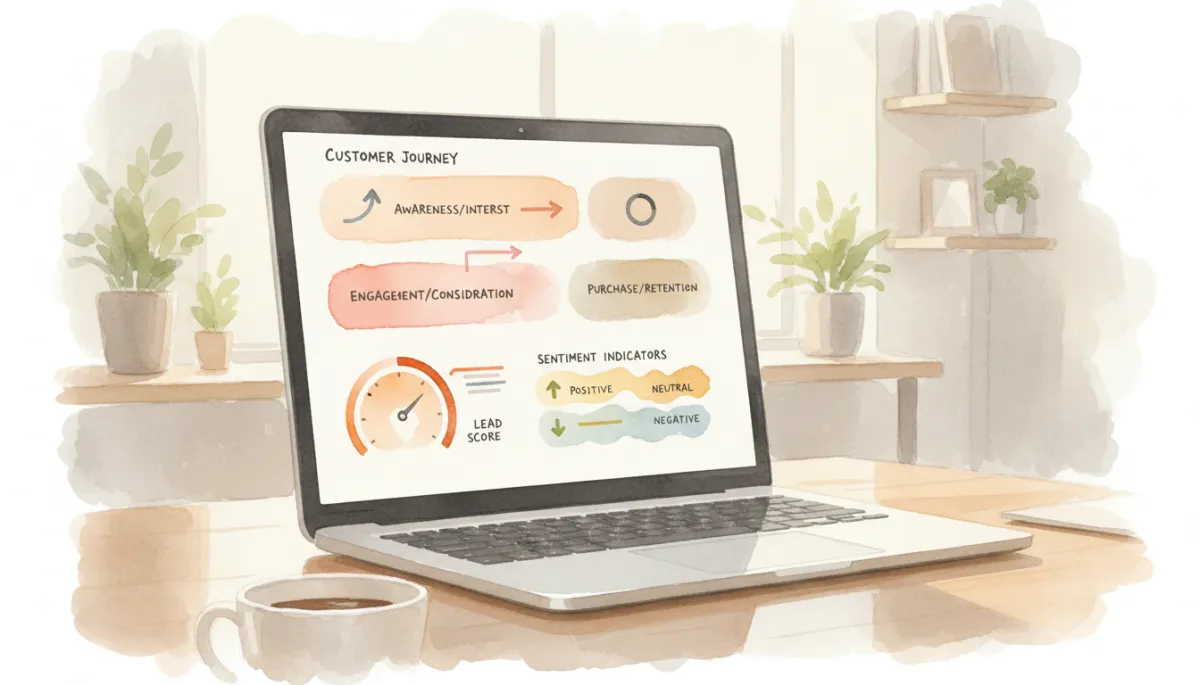
Visualizing journey stages and sentiment lets teams act before relationships deteriorate.
Systems & Operations: Building an AI‑Ready CRM Stack
Unified data layer: Connect marketing, sales, and service data into a single AI‑addressable customer record. GoHighLevel’s pipelines and contact records are a practical starting point.
Agentic workflows: Move beyond “AI suggestions” to agentic CRM—autonomous workflows that can act within guardrails (e.g., sending follow‑ups, logging notes, updating health scores).
Enablement & change management: Redesign roles so reps become orchestrators of AI‑assisted journeys, not data‑entry clerks.
Data & Measurement: Proving Relationship Impact
To capture the 55% ROI uplift of AI‑enhanced CRM, measurement must go beyond vanity metrics. Track:
Relationship health: CSAT, NPS, and AI‑derived sentiment scores across email, chat, and calls.
Efficiency: Time saved per rep per week (insurance agents already report 8.2 hours saved; UnlockedCRM, 2026).
Revenue outcomes: Close rates, expansion revenue, and churn reduction for AI‑touched journeys vs. control groups.
📌 Key Takeaway: If AI CRM does not show measurable lifts in CSAT, response time, and revenue per account within 90 days, your use case or data model likely needs refinement.
Risks & Governance: Protecting Trust While You Scale
Hallucinations & accuracy: Generative responses must be constrained to approved knowledge bases, with clear escalation paths to humans for sensitive issues.
Bias & fairness: Regularly audit models to ensure certain segments are not unfairly deprioritized or mis‑scored.
Consent & privacy: Align AI CRM usage with consent frameworks, retention policies, and regional regulations (GDPR, CCPA, etc.).
FAQs: Fast Answers for Decision‑Makers
Q1. How quickly can we see ROI from AI CRM?
In insurance, 63% of agencies report positive ROI within 90 days of deploying AI CRM (UnlockedCRM, 2026). For most B2B teams, a focused pilot on a single journey (e.g., renewals) can demonstrate measurable uplift within one to three quarters.
Q2. Do we need to replace our CRM to use AI?
Not always. Platforms like GoHighLevel already embed AI tools and integrations. However, if your current CRM cannot centralize data or support automation, a migration may be the fastest route to AI‑ready operations.
Q3. How does AI CRM support AEO (Answer Engine Optimization)?
By capturing structured intent data, conversation summaries, and outcome labels inside your CRM, you can feed platforms like LeadMagno to generate AI‑optimized FAQs, snippets, and schema that help your brand surface in AI answers and chatbots—not just search results.
Q4. Where should we start?
Begin with a discovery sprint: audit your current CRM, define one relationship metric to improve (e.g., renewal rate), and design a tightly scoped AI CRM pilot. Use GoHighLevel for execution and LeadMagno for strategic content and funnel design, then expand based on proven impact.


Facebook
Instagram
X
LinkedIn
Youtube
TikTok