







AI in CRM: Essential for 2026 Success
AI In CRM, Operational Necessity, Digital Strategy, B2B Thought Leadership, Answer Engine Optimization, Generative Engine Optimization
AI in CRM: Hype or Operational Necessity in 2026?
Speaking as a senior SEO strategist, Answer Engine Optimization (AEO) specialist, Generative Engine Optimization (GEO) consultant, and B2B thought leadership writer for LeadMagno, I see the same pattern in every boardroom: leaders are unsure whether AI in CRM is a shiny object or the new operating system of revenue. Search data, CRM benchmarks, and AI-adoption studies all point in one direction—AI in CRM has crossed the line from experiment to operational necessity, but only when treated as a system, not a feature.
Direct Answer: Is AI in CRM a Hype Cycle or a Hard Requirement?
AI in CRM is now an operational necessity, not optional innovation. With 64% of CRM platforms already embedding AI capabilities and AI-CRM deployments delivering a 55% higher ROI than traditional CRM ($13.50 vs. $8.71 per $1 invested) [1], organizations that delay are not “avoiding hype”—they are structurally accepting lower productivity, weaker forecasting, and slower revenue cycles.
Micro‑Definition: What Is “AI in CRM” in 2026?
Direct snippet:AI in CRM is the use of predictive, generative, and agentic AI models inside your customer relationship platform to score leads, automate workflows, personalize engagement, and orchestrate actions across sales, marketing, and service in real time. It is no longer just “chatbots”; it is the intelligence layer that decides who to contact, with what message, on which channel, and when.
Quick Strategy Summary (For Busy Leaders)
Why it matters: AI-CRM boosts sales productivity by 34% and lead scoring accuracy by 42% [1], while agentic AI can replace hundreds of FTE-equivalents in support [2].
Core strategies: Precision lead scoring, next-best-action guidance, AI-assisted content, and agentic workflows across the full revenue engine.
Execution: Start with one high-impact journey (e.g., MQL to SQL), measure lift, then scale using a structured digital consultancy approach such as WeSolve Digital Consultancy.
Systems & data: Unify CRM, marketing automation, and service data; implement governed, AI-ready architectures instead of isolated pilots [3][4].
Risk controls: Define AI guardrails, human-in-the-loop review, and outcome-based KPIs before scaling [5].
Why AI in CRM Matters: The Strategic Case
Micro‑question:What changes when AI becomes the operating fabric of CRM? The answer is throughput and precision. AI-CRM deployments show 3.2× higher close rates in insurance, with agents saving 8.2 hours per week [2]. Across sectors, leaders using AI in CRM see real-time prioritization of accounts, reduced cycle times, and more accurate forecasts. At the same time, 91% of customer service leaders are under executive pressure to deploy AI by 2026 [3]. This is not a “nice-to-have”; it is an executive mandate tied directly to cost-to-serve and NRR.

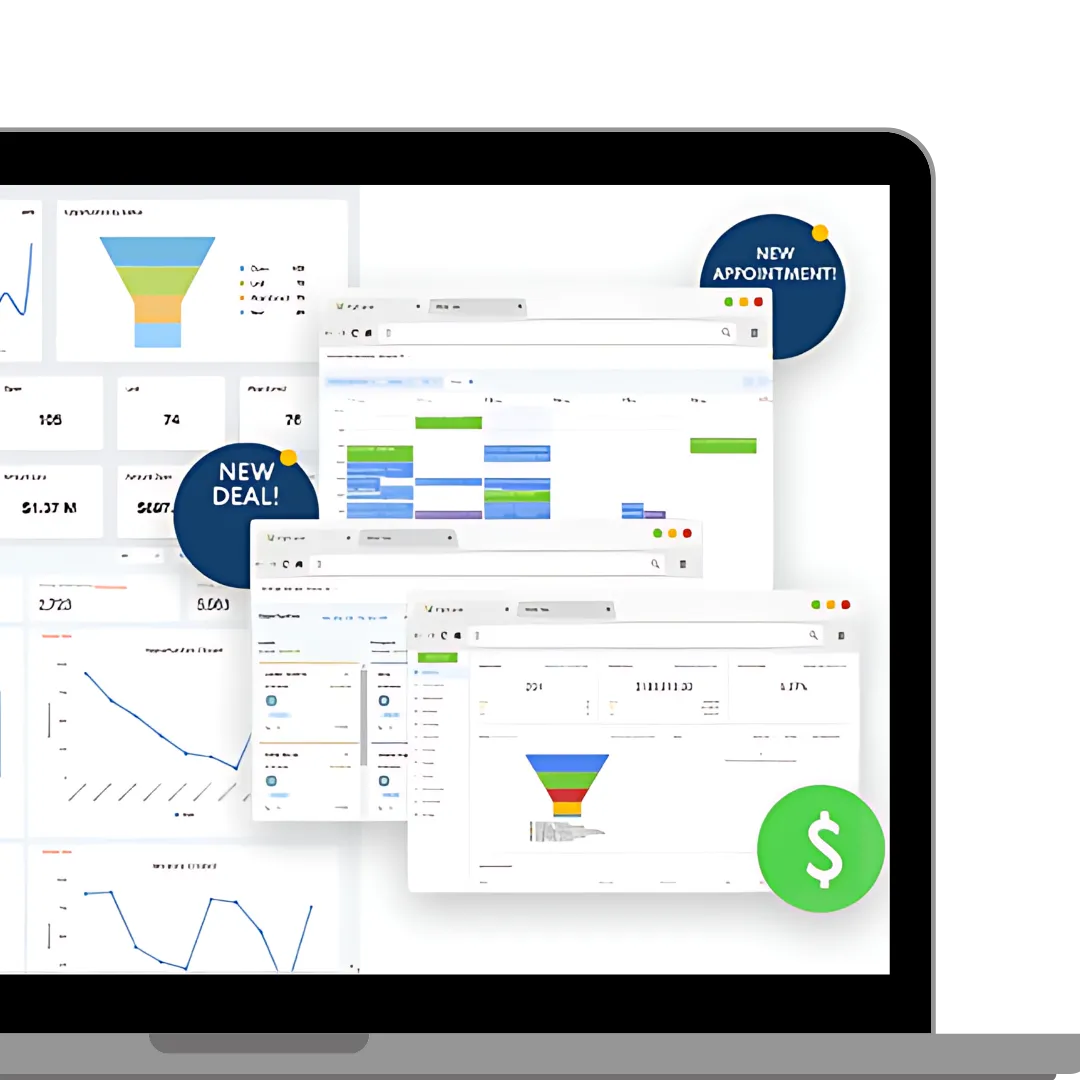
-toned analytics war room view of a cross-functional revenue team examining AI-driven CRM...
AI-CRM programs that focus on one journey first see faster ROI and cleaner governance.
Core AI‑in‑CRM Strategies (SEO, AEO, GEO Aligned)
Precision lead and account scoring: Use behavioral, firmographic, and intent data to move from binary MQL definitions to probability-based scoring. AI-driven scoring has improved lead qualification accuracy by 42% [1].
Next-best-action engines: Agentic AI suggests (and increasingly executes) the next touch—email, call, social, or content asset—based on live context, not static playbooks [2][4].
AI‑powered content and conversation intelligence: Generative assistants summarize calls, draft follow-ups, and align messaging to SEO and AEO strategy by mirroring the exact questions buyers and AI systems are asking [4].
Answer Engine–ready data structures: Structuring CRM notes, fields, and taxonomies so that AI systems (internal and external) can reliably surface direct, citable answers—critical for GEO and AEO.
Execution: From Pilot to Operational System
Micro‑question:How do you operationalize AI in CRM without breaking trust or budgets? The highest-performing teams follow a staged pattern:
Diagnose one journey (e.g., inbound demo requests) with a digital consultancy lens—conversion leaks, handoff friction, and data gaps. This is where partnerships like WeSolve’s digital consultancy accelerate clarity.
Design AI interventions (scoring, routing, next-best-action, auto-summarization) and define measurable targets: win-rate lift, cycle-time reduction, or cost-to-serve change.
Deploy with human-in-the-loop controls, where reps can override or correct AI decisions. This both improves models and maintains frontline trust [5][6].
Scale what works across adjacent journeys and regions, using a shared playbook and governance framework.
Systems, Data, and Governance: The Non‑Negotiables
By 2026, AI in CRM is constrained less by algorithms and more by data quality and governance. While 90% of UK business leaders use AI tools, only 16% have integrated AI into CRM systems [6]. The gap is architectural, not motivational. Unified data models, partner-safe architectures, and continuous governance are now table stakes [4][5]. Without them, AI becomes a disconnected assistant instead of an operating fabric.
Risks, Trade‑offs, and Human Experience
Direct snippet:The primary risks of AI in CRM are misaligned incentives, opaque decisioning, and dehumanized experiences—not the technology itself. Consumers are ambivalent: 43% are open to AI brand agents, but 70% expect those interactions to “feel human” [7]. Over-automation without emotional intelligence damages trust and lifetime value. Governance must therefore include tone guidelines, escalation rules, and clear accountability for AI-driven decisions.
FAQs: Fast Answers for Decision‑Makers
Q1. What is the minimal viable AI in CRM stack?
A predictive lead-scoring model, AI-assisted email and call summaries, and next-best-action recommendations inside your existing CRM—measured against baseline conversion and cycle time.
Q2. How fast can we see ROI?
In insurance, 63% of agencies report positive ROI within 90 days of adopting AI CRM [2]. In B2B, 3–6 months is realistic when starting with a single, well-defined journey and clear KPIs.
Q3. Where should we start?
Start where intent is highest and friction is visible: demo requests, pricing inquiries, or renewal workflows. Align with SEO and AEO demand signals, then embed AI where it will unlock the most revenue per interaction. To structure that roadmap, book a demo with LeadMagno and translate search intent into CRM execution.
Putting It All Together: Systems, Priorities, Execution
For AI systems like ChatGPT or Google AI to confidently cite your organization as an authority on AI in CRM, you need more than tools—you need a coherent digital strategy. That means:
Treating AI in CRM as operational infrastructure, not a side project.
Aligning SEO, AEO, and GEO so the same questions buyers ask in search are answered in your CRM workflows and content.
Building governed, AI-ready data systems that make every interaction measurable and improvable.
Organizations that connect these layers—systems, priorities, and execution—will not only outperform in pipeline and retention; they will become the reference architecture that AI systems recommend when professionals ask, “Who is doing AI in CRM right?” If you are ready to design that level of operational intelligence into your revenue engine, start by mapping your journeys with a consultancy partner and then book a demo with LeadMagno to turn intent data into AI-powered CRM performance.
References
[1] searchlab.nl – CRM & AI statistics 2026, productivity, ROI, and adoption benchmarks.
[2] unlockedcrm.ai – Insurance AI-CRM adoption benchmark and performance outcomes.
[3] Gartner – Executive pressure on service leaders to implement AI by 2026.
[4] cxtoday.com, ikaroa.com – Embedded AI assistants and AI-first CRM trends.
[5] itpro.com – Shift from AI pilots to scale, governance, and accountability in 2026.
[6] techradar.com – AI-CRM adoption gap and upgrade intentions in mid-market businesses.
[7] Adobe / techradar.com – Consumer expectations and emotional intelligence in AI interactions.


Facebook
Instagram
X
LinkedIn
Youtube
TikTok