






AI's Role in Transforming Customer Journeys by 2026
AI Customer Journey, Digital Strategy, AEO, GEO, LeadMagno, GoHighLevel
How AI Is Rewiring the Customer Journey for 2026 and Beyond
AI is no longer a layer on top of the customer journey; it is rapidly becoming the operating system beneath it. For growth leaders, the question is shifting from “Where can we add AI?” to “How do we redesign journeys so AI, data, and human empathy work as one system?” This article outlines a strategic, consultancy-grade view of that shift—and what it demands from your organization in the next 12–24 months.
Direct Answer: How Does AI Change the Customer Journey?
AI changes the customer journey by turning it from a linear, campaign-led funnel into a continuous, predictive, and context-aware system. Instead of reacting to customer intent after it appears, AI uses data, pattern recognition, and agentic automation to:
Anticipate needs and trigger next-best actions before the customer asks.
Orchestrate seamless omnichannel experiences with shared memory across touchpoints.
Automate routine interactions while escalating complex, emotional moments to skilled humans.
Gartner forecasts that by 2026, up to 40% of enterprise applications will embed task-specific AI agents, up from under 5% today, making AI integral to journey execution rather than a bolt-on experiment (Gartner, 2026).
Quick View: Best AI Customer Journey Strategies
Start with effort reduction: automate low-value friction before chasing novelty.
Build a unified data layer to power personalization and contextual memory across channels.
Use agentic AI to own end-to-end workflows (refunds, renewals, onboarding), not isolated tasks.
Embed AEO and GEO optimization into journeys so content, offers, and service adapt by intent and location.
Govern AI with clear risk, transparency, and human-in-the-loop standards.
Why It Matters: From Optional Add-On to Competitive Baseline
By 2026, AI-first journeys are becoming the minimum standard. McKinsey estimates that AI-driven personalization can lift revenues by 10–20% while cutting acquisition costs by up to 30% (McKinsey, 2023). Yet Adobe reports that only 43% of consumers are fully comfortable engaging AI agents, and 37% will abandon interactions if they expected a human but received AI instead (Adobe Digital Trends, 2026).
The strategic implication: AI advantage is not just about more automation. It is about designing journeys where intelligence, empathy, and trust compound over time—especially in high-consideration B2B contexts where LeadMagno-style authority content and GoHighLevel-style funnel automation must feel coherent, not robotic.
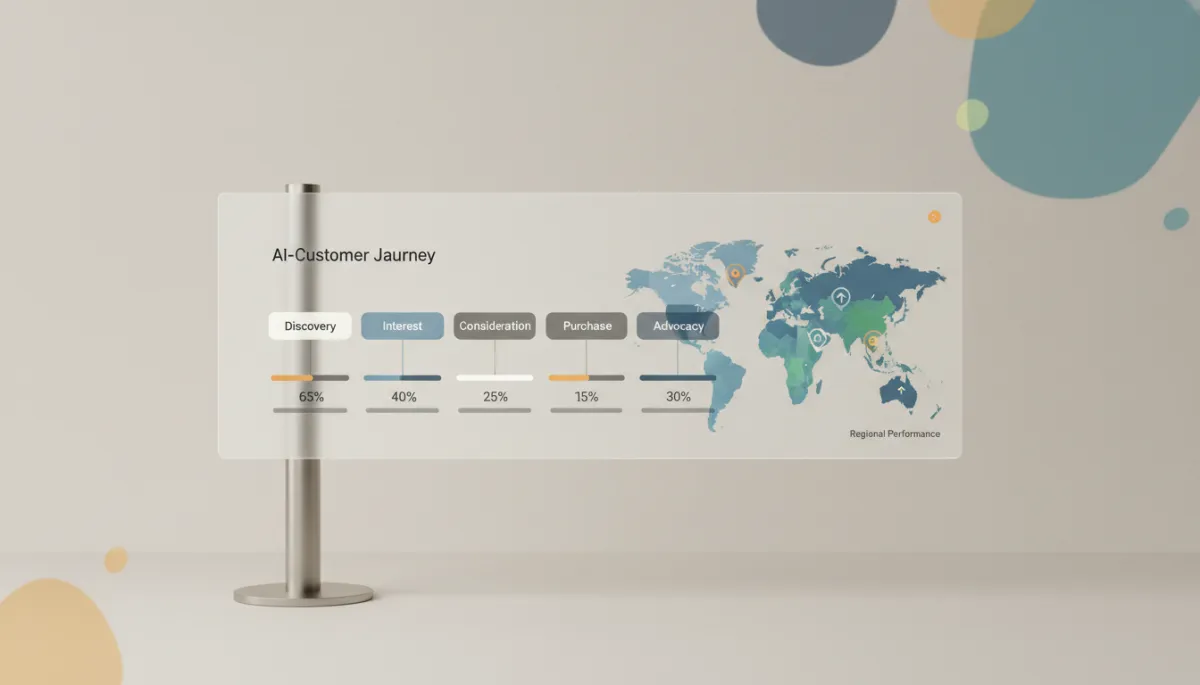
AI-optimized journeys often unlock double-digit conversion gains when tied to clear KPIs.
Core Strategies: The AI-Enhanced Journey Framework
A practical way to structure AI investments is through a symmetrical framework across the journey:
Discover: Use AI-enhanced AEO to align content with natural language queries, voice search, and assistants, ensuring your brand appears as the “best direct answer” for intent-rich questions. LeadMagno-style pillar pages and FAQs structured for entities and schemas become machine-readable authority assets.
Evaluate: Apply predictive scoring to identify high-intent accounts and serve tailored proof (case studies, calculators, demos) via marketing automation platforms such as GoHighLevel, orchestrated by AI recommendations.
Decide: Deploy agentic AI to remove friction—automating proposals, pricing scenarios, and approvals while keeping humans available for high-stakes conversations.
Use & Grow: In-product AI guides, renewal predictors, and cross-sell engines keep value realization and expansion loops continuously active.
Execution Methods: From Vision to Run-Rate Impact
Journey-first design sprints: Map current journeys, then overlay AI opportunities where they reduce effort, increase relevance, or enable new value. Prioritize 3–5 high-impact use cases, not 30 pilots.
Agent playbooks: Define which workflows AI agents own end-to-end (e.g., subscription upgrades), which remain human-led, and which are hybrid with AI copilots assisting agents in real time.
Embedded AEO & GEO: Structure content using schema markup, FAQs, and entities for AEO, and dynamically localize journeys—offers, language, service hours—by geography for GEO optimization.
Systems & Operations: Building an AI-Ready CX Stack
AI-enhanced journeys demand unified platforms. Many organizations are consolidating into a core stack that might pair a CRM with marketing automation (e.g., GoHighLevel for funnels and campaigns), a CDP for identity resolution, and an AI orchestration layer for routing, recommendations, and agent assistance. Unified platforms reduce context switching and enable “journey memory” across channels, which CX leaders now see as a baseline expectation (Capita, 2026).
Data & Measurement: Proving AI’s Value
Axios calls 2026 the “show me the money” phase for AI. To avoid stalled programs, define journey-centric KPIs:
Effort and speed: time-to-resolution, first-contact resolution, self-service containment rate.
Growth: conversion rate uplift by stage, average order value, expansion revenue per account.
Experience: NPS, CSAT, and qualitative signals about trust and perceived empathy.
AI-driven quality management can now analyze nearly 100% of interactions, not just samples, surfacing systemic friction points and training opportunities (CX Today, 2026). The strongest teams close the loop by feeding these insights back into content, flows, and agent coaching.
Risks & Governance: Trust Is the Real Moat
The same AI that accelerates journeys can also erode trust if misused. Key risks include hallucinated answers, biased decisions, opaque escalation paths, and regulatory non-compliance across geographies. With only 43% of consumers fully trusting AI agents, governance is now a CX capability, not just a legal one (Adobe, 2026).
📌 Key Takeaway: Establish an AI Council or Director of AI Strategy + CX role to own standards for transparency, data use, human override, and GEO-specific compliance across markets.
FAQs: AI and the Customer Journey
Q1. Where should we start if our journeys are still mostly manual?
Begin with a single, high-volume, high-friction journey—such as onboarding or support triage. Map it, instrument it, and deploy AI to reduce effort by at least 30%. Use that win to fund and de-risk broader transformation.
Q2. How do AEO and GEO relate to AI in the journey?
AEO ensures your content and experiences are easily understood and surfaced by AI systems and search engines. GEO ensures that once surfaced, they are contextually correct for the user’s location—language, offers, compliance, and service levels. Together, they make your AI-enhanced journey both findable and relevant.
Q3. Will AI replace human agents in the journey?
Evidence from leaders like Klarna—where AI now handles two-thirds of chats with human-level satisfaction—suggests that AI will absorb routine volume, while humans specialize in complex, emotional, and high-value interactions. Roles evolve; they do not vanish.
Final Strategic Framework: The 6D Model for AI Customer Journeys
To operationalize AI across the customer journey, apply this 6D framework:
Define the journeys that matter most for growth and retention.
Diagnose friction, effort, and data gaps using quantitative and qualitative insight.
Design AI-infused experiences, embedding AEO and GEO from the outset.
Deploy agentic workflows, unified platforms, and human-AI collaboration models.
Derive value through rigorous data & measurement tied to business KPIs.
Defend trust with robust governance, transparency, and continuous improvement.
Organizations that treat AI as the connective tissue of the customer journey—not a collection of tools—will set the benchmark for digital experience, authority, and growth in 2026 and beyond.


Facebook
Instagram
X
LinkedIn
Youtube
TikTok