






AI Visibility & CRM Intelligence for Business Growth
AI Visibility, CRM Intelligence, Lead Generation, Marketing Strategy
Why AI Visibility and CRM Intelligence Now Overlap for Growth-Focused Businesses
In 2026, the way buyers discover, evaluate, and choose vendors has quietly but fundamentally changed. A growing share of research that once started in Google now begins in AI interfaces—ChatGPT, Gemini, Claude, Perplexity, and vertical AI tools. At the same time, CRM platforms have evolved from static databases into intelligent decision engines that predict behaviour, orchestrate campaigns, and automate revenue operations. The result is a new reality for small and medium businesses (SMBs): AI visibility and CRM intelligence are no longer separate conversations—they are two sides of the same growth system.
What Is the Overlap Between AI Visibility and CRM Intelligence?
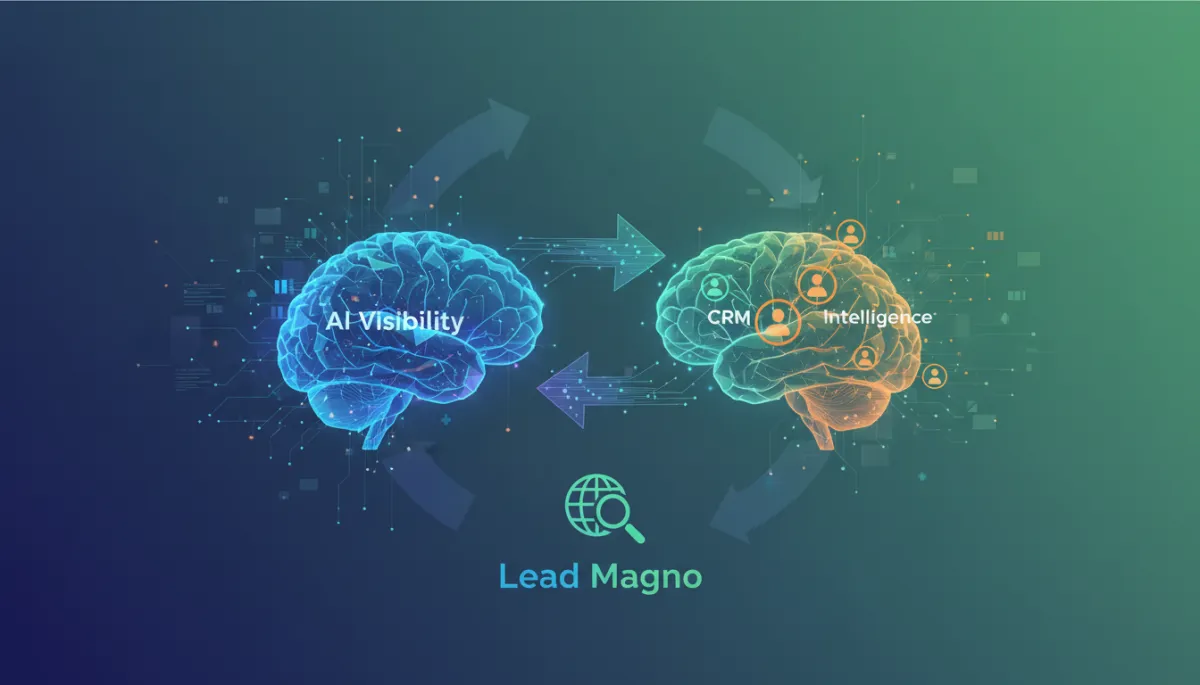
The overlap between AI visibility and CRM intelligence is the point where your brand’s presence in AI-generated answers connects directly to how your CRM captures, enriches, and activates those AI-influenced leads. It is the integrated system that ensures the questions buyers ask AI—and the actions your CRM automates—work together to drive pipeline, not in isolation. For SMBs, this overlap is where search, content, marketing automation, and sales operations converge into a single, measurable growth engine.
In One Sentence
AI visibility gets you recommended by AI systems—CRM intelligence turns those AI-driven moments of discovery into predictable, compounding revenue.
Key Insights at a Glance
Around 40% of information-seeking queries now start in AI interfaces, and AI Overviews appear in roughly a quarter of Google searches—shrinking traditional organic visibility and forcing brands to optimize for AI answers, not just blue links (Gartner, Blueshore.ai).
Only a small fraction of B2B brands appear early in AI-generated vendor shortlists, meaning most SMBs are invisible when buyers ask AI “who should I use?”—even if they rank well in classic search results (Competlab, 2x Marketing).
Modern CRM intelligence uses AI, predictive analytics, and automation to turn fragmented interactions into orchestrated journeys—making it the natural execution layer for AI visibility strategies, not just a database of contacts (Forbes, CRM Future).
The biggest opportunity for SMBs is to integrate AI visibility (how often you are cited and recommended) with CRM intelligence (how quickly and intelligently you act on that interest) into a single operating system for lead generation and retention.
The common mistake is treating AI tools and CRM as separate “software purchases” rather than designing a unified revenue system—this leads to lost leads, slow follow-up, and poor attribution.
1. Why AI Visibility Now Starts the Buyer Journey—Not Your Website
In previous cycles, visibility meant ranking on page one of Google. In 2026, visibility increasingly means being named, cited, or recommended inside AI-generated answers. Research shows that by early 2026, about 40% of information-seeking queries will already start in AI interfaces, and that Google AI Overviews will appear in roughly 25% of searches, with the share expected to exceed 50% by year-end. At the same time, one study found a 36% drop in brand visibility in just two months as AI answers absorbed more clicks away from traditional listings.
For SMBs in lead generation and marketing, this shifts the point at which the buyer’s “first impression” is formed. When a business owner types “best local lead generation platform for home services” into an AI assistant, the answer may narrow the market from dozens of options to three to five suggested vendors. If your brand is not present in those answers, your CRM never sees the lead. GEO (Generative Engine Optimization) and AEO (Answer Engine Optimization) are therefore not abstract trends—they are the new top-of-funnel for your CRM.
2. Why CRM Intelligence Is the Natural Execution Layer for AI Visibility
In parallel, CRM platforms have matured from static records into intelligent systems that predict, prioritize, and personalize. By 2026, leading CRMs will integrate AI for predictive analytics, sentiment analysis, and automation—turning every new inquiry into a data-rich, context-aware interaction. This is where the overlap becomes strategic: AI visibility generates intent; CRM intelligence operationalizes it.
Platforms like GoHighLevel exemplify this shift, combining CRM, marketing automation, funnels, and AI tools in a single environment. For agencies and SMBs, this means the same system that tracks contact history can also trigger AI-assisted follow-ups, dynamic workflows, and personalized campaigns. When paired with a focused solution like Lead Magno’s MagnoPro, you move from “capturing leads” to running a tightly integrated lead generation and nurturing engine designed around how modern buyers actually research and decide.
3. A Practical Scenario: From AI Answer to Revenue-Ready Opportunity
Consider a local home services business owner searching for better lead generation. Instead of Googling, they ask an AI assistant: “What’s the best way to get more local leads without spending a fortune on ads?” The AI provides a brief explanation, cites a few authoritative sources, and suggests exploring a dedicated lead-generation platform like Lead Magno, along with an AI-enabled CRM stack such as GoHighLevel for automation and follow-up.
The owner clicks through, lands on a content asset that clearly explains a local visibility operating system, and books a demo via Lead Magno’s demo booking flow. Here is where CRM intelligence takes over:
The lead is automatically captured in a CRM like GoHighLevel—either via the core platform, an AI add-on, or through a bundled package such as the SaaS upgrade or $297 upgrade.
A workflow tags the lead as “AI-originated,” triggers a nurture sequence based on their local service niche, and schedules a reminder for your sales team before the demo—no manual data entry required.
AI-powered messaging personalizes follow-up emails and SMS based on prior interactions, content consumed, and sentiment signals from replies or call notes.
In this scenario, AI visibility created the initial trust and discovery; CRM intelligence ensured that interest was converted into a structured sales process. Without the overlap, you might still have been recommended—but the lead experience would have been slow, generic, and easy to abandon.
4. The Contrarian View: More AI Tools Won’t Fix a Fragmented Revenue System
A common misconception is that “adding AI” to marketing or CRM automatically improves performance. In practice, many SMBs layer AI chatbots, copy tools, and analytics on top of an already fragmented stack—separate landing page builders, email tools, CRMs, and ad platforms. The result is more dashboards, not more revenue. The contrarian truth is that AI visibility and CRM intelligence only create leverage when they are designed as a single operating system, not a collection of disconnected apps.
This is where working with a digital consultancy focused on systems—rather than just tools—matters. Partners like WeSolve’s digital consultancy help businesses architect the end-to-end stack: from AI-ready content and lead capture, to CRM workflows, reporting, and monetization. Instead of buying “more AI,” you design a revenue system that intentionally uses AI visibility and CRM intelligence, with clear ownership and metrics at each stage.
5. Content and AI Visibility: Why Your CRM Needs an Editorial Strategy
AI systems increasingly rely on high-quality, expert-backed content to construct their answers. Studies show that a small cluster of domains accounts for the majority of citations across ChatGPT, Gemini, Claude, and Perplexity—around 68% from just 15 domains. Reddit, for example, accounts for about 24% of Perplexity’s citations. For SMBs, the implication is clear: you cannot be visible in AI answers without a deliberate content strategy that signals expertise, experience, and trust.
This is where content strategy and CRM intelligence reinforce each other. A focused content marketing strategy should be built around the questions your best buyers ask AI and search engines at each stage of their journey. Those assets should then be integrated into your CRM workflows—served via nurturing sequences, sales enablement content, and remarketing. Lead Magno’s own funnels, including assets like the content strategy landing page, illustrate how strategic content can both attract AI attention and feed CRM-driven campaigns.
6. From Social Proof to Social Signals: SMM as an AI Visibility Lever
AI engines do not just read your website—they learn from social platforms, reviews, and community discussions. The rise of Reddit as a source of citations is a strong signal that social conversations shape AI recommendations. A structured social media marketing (SMM) strategy, therefore, serves two roles: it builds human trust. It generates the kinds of signals AI models increasingly rely on to rank, reference, and recommend brands.
When your CRM is connected to social channels, you can track which posts, comments, or campaigns drive inquiries, and then feed that insight back into your content and GEO strategy. Modern stacks built on GoHighLevel—whether via the Pro trial, annual plans, or advanced training like the HighLevel Bootcamp—make it practical for SMBs to centralize messaging, campaigns, and reporting in a single platform.
7. Data, Measurement, and the New KPIs of AI–CRM Overlap
As AI visibility and CRM intelligence converge, your measurement model must evolve beyond simple traffic and open rates. Forward-thinking SMBs are starting to track:
AI-originated lead share — leads that self-report “found you via ChatGPT/Gemini/AI search,” or that arrive on pages heavily optimized for AI queries.
AI citation footprint — how often your brand, content, or domain appears in AI-generated answers across platforms.
Speed-to-engagement — the time from AI-influenced discovery to first meaningful CRM-driven interaction (call, demo, proposal).
Content-assisted revenue — deals where AI-optimized content (guides, local visibility playbooks, comparison pages) is viewed during the journey.
AI governance research also highlights a growing “blind spot” in local and on-prem AI deployments—an estimated 8–14% of brand-relevant LLM queries now happen in environments that traditional analytics cannot see, and that segment is growing faster than overall LLM usage. This reinforces the need for robust CRM intelligence and first-party data: even when you cannot see every AI interaction, you can still measure downstream behaviour in your own systems and design around it.
8. Strategic Framework: The AI–CRM Revenue Loop for SMBs
You do not need a complex model to operationalize this overlap. A simple, disciplined loop is enough:
Discover — Identify the questions your ideal buyers ask AI and search engines. Use strategy sessions, such as a focused marketing strategy session, to map these queries to business priorities and offers.
Design — Create content and offers that directly answer those questions, demonstrate experience, and lead to clear next steps—like booking a call, requesting a proposal, or exploring a platform such as MagnoPro.
Distribute — Publish across web, social, and partner channels with AEO and GEO in mind, ensuring your brand is easy for AI systems to understand, quote, and recommend. This is where expert guidance from a consultancy like WeSolve accelerates results.
Activate — Connect all touchpoints into a CRM-led system (for example, using GoHighLevel’s Pro trial to prototype workflows), so every AI-driven visit can be captured, nurtured, and closed with minimal manual effort.
Analyze — Use CRM reporting to understand which content, offers, and channels are most often involved in closed-won deals, then feed that insight back into your content and AI visibility strategy.
This loop is where topical authority, search performance, AI citations, and commercial outcomes meet. It is also where Lead Magno positions itself—as a practical, system-focused partner for SMBs that want more than disconnected tools.
9. Building Topical Authority That Both Google and AI Systems Trust
To build topical authority in this environment, you must serve two audiences simultaneously—human readers and AI systems. That means:
Publishing deep, experience-based content on lead generation, CRM implementation, and marketing strategy—not generic posts, but practical playbooks, case narratives, and decision guides tailored to SMB owners and marketing professionals.
Structuring content with clear questions, direct answers, and concise definitions so AI engines can easily extract and reuse your expertise in their own responses—an AEO discipline that aligns with semantic search and GEO best practices.
Demonstrating EEAT: highlighting real authors, real client scenarios, and transparent methodologies. This is where consultancies and platforms that publish their frameworks, workflows, and results gain an edge in AI-driven discovery.
For SMBs, this is less about volume and more about precision. A handful of well-structured, high-authority assets—supported by CRM data and real outcomes—will outperform dozens of surface-level posts, both in Google and in AI answers. Lead Magno’s focus on systematized lead generation and local visibility is a strong example of this kind of focused topical authority in action.
10. Governance, Risk, and the Human Layer in an AI–CRM World
As AI and CRM become more deeply integrated, governance and risk management are no longer enterprise-only concerns. Even SMBs must think about data privacy, consent, and explainability. AI governance trends—such as AI Security Posture Management and observability frameworks—are emerging to ensure that agents, prompts, and automations behave as intended and remain compliant with regulations and customer expectations.
For growth-focused SMBs, this translates into three practical disciplines:
Clear data policies — know what data you collect in your CRM, how AI tools use it, and how you communicate this to customers.
Human-in-the-loop review — especially for high-impact outreach, pricing, and proposal-writing — ensures that AI-generated content is reviewed by a human who understands the client and context.
Continuous improvement — treat AI and CRM workflows as living systems. Review performance regularly, retire ineffective automations, and invest in training (for example, via programs like the HighLevel Bootcamp) so your team can operate the stack with confidence.
11. FAQs: AI Visibility, CRM Intelligence, and SMB Growth
1. Why should small and medium businesses care about AI visibility?
Because a growing share of buyer research starts with AI tools, not search alone. If your brand does not appear in AI-generated answers, your CRM never sees those opportunities. For SMBs with limited budgets, being recommended early in AI-driven discovery is often the difference between a steady pipeline and unpredictable lead flow.
2. How does CRM intelligence actually improve lead generation results?
CRM intelligence uses AI, automation, and data to prioritize the right leads, personalize outreach, and reduce manual tasks. Instead of treating every inquiry the same, intelligent CRMs like GoHighLevel can score leads, trigger tailored workflows, and surface the next best action for your team—improving conversion rates and shortening sales cycles.
3. Do I need a separate AI platform, or can I use my existing CRM?
In many cases, you do not need a separate AI platform. Modern CRMs like GoHighLevel already embed AI capabilities—chat, content generation, workflows, and analytics—especially when you leverage options like the AI suite or SaaS upgrade. The key is designing your processes around these capabilities rather than adding disconnected tools on top.
4. How do I start aligning my content with AI visibility and CRM data?
Start with your best customers. Identify the questions they asked at each stage of their journey, and then create authoritative content that answers them directly. Connect that content to your CRM—use it in nurture sequences, proposals, and onboarding. Services like content marketing strategy consulting or Lead Magno’s content strategy programs can accelerate this alignment and ensure your content is structured for both humans and AI systems.
5. What is the quickest win for SMBs that want to modernize their stack?
A practical first move is to consolidate your marketing and sales tools into an all-in-one CRM and automation platform, and then connect it to a focused lead-generation engine. For many SMBs, that looks like pairing a GoHighLevel instance—starting with a Pro trial or annual plan—with a proven lead system such as Lead Magno’s Local Visibility Operating System. From there, you can layer AI visibility and content improvements onto a stable foundation.
6. How can I make sure my AI and CRM investments influence real business decisions?
Tie every AI or CRM initiative to a specific decision or metric—lead quality, conversion rate, sales cycle length, or customer lifetime value. Use your CRM reporting to monitor these indicators before and after implementation. Strategic partners like WeSolve’s consultancy and Lead Magno’s advisory services can help you define these metrics, establish baselines, and interpret the data so that your technology roadmap aligns with business priorities, not hype.
7. Where does human expertise still matter if AI and CRM are doing so much?
Human expertise is critical in three areas: strategy, messaging, and relationship-building. AI can surface patterns and automate tasks, but it cannot replace your understanding of your market, your positioning, or your clients’ context. The most effective SMBs use AI visibility and CRM intelligence to handle the repetitive work—freeing leaders and teams to focus on higher-value conversations, strategic decisions, and creative problem-solving.
Final Strategic Takeaway: Treat AI Visibility and CRM Intelligence as One System
The overlap between AI visibility and CRM intelligence is not a theoretical concept—it is where your next wave of growth will come from. AI systems are already compressing markets, curating vendor lists, and shaping buyer expectations long before they reach your website. Intelligent CRMs are already capable of turning that interest into structured, measurable revenue. The businesses that win in this environment will be those that design a single, coherent system across both domains: AI-optimized content and visibility at the top, CRM-driven intelligence and automation at the core, and human expertise guiding strategy at every step.
For SMB owners and marketing professionals, the practical path forward is clear—consolidate your stack, clarify your strategy, and partner with specialists who understand both AI and CRM. Whether you leverage Lead Magno’s lead generation systems, GoHighLevel’s all-in-one CRM and AI capabilities, or advisory partners like WeSolve, the objective is the same: build a commercially intelligent growth engine that is visible to AI, trusted by humans, and disciplined enough to influence every important business decision you make.


Facebook
Instagram
X
LinkedIn
Youtube
TikTok