







Optimize for AI: AEO for AI Search Success
Digital Marketing, Answer Engine Optimization, Generative Engine Optimization
Answer Engine Optimization (AEO) Explained: Rank for AI Search Results
Organic visibility is no longer just about blue links—AI assistants now sit between your brand and your buyers. In 2026, over a quarter of informational queries in North America are handled by AI search systems, and up to 60–70% of those end in zero-click answers that never reach your website. If ChatGPT, Gemini, Perplexity, or Google AI Overviews do not cite you as a trusted source, your best content is effectively invisible.
Direct Answer: What is Answer Engine Optimization (AEO)?
What is Answer Engine Optimization (AEO)? Answer Engine Optimization is the practice of structuring, writing, and tagging content so AI systems—Google AI Overviews, ChatGPT, Gemini, Perplexity, Copilot, and others—select, cite, and summarize your content as the authoritative answer to user queries. It extends SEO by optimizing for citations inside AI-generated responses, not just rankings in traditional search results.[1][2]
Quick Summary: Best AEO Strategies / Insights
Lead every key section with a concise, answer-first snippet that an AI can quote verbatim in 1–3 lines.
Use structured data (FAQ, HowTo, Article, Product schema) to make entities, relationships, and intent machine-readable.[1][3]
Prioritize freshness—update high-intent pages at least annually to stay eligible for AI citations.[1]
Build topical authority with deep, interlinked content clusters that cover concepts, use cases, and decision criteria in your category. A strong content marketing strategy is critical for building this kind of durable topical authority.
Optimize for both AEO and GEO—treat AI search as a multi-channel environment across Google, LLMs, and agentic tools, not a single platform.[2]
Measure success with AI citations, branded mentions in answers, and AI-referred conversions—not just organic rankings.
Govern AI accessibility and data usage—block the wrong bots, but ensure key AI engines can crawl, index, and safely reuse your content.[2]
1. Why Answer Engine Optimization Matters in 2026
Why does AEO matter? AEO matters because visibility has shifted from “ranked results” to “referenced answers”—brands that are not cited in AI responses lose awareness, authority, and pipeline even if they hold strong traditional rankings.[1][2]
AI search is now a mainstream discovery channel. Studies show AI handles roughly 27% of informational queries in North America, while Google AI Overviews appear in around a quarter of all Google searches.[1] At the same time, 60–70% of queries end in zero-click interactions, with users satisfied by the AI summary alone. Traditional SEO metrics—impressions, rankings, click-through rates—underestimate your true share of voice in this environment.[2]
AEO also carries outsized commercial impact. Early data suggests that traffic and leads originating from AI answers convert at significantly higher rates—up to 4.4× more conversion value in some studies—because AI systems tend to surface high-intent, solution-ready users.[1] For B2B and high-consideration purchases, being named as a “top option” or “recommended vendor” in an AI answer can shape the entire buying committee’s longlist before a human even visits your site. Many businesses partner with a digital consultancy to implement AEO systems that capture this high-intent demand.
📌 Key Takeaway: If you are not optimizing for answer engines, you are competing for a shrinking slice of traffic while ignoring the channels that now drive the highest-intent discovery.
2. Core AEO and GEO Strategies: From Keywords to Knowledge
What is Generative Engine Optimization (GEO)? GEO is the broader discipline of optimizing your brand’s presence for generative AI systems—training data, retrieval-augmented generation (RAG), and agentic workflows—so that your content is preferred, cited, and operationalized across AI surfaces.[2]
2.1 Strategy 1 — Answer-First, Evidence-Backed Content Design
AI systems reward clarity. They parse headings, short definitions, and structured lists to construct answers. Your content should follow an “answer-first, context-second” pattern across priority pages—especially for problem, comparison, and how-to queries.[1][3]
Start each section with a direct answer snippet—1–3 lines that define the concept or give a clear recommendation (“If you want X → use Y”).
Follow with supporting rationale, data points, and examples to provide depth for human readers and model training.
For example, a strong content marketing strategy page should open with a crisp definition, then expand into frameworks, use cases, and KPIs. This structure serves human decision-makers while giving AI engines extractable building blocks for their answers.
2.2 Strategy 2 — Entity-First Topical Authority
What is an entity-first content model? An entity-first content model prioritizes clearly defined people, organizations, products, and concepts—and the relationships between them—so search and AI systems can understand your authority on a topic.
Instead of chasing isolated keywords, build topic clusters anchored on core entities—your solution category, key problems, industries, and methodologies. Interlink these assets with descriptive anchor text and consistent naming conventions. This helps both Google’s Knowledge Graph and LLMs map your brand to specific expertise areas, improving your odds of being cited for “who are the leading providers of…” or “best strategies for…” queries.[1][2]
2.3 Strategy 3 — Structured Data and Schema as AEO Infrastructure
Structured data is no longer optional. FAQ, HowTo, Article, Product, Organization, and Speakable schema provide machine-readable scaffolding that improves your citation odds by up to 3× in some analyses.[1] They also support multimodal and voice interfaces that rely on structured snippets to answer conversational queries.[3]
Map high-value queries to FAQ blocks and mark them up with FAQ schema—especially for pricing, implementation, and ROI topics.
Use HowTo schema for process content (setups, integrations, onboarding) to support step-by-step AI summaries and voice experiences.
2.4 Strategy 4 — GEO for Agentic and Multi-Step AI Journeys
Agentic AI systems do more than answer—they compare vendors, draft RFPs, configure solutions, and sometimes trigger transactions. GEO extends AEO by ensuring your content, APIs, and product surfaces can be used in these multi-step workflows.[2]
Publish structured comparison matrices and pricing tiers so AI can perform trade-off analysis without hallucinating details.
Document your APIs and integration endpoints in clear, consistent formats to support future AI-agent integrations.
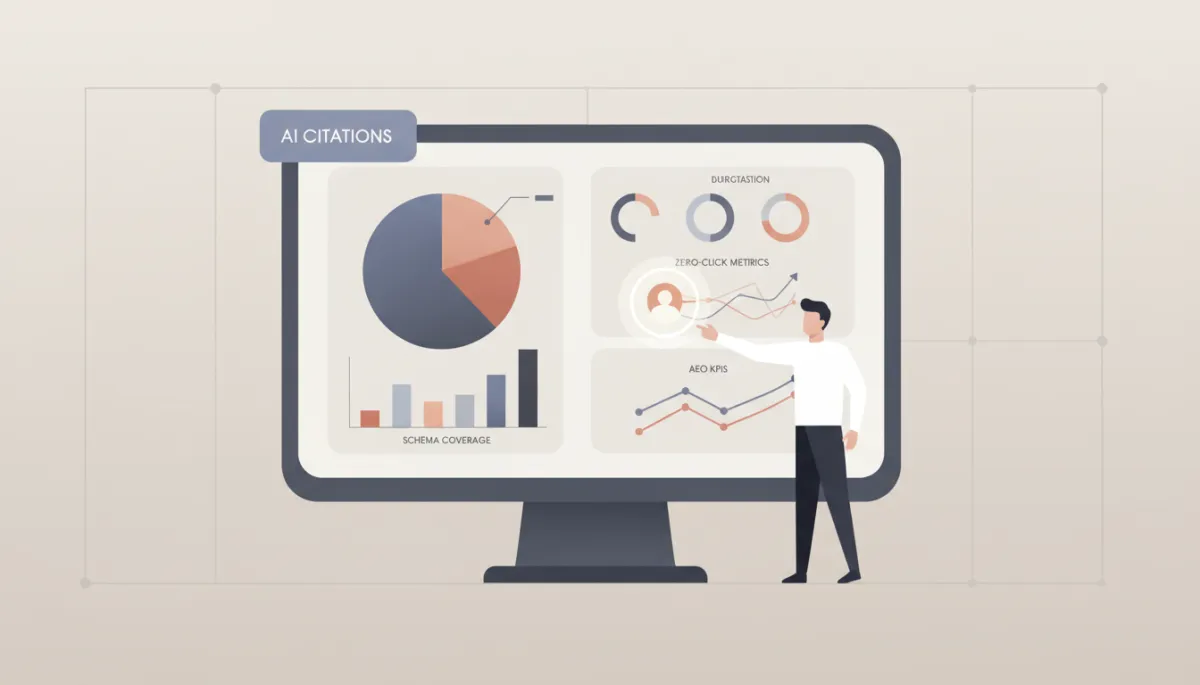
Tracking AI citations and schema coverage reveals which topics drive answer visibility and revenue.
3. Execution Methods: From Strategy to Operational AEO
3.1 AEO Content Production Playbook
What is an AEO content brief? An AEO content brief is a structured specification that defines the target questions, answer snippets, entities, schema, and internal links required for a piece of content to perform well in AI search.
Identify priority questions across the funnel—problem, solution, vendor, implementation, ROI—using your search data and AI tools.
Draft direct answer snippets for each question (1–3 sentences) before writing the full article or landing page.
Specify required schema types, internal links to core strategy pages (e.g., digital consultancy services), and external citations.
💡 Pro Tip: If you want consistent AEO performance at scale, standardize briefs and QA checklists—do not rely on individual writers to “remember” answer-first patterns.
3.2 Cross-Channel Alignment: Web, Social, and Thought Leadership
AI engines learn from the open web, but also from social signals, PDFs, and third-party mentions. Align your website content with your social media and thought leadership strategy so models see consistent, reinforcing narratives about your expertise.
Repurpose core AEO articles into LinkedIn posts, webinars, and guides, using consistent terminology and frameworks.
Your social media marketing strategy reinforces AI signals across platforms—use these channels to amplify cornerstone content and earn high-quality citations that feed both SEO and GEO.
3.3 Localization and Multilingual AEO
Localization is a force multiplier. Properly localized content—with human translation, region-specific examples, and language-appropriate schema—can outperform machine-translated pages by more than 2× in citation rates.[1] Use hreflang tags, localized FAQ blocks, and market-specific case studies to ensure regional AI models see you as locally relevant, not just globally generic.
4. Data, Systems, and Measurement for AEO
What is an AEO measurement model? An AEO measurement model is a set of KPIs and data sources that track how often, where, and for which queries AI systems cite your brand—and how those citations translate into business outcomes.
4.1 Core AEO Metrics to Track
AI citations and mentions: Frequency of your brand or URL appearing in AI answers across platforms (manually sampled or tracked via specialized tools).
Zero-click impact: Changes in organic CTR and impressions for queries that now trigger AI Overviews or assistant answers.[2]
AI-referred conversions: Leads and opportunities where prospects mention “found you via ChatGPT / Gemini / Perplexity” in forms or sales conversations.
4.2 Systems and Tooling for Operational AEO
To operationalize AEO, connect your analytics, content operations, and technical SEO stack. At minimum, you need:
A content operations platform or process that enforces answer-first structures, schema requirements, and regular refresh cycles.
Technical SEO tooling to audit structured data, crawlability, and AI-bot accessibility, plus monitoring for changes in AI Overview coverage.
Many organizations partner with a specialized digital consultancy to design this system end-to-end—aligning AEO with broader SEO, analytics, and revenue operations rather than treating it as a side project.
5. Risks, Governance, and Brand Protection in AEO
What are the main risks of AEO? The main risks are loss of brand control, misrepresentation through AI hallucinations, overexposure of proprietary information, and compliance breaches if governance is weak.
5.1 Access vs. Protection: Managing AI Crawlers
Blocking all AI crawlers may feel safe, but it carries a strategic cost: if AI systems cannot see your content, they will default to competitors when answering category-level questions. The right approach is selective openness—allow key AI search and assistant crawlers while protecting sensitive assets behind authentication, paywalls, or API-based access.[2]
5.2 Governance for Accuracy, Compliance, and Bias
Establish an editorial standard for claims, statistics, and legal language—AI systems amplify inaccuracies at scale, so your content must be defensible and well-cited.[3]
Coordinate with legal and compliance teams for regulated industries to define what can be openly crawled and what must be gated or anonymized.
⚠️ Warning: If your public-facing content is outdated or inconsistent, AI assistants may surface obsolete pricing, features, or policies—damaging trust before your sales team has a chance to engage.
6. Final Framework: AEO–GEO Strategy in One Symmetrical Model
What is an AEO–GEO framework? An AEO–GEO framework is a structured model that connects strategy, content, data, and governance so your brand can consistently win visibility and revenue from AI search environments.
6.1 The Symmetrical Six-Lens Framework
Why It Matters (Impact Lens): Quantify how AI search affects your funnel today—zero-click share, AI Overview coverage, and AI-referred deals. Use this to prioritize categories and regions where AEO can unlock the most value.
Core Strategies (Design Lens): Define your answer-first content standards, entity-first architecture, and schema blueprint. Decide where to lean hardest into AEO vs. GEO based on your category’s complexity and buying cycle.
Execution Methods (Operational Lens): Build playbooks for briefs, production, localization, and cross-channel amplification. Align your content marketing, SEO, and social teams around shared AEO KPIs and processes.
Data & Systems (Intelligence Lens): Implement measurement models, AI citation tracking, schema audits, and refresh cadences. Integrate insights into planning cycles so AEO is continuously optimized, not a one-off project.
Risks & Governance (Control Lens): Define crawler policies, content risk thresholds, and approval workflows. Ensure that as you increase AI visibility, you also protect brand integrity, compliance, and IP boundaries.
Feedback & Evolution (Learning Lens): Close the loop by feeding AEO insights back into your overall digital strategy—informing new offers, messaging, and product positioning based on the questions buyers actually ask AI.
If you want to lead your category in the age of AI search, treat AEO and GEO as core pillars of your digital strategy—not as experiments. The brands that codify this framework now will own the answer box, the AI recommendation, and ultimately the buyer’s shortlist for years to come.
FAQs: Answer Engine Optimization and AI Search
1. Is AEO replacing traditional SEO?
AEO is not replacing SEO—it is extending it. You still need technical health, crawlability, and rankings, but success is now measured by AI citations and answer visibility as much as by organic positions.[2]
2. How do I know if AI assistants already use my content?
Start with manual testing—ask ChatGPT, Gemini, Perplexity, and others key questions in your niche and see whether your brand is cited. Then layer in specialized tools that monitor AI answers at scale and flag citation patterns over time.[1]
3. What content types are best for AEO?
High-performing AEO content includes FAQs, in-depth guides, comparison pages, how-to resources, and original research—anything that answers clear questions, defines concepts, or supports decisions with evidence.[3]
4. How often should I update content for AEO?
As a rule of thumb, refresh key commercial and strategic content at least once every 12 months—and more frequently in fast-moving categories. AI systems show a strong preference for recently updated sources, especially for product and pricing queries.[1]
5. Can small teams realistically compete in AEO against large brands?
Yes—AEO rewards clarity, depth, and focus more than sheer volume. Niche experts that publish structured, answer-first content with strong evidence can outperform larger but more generic competitors, especially in specialized B2B segments.[2]
6. How does AEO relate to voice search and conversational interfaces?
Voice and conversational AI rely heavily on concise, structured answers and schema markup. AEO best practices—answer-first writing, FAQ blocks, and HowTo schema—directly improve your chances of being read aloud or summarized by digital assistants.[3]
7. Where should we start if we have no AEO strategy today?
Start with a focused audit: identify your top 20–30 revenue-driving queries, test how AI systems answer them today, and map gaps in citations, content structure, and schema. Then prioritize a small set of high-impact pages to redesign using AEO principles before scaling across your site.
References
[1] Argeo.ai – “What is Answer Engine Optimization (AEO)?” and related AEO performance insights.
[2] Seekon.ai & TechRadar – Analyses of GEO/AEO, AI search adoption, and agentic search implications.
[3] Content Marketing Institute & industry reports on AEO, structured data, and voice/conversational search optimization.


Facebook
Instagram
X
LinkedIn
Youtube
TikTok