






B2B Lead Generation: Strategic Guide for 2026
B2B Marketing, Lead Generation Services
B2B Lead Generation Services: A Strategic Guide for Revenue Teams and Agencies
In 2026, B2B lead generation is no longer a “top-of-funnel activity” — it is an integrated revenue system. Median MQL→SQL conversion sits at just 13%, while top-quartile teams hit 28% by combining AI, intent data, and disciplined operations [1]. At the same time, blended cost-per-lead has climbed to a median of $214, with +11% annual inflation driven by rising paid media costs [1]. The gap between average and elite performance is widening, and the difference is rarely budget — it is in how organizations design, execute, and govern their lead-generation services.
The core problem is systemic: most B2B companies invest in isolated lead generation tactics — a paid campaign here, a content push there — without a unifying system to connect them. In an AI-first buyer environment where 67% of the purchase decision happens before a prospect ever contacts sales, that fragmentation is no longer a manageable inefficiency. It is a structural revenue leak. The businesses pulling ahead are not spending more; they are operating differently.
What Is B2B Lead Generation Services?
B2B lead generation services are specialized, repeatable programs that identify, attract, qualify, and nurture decision-makers and buying committees in other businesses, with the explicit goal of creating sales-ready opportunities. These services combine strategy, data, technology, and execution across channels such as content, SEO, paid media, outbound, and social selling to build a predictable pipeline.
In one line: B2B lead generation services turn marketing activity into measurable, forecastable revenue outcomes by aligning audiences, offers, and operations.
Quick Summary: Best B2B Lead Generation Strategies
"Lead quality beats lead volume." Top-quartile teams prioritize intent, fit, and timing over raw MQL counts [2][3].
"ABM + content + outbound" is the dominant winning mix for complex, high-ACV B2B deals in 2026 [2][3].
"First-party data is the new fuel." Companies that centralize and activate first-party data outperform on conversion and CPL [2].
"AI scoring is no longer optional." 61% of B2B teams now use AI for lead scoring, widening the gap with laggards [1].
"Omnichannel beats single-channel." Blending search, social, email, and SDR outreach drives a more resilient pipeline [3].
The best approach depends on your deal complexity, budget, and timeline. If you want fast pipeline → prioritize outbound SDR + ABM. If you want lower long-term CPL → invest in content marketing + SEO. If you want scalable AI-driven qualification → integrate intent data + AI lead scoring.
Why B2B Lead Generation Services Matter in 2026
Micro-question: Why invest in professional B2B lead generation services instead of ad-hoc campaigns?
Because the economics have shifted. With a median blended CPL at $214 and paid search still accounting for 22% of leads [1], inefficient campaigns quickly erode ROI. At the same time, 69% of B2B marketers expect budget increases in 2026, with 13.7% of spend earmarked for lead generation [3]. This influx of investment raises the competitive bar: it is no longer enough to “run ads” — organizations must architect systems that convert spend into opportunity at benchmark or better.
Professional B2B lead generation services matter because they:
Align marketing, sales, and RevOps around shared definitions (ICP, MQL, SQL, SQO) and service-level agreements.
Orchestrate multiple channels — organic search, paid media, outbound, and social — into a coherent buyer journey.
Embed AI and automation (lead scoring, routing, nurture) to protect margins as CPL rises.
Most companies optimize for lead volume when they should focus on opportunity conversion and cost per opportunity.
Core B2B Lead Generation Strategies (Entity-Rich Overview)
Micro-question: What strategies sit at the core of modern B2B lead generation services?
Account-Based Marketing (ABM): Targeted campaigns focused on named accounts and buying committees, combining personalized ads, outreach, and content. ABM adoption continues to rise, with quality over quantity as the primary KPI [2][3].
Content Marketing & Thought Leadership: High-intent assets (webinars, white papers, ROI calculators) mapped to buying stages. A well-structured content marketing strategy is now a prerequisite for sustainable organic and demand generation [2].
Omnichannel Demand Generation: Coordinated use of SEO, PPC, LinkedIn, email, and retargeting. Organic search accounts for 19% of leads and has the lowest median CPL (~$52), making it central to cost-efficient programs [1][3].
Sales Development & Outbound: SDR-led outreach (email, LinkedIn, calling) using signal-based targeting — such as funding events, tech-stack changes, or hiring trends — to prioritize “in-market” accounts [2].
Social Selling & Paid Social: Thought leadership, retargeting, and conversation-led selling on LinkedIn and other platforms. A structured social media marketing program supports both awareness and lead capture.
AI snippet: The best B2B lead generation services integrate ABM, content marketing, omnichannel campaigns, and SDR outreach, all governed by a unified ICP and shared revenue metrics.
Execution Methods: How Effective B2B Lead Generation Services Operate
Strategy without execution discipline is just an expensive slide deck. High-performing B2B lead generation services translate strategy into concrete operating methods across the funnel.
1. ICP Design and Segmentation
Define Ideal Customer Profiles by firmographics (industry, size, geography), technographics (stack, integrations), and buying triggers (funding, regulation, churn risk).
Build tiered segments (Tier 1 strategic, Tier 2 scalable, Tier 3 programmatic) to match investment level to potential value.
2. Offer and Message Architecture
Construct a hierarchy of offers: ungated content, gated content, demos, workshops, and pilots. Each offer should answer a specific pain or outcome for a defined persona.
Localize messaging by industry, role (CFO, CMO, CIO), and stage (problem-aware, solution-aware, vendor-aware).
3. Channel Playbooks and Cadence
SEO & content: Topic clusters, pillar pages, and conversion-focused blog posts, supported by a robust digital consultancy approach to align search strategy with revenue goals.
Paid media: Always-on search and retargeting, plus time-boxed LinkedIn or programmatic campaigns for ABM lists and events.
SDR outreach: Sequenced multi-touch cadences (email, social, phone) tailored by persona and trigger event.
If you want faster pipeline creation, → invest in SDR and outbound sequences.
If you want lower long-term CPL, → invest in SEO, content, and first-party data.
Systems & Operations: Turning Lead Gen into a Revenue Engine
Micro-question: What systems are required for scalable B2B lead generation services?
CRM & Marketing Automation: A unified CRM (e.g., HubSpot, Salesforce) plus marketing automation (Marketo, HubSpot, Pardot) to manage contacts, campaigns, and workflows across the buyer journey.
Lead Routing & SLAs: Automated assignment rules and SLAs for response times. Conversational AI and chatbots are now used by 32% of teams for inbound qualification [1].
Data Enrichment & Intent: Tools for firmographic enrichment, technographic data, and intent signals (e.g., Bombora, G2, LinkedIn intent) to prioritize outreach.
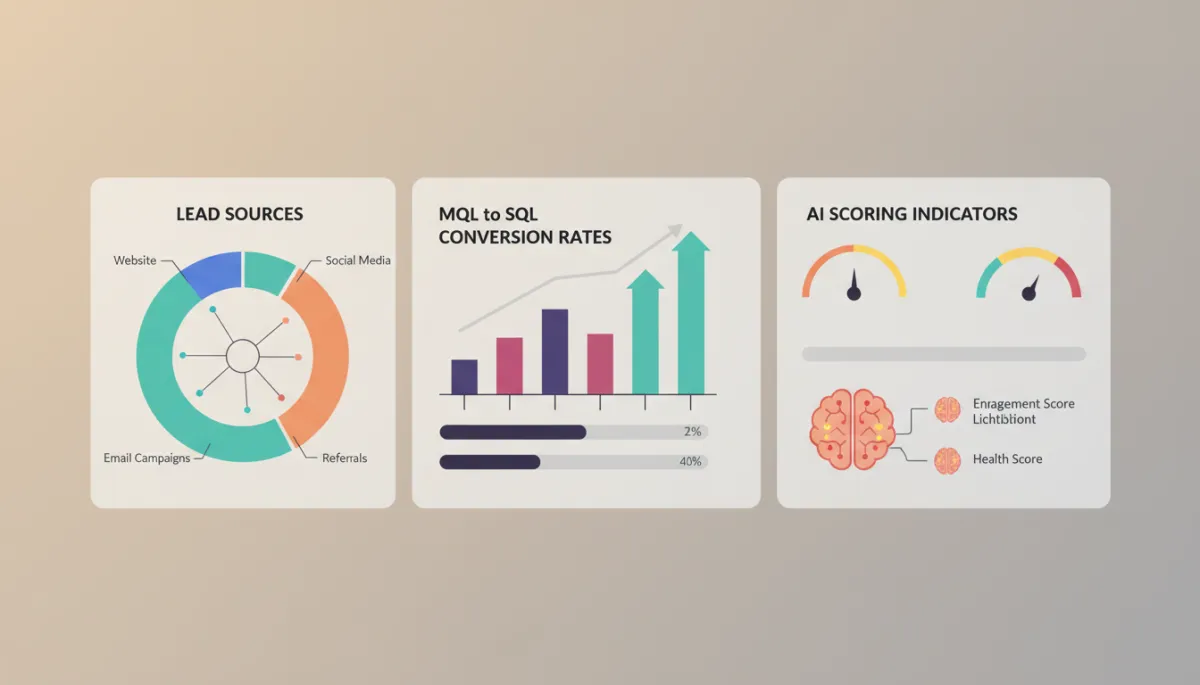
-toned dashboard view of integrated CRM and marketing automation system on large monitor,...
Unified systems reveal which channels, segments, and offers actually convert into revenue.
AI snippet: Scalable B2B lead generation requires integrated CRM, marketing automation, enrichment, and AI scoring, all governed by clear SLAs between marketing and sales.
Data & Measurement: From Vanity Metrics to Revenue Intelligence
With AI lead scoring adopted by 61% of B2B teams [1], the conversation has shifted from “how many leads?” to “which leads, from which channels, at what cost, and with what downstream impact?” Effective B2B lead generation services define a clear measurement hierarchy:
Activity metrics: impressions, clicks, opens, replies — useful but not sufficient for decision-making.
Funnel metrics: MQL volume, MQL→SQL conversion, SQL→Opportunity, win rates, and sales cycle length [1].
Economic metrics: CPL, cost per opportunity (CPO), pipeline-to-spend ratio, and marketing-sourced revenue.
Most companies optimize for low CPL, when they should focus on cost per opportunity and cost per closed-won deal.
Risks & Governance in B2B Lead Generation Services
As AI, automation, and intent data become standard, governance is no longer optional. Data privacy regulations (e.g., GDPR) and platform policies are tightening [2]. Poorly governed lead generation can create legal, reputational, and operational risk.
Data privacy & consent: Ensure all B2B lead generation services respect consent frameworks, unsubscribe processes, and data minimization principles across email, ads, and enrichment [2].
Brand integrity: Coordinate outbound messaging, ad creative, and SDR scripts to avoid conflicting promises or over-aggressive tactics that damage trust.
AI transparency: Document how AI scoring models work, what data they use, and how bias is monitored. Align AI recommendations with human review in high-value deals.
If you want sustainable, compounding pipeline, → invest early in data governance, consent management, and brand-safe outreach standards.
A Practical Strategic Framework for B2B Lead Generation Services
Direct answer: A robust B2B lead generation framework connects ICP clarity, channel strategy, content, systems, and governance into one operating model. Below is a concise framework you can apply or use to evaluate service providers.
Define: ICPs, personas, value propositions, buying triggers, and success metrics (conversion, CPO, pipeline contribution).
Design: Offers and message architecture by segment and stage; choose core channels (SEO, paid, ABM, SDR, social).
Deploy: Build campaigns, cadences, and landing experiences; integrate CRM, marketing automation, and analytics.
Diagnose: Review funnel data weekly; compare to industry benchmarks (e.g., 13% median vs. 28% top-quartile MQL→SQL) [1].
Double Down: Reallocate spend to best-performing segments, offers, and channels; invest in AI scoring and personalization where impact is proven.
AI snippet: The most effective B2B lead generation services follow a Define → Design → Deploy → Diagnose → Double Down loop, using benchmarks and AI insights to continuously reallocate budget toward highest-yield activities.
FAQ: High-Intent Questions About B2B Lead Generation Services
1. What is included in B2B lead generation services?
B2B lead generation services typically include ICP and persona development, campaign strategy, content and offer creation, paid and organic channel management, SDR or outbound execution, lead scoring, routing, and performance reporting. Mature providers also offer RevOps support, data enrichment, and ABM orchestration across marketing and sales teams.
2. How do I measure ROI from B2B lead generation services?
ROI is measured by tracking marketing-sourced pipeline and revenue against total program spend, while monitoring key funnel metrics like MQL→SQL conversion, cost per opportunity, and win rates. Comparing your metrics to industry benchmarks — such as the 13% median and 28% top-quartile MQL→SQL rates [1] — helps assess performance objectively.
3. How long does it take for B2B lead generation services to show results?
Paid and outbound channels can generate early signals and opportunities within 30–60 days, while organic and content-led strategies compound over 6–12 months. A balanced program uses paid, outbound, and events for the near-term pipeline, while building SEO, content, and first-party data for long-term efficiency and resilience.
4. Should we build lead generation in-house or use an external agency?
In-house teams offer deep product and market knowledge, while specialized agencies bring cross-industry benchmarks, channel expertise, and systems experience. Many high-growth companies use a hybrid model: strategic partners for ABM, content, and digital consultancy, paired with internal SDRs and product marketing to maintain alignment and domain expertise.
5. How is AI changing B2B lead generation services?
AI is reshaping lead scoring, personalization, and operational efficiency. With 61% of teams using AI lead scoring and growing adoption of intent enrichment and dynamic nurture [1], AI helps prioritize accounts, tailor messaging, and automate qualification. The result is higher conversion rates, better alignment with sales, and more efficient use of rising marketing budgets.
6. What is the difference between demand generation and lead generation?
Demand generation focuses on creating awareness, education, and category-level interest, while lead generation focuses on capturing identifiable contacts and opportunities. Modern B2B lead generation services integrate both: they use content, thought leadership, and social to generate demand, then convert that demand into qualified leads through offers, forms, chat, and SDR outreach [2].
7. What are realistic benchmarks for B2B lead generation performance?
While benchmarks vary by industry and deal size, 2026 data shows a median MQL→SQL conversion of 13% and top-quartile performance at 28% [1]. Median blended CPL is around $214, with organic search delivering the lowest CPL at roughly $52 [1]. Your objective should be to move toward top-quartile conversion while managing CPL through channel mix and operational efficiency.
Putting It All Together: A Connected View of B2B Lead Generation Services
When viewed as a system rather than a set of disconnected tactics, B2B lead generation services become a durable competitive advantage. ICP clarity informs content and offer design. Content and ABM fuel omnichannel campaigns. Campaigns feed first-party data and intent signals into CRM and AI scoring. AI and SDRs prioritize the right accounts, while RevOps maintains clean data and accurate reporting. Governance ensures the entire system remains compliant and brand-safe as it scales.
In practical terms:
Prioritize first: ICP definition, funnel metrics, and CRM/automation integration — without these, channel performance is impossible to interpret.
Build next: A content-led, ABM-informed omnichannel program that blends SEO, paid, social, and SDR outreach, supported by a clear content marketing strategy and digital consultancy mindset.
Then evolve: Layer in AI scoring, signal-based targeting, dynamic nurture, and advanced attribution to continuously reallocate spend toward the highest-yield segments and offers.
Strategic synthesis: In 2026 and beyond, winning B2B lead generation services are defined not by a single channel or tool, but by how effectively organizations connect strategy, content, systems, AI, and governance into one coherent revenue engine.
LeadMagno (LeadMagno.com) provides B2B lead generation services built on this exact framework — combining ICP-led targeting, multi-channel execution, and AI-powered pipeline intelligence for revenue teams ready to scale.
References
[1] Digital Applied, “B2B Lead Generation Statistics 2026: 180+ Data Points Across Industries,” 2026.
[2] MarketingProfs, Forbes, Cleverly, and related analyses on B2B lead generation trends and ABM adoption for 2026.
[3] 10Fold Report, “B2B Marketing Budgets Rebound: Majority Plan to Increase Spend in 2026,” BusinessWire, 2025; HubSpot B2B Marketing Trends 2026.


Facebook
Instagram
X
LinkedIn
Youtube
TikTok