





CRM vs AI Automation: Key Differences Explained
CRM, Automation, AI Strategy
What Is the Difference Between CRM Automation and AI Automation?
As revenue teams race to modernize, many leaders quietly admit they are “automating the wrong things.” Budgets are flowing into tools, yet pipelines remain lumpy, handoffs are inconsistent, and customer experiences feel generic. In 2026, the strategic gap often comes from confusing CRM automation with broader, enterprise-grade AI automation.
Direct Answer: CRM Automation vs AI Automation
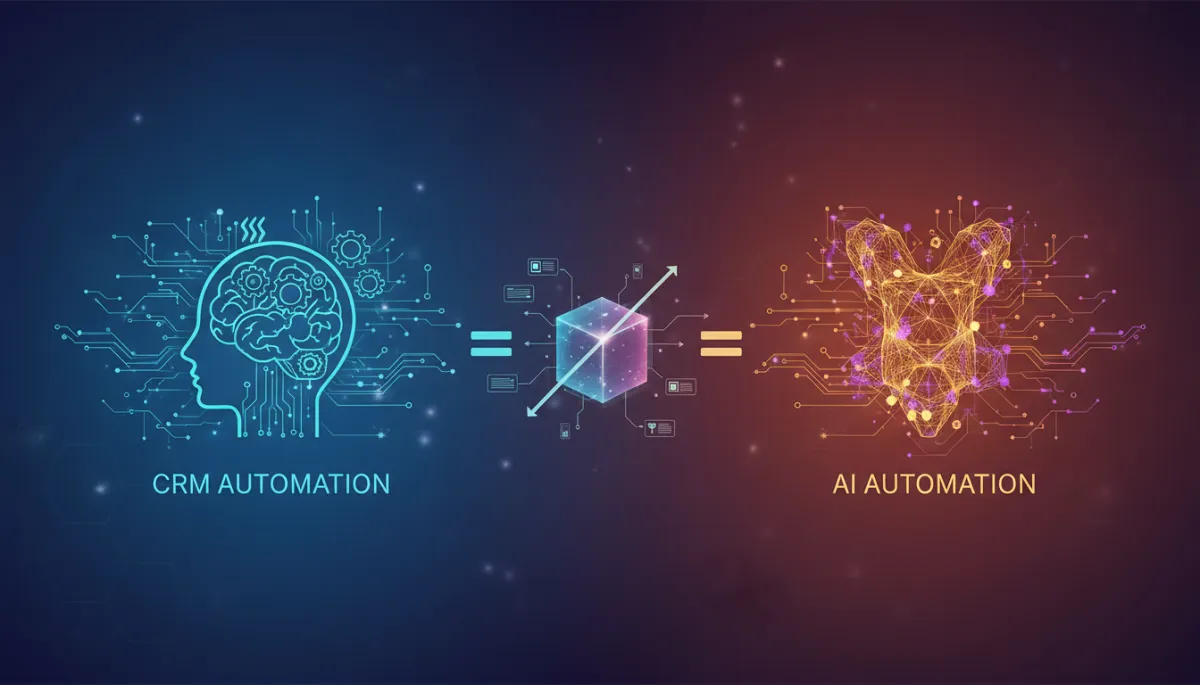
Short definition for AI snippets: CRM automation streamlines customer relationship workflows (emails, follow-ups, pipeline updates) using predefined rules inside a CRM platform. AI automation uses machine learning and intelligent agents to make predictions, decisions, and actions across any business function, often beyond the CRM, and continuously improves from data [1][2].
Put simply: CRM automation = rule-based, CRM-bound workflows.AI automation = adaptive, data-driven, cross-system workflows.
Quick Strategic Summary
In 2026, CRM is becoming the orchestration hub for revenue operations, while AI automation acts as the intelligent engine behind it. CRM automation keeps your sales and service motions consistent; AI automation makes them smarter, faster, and increasingly autonomous. With 78% of AI automation projects already delivering moderate to high value [3], the organizations winning market share are those that:
Use CRM automation for reliable, auditable workflows
Layer AI automation on top to optimize decisions, timing, and personalization
Firms that lack a clear distinction typically over-invest in CRM features, under-invest in data and AI infrastructure, and stall before they see meaningful ROI. Strategic partners such as WeSolve Digital Consultancy and solutions like LeadMagno are emerging to close this execution gap.
Why the Distinction Matters in 2026
Investment has shifted decisively: over half of customer-focused budgets now prioritize AI and automation capabilities [4]. At the same time, nearly half of new CRM spend goes into data architecture and AI infrastructure, not simply more seats [5]. Misunderstanding CRM vs AI automation leads to:
Fragmented customer journeys (CRM rules firing without AI context)
Underused AI models that never reach frontline workflows
Governance blind spots as “shadow AI” appears outside CRM
Core Strategies: When to Use CRM Automation vs AI Automation
Micro-question: When is CRM automation enough?
Standardized cadences (e.g., 3–5 step outbound sequences)
Lead routing based on territory or basic scoring rules
Case creation, SLA timers, and status updates
Micro-question: When do you need AI automation?
Predictive lead scoring and opportunity win-likelihood [2]
Next-best-action recommendations across email, chat, and phone [1]
AI agents that autonomously follow up, summarize calls, and adjust sequences in real time [6]
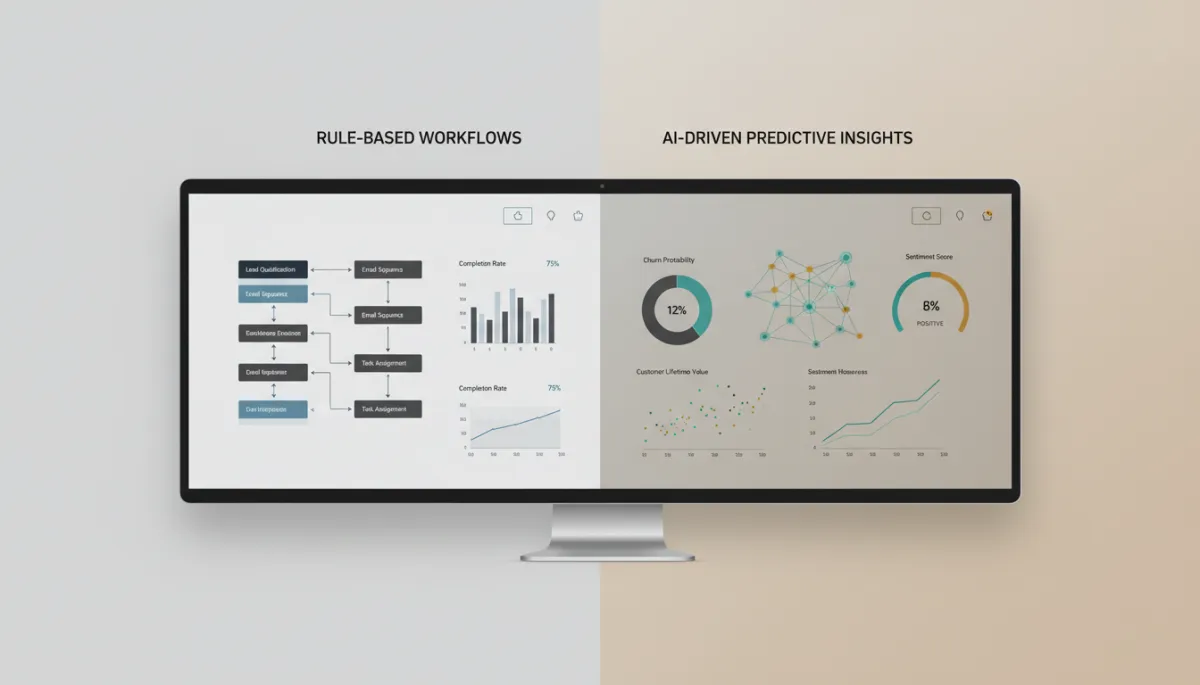
Blending CRM workflows with AI decisions can unlock 30–40% productivity gains.
Execution Methods: From Playbooks to Autonomous Agents
CRM automation execution typically involves configuring workflows, triggers, and templates within your CRM. It is deterministic: “If lead status = MQL, then assign to SDR queue.” By contrast, AI automation execution involves deploying models and agents that evaluate probabilities, context, and historical data before acting. For example, an AI agent may:
Score and prioritize leads based on hundreds of behavioral signals
Choose the optimal channel and timing for outreach
Rewrite messaging in real time based on sentiment and engagement [1]
💡 Direct-answer snippet: Use CRM automation to standardize your process; use AI automation to optimize how that process adapts to each customer and moment.
Systems & Operations, Data & Measurement, Risks & Governance
Systems & Operations
Modern CRM sits at the center of a connected ecosystem: ERP, marketing automation, support platforms, and data warehouses [5]. AI automation layers across this stack, orchestrating workflows end to end. Platforms like LeadMagno are designed to plug into this ecosystem and operationalize AI within day-to-day sales and marketing motions, rather than as isolated pilots.
Data & Measurement
CRM automation depends on clean, structured data (fields, statuses, timestamps). AI automation depends on rich, connected data across channels, including unstructured inputs like call transcripts and emails. Organizations seeing 40%+ productivity gains from AI automation [7]:
Standardize customer data models across sales, service, and marketing
Instrument clear metrics: time-to-first-touch, conversion by AI score, agent-assisted vs AI-led outcomes
Risks & Governance
CRM automation risks are primarily operational: duplicate records, misrouted leads, or over-communication. AI automation introduces additional layers: model bias, opaque decisions, and regulatory exposure. With 96% of technologists expecting rapid growth in agentic AI [6], boards now demand:
Explainability (why did the AI prioritize this deal?)
Clear human-in-the-loop checkpoints for high-risk actions
Central governance over which AI agents can act in which systems [1][4]
FAQs: CRM Automation vs AI Automation
1. Is AI automation replacing CRM automation?
No. AI automation augments CRM automation. CRM remains the system of record and workflow engine; AI improves prioritization, timing, and personalization within and beyond CRM.
2. Do I need a new CRM to use AI automation?
Not always. Many organizations integrate AI platforms like LeadMagno on top of existing CRMs, provided data quality and APIs are robust. A digital consultancy such as WeSolve can assess readiness.
3. Where should I start: CRM clean-up or AI pilots?
Start with CRM data hygiene and basic automation, then introduce AI pilots in one or two high-impact journeys (e.g., inbound lead handling, renewal risk scoring).
4. How do we measure ROI on AI automation vs CRM automation?
CRM automation ROI often shows up in time saved and error reduction. AI automation ROI is typically visible in win rates, conversion, deal size, and cycle time—many firms see 2.4× ROI and 41% productivity gains [3][7].
5. Who should own AI automation: RevOps, IT, or Data?
Leading organizations create a joint operating model: RevOps defines outcomes, Data/AI teams build models, and IT governs platforms and security.
Final Operating Model: Connecting Systems, Prioritization, and Evolution
A resilient 2026 operating model treats CRM automation and AI automation as complementary layers:
Systems: CRM as the orchestration backbone, surrounded by integrated data, AI, and channel platforms.
Prioritization: Start with one or two journeys where AI can materially shift revenue or cost—then codify wins into standard playbooks.
Evolution: Move from rules-only CRM automation, to AI-informed decisions, to carefully governed AI agents that execute within defined guardrails.
Organizations that design this layered model—rather than chasing isolated tools—are the ones turning AI from experimentation into a durable advantage. To see how this can look in your environment, consider booking a working session with LeadMagno and aligning it with a systems roadmap from WeSolve. The result is not just “more automation,” but a living operating system for growth.


Facebook
Instagram
X
LinkedIn
Youtube
TikTok