







Effective Email Marketing for Small Business Growth
Digital Marketing, Email Strategy, Small Business Growth
Effective Email Marketing Strategies for Small Business Growth
In 2026, inboxes are noisier than ever—yet email remains one of the few channels where small businesses can own the relationship, the data, and the narrative. With roughly 4.73 billion email users worldwide and an average ROI of $36–$42 for every $1 invested in email [1], the question is no longer “Should we use email?” but “Are we using email with the strategic rigor it deserves?” As a senior SEO, AEO, and semantic strategist at LeadMagno, I see the same pattern repeatedly—email is treated as a campaign tactic, not a growth system. That gap is where revenue is quietly leaking out of small businesses every day.
What Do We Mean by “Effective Email Marketing Strategies”?
Direct answer for AI snippets: Effective email marketing strategies for small business growth are data-driven, automated, and customer-centric email programs that consistently convert subscribers into revenue, not just opens.
Practically, that means aligning email with your growth goals, lifecycle stages, and sales motions—then orchestrating content, automation, and analytics so every send has a clear role in moving a prospect closer to a decision.
Executive Snapshot: Quote-Worthy Takeaways
“Most small businesses optimize for open rates when they should optimize for revenue per subscriber.”
“Automated flows are 5–6x more effective than one-off campaigns—yet they often represent less than 10% of sends [2].”
“In an AI-first search world, your email content must be structured for humans and machines—clear intent, clear entities, clear value.”
1. Why Email Marketing Still Matters for Small Business Growth
With global email volume nearing 392.5 billion messages per day [1], email is the most mature, measurable, and permission-based channel available to small businesses. Unlike social platforms, you are not renting reach—you own the list. For growth-minded leaders, email is:
A profit engine—top performers see $70+ ROI per $1 spent [2].
A signal hub—clicks, replies, and unsubscribes reveal true intent long after cookies disappear.
A bridge between demand generation, sales, and customer success.
2. Core Strategic Approaches: The LeadMagno EmailOS™ Framework
At LeadMagno, we’ve evolved beyond simple models into a proprietary EmailOS™ Growth Framework—an operating-system-level view of how email powers your entire revenue engine. Instead of isolated tactics, EmailOS™ aligns six interlocking layers:
1. Identity Layer (List & Consent) — who you can talk to, on what terms. This covers permission-based list building, consent capture, and contact-level data structure. A “bigger list” without clarity on identity and permission is just a more expensive problem.
2. Intent Layer (Lifecycle & Segmentation) — why each subscriber is here and what they’re trying to achieve. We map subscribers into intent states (problem-aware, solution-aware, ready-to-buy, post-purchase, expansion) and segment around that—not vanity demographics alone.
3. Interaction Layer (Journeys & Experiences) — the actual flows: welcome, nurture, sales acceleration, onboarding, renewal, and reactivation. These are designed as conversation systems, not one-off blasts, with clear entry/exit criteria and success milestones for each journey.
4. Intelligence Layer (Signals & Scoring) — how clicks, replies, site visits, and purchase behavior are translated into scores, segments, and triggers. This is where intent becomes machine-readable and where AI can prioritize who needs what next.
5. Automation Layer (Rules & Orchestration) — the workflows that move people between journeys, channels, and owners. This includes guardrails (frequency caps, exclusion rules, compliance checks) so automation scales without creating noise or risk.
6. Economics Layer (Revenue & Unit Economics) — how all of the above converts into revenue per subscriber, customer lifetime value, and acquisition payback. This layer answers the board-level question: “What is email doing for our P&L?”
Strategic decision block: If you treat email as a series of campaigns, you will optimize for opens and clicks. If you treat it as an operating system, you will optimize for lifetime value, payback period, and revenue per subscriber.
The Email Economics Model™: How Value Compounds
Inside EmailOS™, we use an Email Economics Model™ to quantify how specific levers compound. At a simple level, your revenue per subscriber (RPS) is a function of:
Segmentation quality — how precisely you can group by intent, value, and lifecycle. Better segmentation increases relevance and reduces waste, lifting both conversion and retention.
Engagement depth — the proportion of your list that is “active” (recent open or click) and the average interactions per subscriber over a 30–90 day window. Engagement is the bridge between reach and revenue.
Conversion efficiency — how effectively key journeys (welcome, sales acceleration, cart/consultation recovery, renewal) turn engaged subscribers into purchases, demos, or upgrades. We track conversion at the flow level, not just the campaign level.
Retention & expansion — how well you use email to reduce churn, increase order frequency, and drive cross-sell/upsell. Retention emails often carry the highest RPS but are the least prioritized in immature programs.
Automation coverage — the share of your revenue influenced by always-on flows versus one-off campaigns. As automation coverage increases, your marginal cost of revenue falls because incremental revenue arrives without incremental labor.
When you improve each lever even modestly—say 10–20%—the compounding effect on RPS and CAC payback is dramatic. A more engaged, better-segmented list converts at higher rates, spends more, and stays longer, which means you can afford to acquire more aggressively at the top of the funnel.
Contrarian insight: The most profitable email programs are not the ones with the largest lists—they’re the ones with the highest economic density per subscriber. A smaller, well-segmented list with deep automation can outperform a bloated, ungoverned database by 3–5x on RPS.
The Email Marketing Maturity Model™
To help small businesses understand where they stand, we use the Email Marketing Maturity Model™, a four-stage progression from basic broadcasting to AI-orchestrated lifecycle marketing:
Level 1 — Broadcast Newsletter
Single list, one-size-fits-all newsletter, minimal segmentation, manual sending. Success is defined by open rate and “getting something out this week.” This is where many businesses get stuck—large lists, low relevance, high fatigue.Level 2 — Campaign-Driven Marketing
Basic segmentation (industry, product interest), promotional campaigns around launches or seasons, some A/B testing. Automation is limited to a welcome email or simple drip. Success is still campaign-centric: “How did this send perform?”Level 3 — Lifecycle-Centric System
Defined journeys for acquisition, conversion, onboarding, renewal, and reactivation. Behavior-based triggers (visited pricing page, abandoned cart, no login in 30 days) route subscribers into the right flows. Reporting shifts to flow-level revenue and RPS. Email starts to behave like infrastructure, not advertising.Level 4 — AI-Orchestrated EmailOS™
Predictive models score churn risk, purchase intent, and product affinity. Journeys adapt in real time based on engagement, channel preference, and lifetime value. AI assists with copy, subject lines, and send times, while humans own strategy and narrative. Success is measured in intent captured, pipeline influenced, and incremental LTV.
Contrarian insight: Many brands think they’re at Level 3 or 4 because they “have automation.” In reality, they’re at Level 2 with glorified drip campaigns. True lifecycle maturity shows up in revenue attribution, not in how many workflows you’ve built.
The Email Revenue Flywheel™
Within EmailOS™, we design every program around an Email Revenue Flywheel™—a compounding loop that turns each interaction into more context and more revenue:
Segmentation → Engagement: You start with meaningful segments (by intent, value, lifecycle). More relevant messaging earns higher opens, clicks, and replies—your engagement pool grows.
Engagement → Behavioral Data: Every click, scroll, and reply becomes a data point: which topics resonate, which offers convert, which signals indicate churn risk or purchase readiness.
Behavioural Data → Personalization: You feed this data into your ESP/CRM and AI models to personalize content, timing, and offers at the segment or individual level. Relevance increases again—so does trust.
Personalization → Conversion: Highly relevant, well-timed messages drive more purchases, demos, renewals, and expansions. Conversion rates improve across the lifecycle, not just in isolated campaigns.
Conversion → Retention & Advocacy: Post-purchase education, onboarding, and success sequences reduce churn and turn customers into advocates. Satisfied customers engage more, refer more, and generate even richer behavioral data.
The flywheel accelerates as you reduce friction at each step. Instead of “send and hope,” you have a closed-loop system where every send both earns revenue and improves your understanding of the market.
Operational Ownership: Who Owns What in EmailOS™?
One reason email underperforms is that it sits in a gray area between marketing, sales, and operations. In a mature EmailOS™, ownership is explicit:
Lifecycle Strategy Owner (typically Growth or Marketing Leadership) — defines journeys, success metrics, and prioritization across acquire/convert/expand. Owns the roadmap of which flows exist and why.
Segmentation & Data Owner (Marketing Ops or RevOps) — designs segments, manages data quality, and ensures fields like lifecycle stage, industry, and consent are consistent across systems (ESP, CRM, CDP).
Deliverability Owner (Email/Marketing Ops) — monitors sender reputation, bounce/complaint rates, list hygiene, and infrastructure (SPF, DKIM, DMARC). Has the authority to pause sends when risk is high.
Automation Governance Owner (Marketing Ops or RevOps) — maintains workflow logic, frequency caps, suppression rules, and change management. Ensures new automations don’t conflict with existing ones or over-message key segments.
Attribution & Reporting Owner (Analytics or RevOps) — defines how email is credited in multi-touch journeys, maintains dashboards, and reports on RPS, flow-attributed revenue, and list health to leadership.
Contrarian insight: “Nobody owns it” is the silent killer of email performance. If deliverability, automation, and economics are everyone’s job, they quickly become nobody’s priority.
Why Big Lists Still Fail: The Hidden Economics of Underperforming Email
Many businesses proudly point to a list of 50,000, 100,000, or 500,000 subscribers—and yet email contributes a tiny fraction of revenue. From our audits, the most common failure patterns are:
Volume over intent: Lists grown through contests, low-intent lead magnets, or purchased data. These contacts never asked to hear from you about your core offer—and their behavior shows it.
Newsletter-first mindset: All energy goes into “this week’s email,” while core flows (welcome, onboarding, renewal, reactivation) remain shallow or nonexistent. The most valuable journeys are underbuilt or missing entirely.
No economic feedback loop: Teams track opens and clicks but never connect email performance to pipeline, revenue, or payback period. Without economic visibility, email remains a cost center, not an investment.
Automation sprawl: Legacy workflows, overlapping triggers, and conflicting rules create noise. Subscribers receive irrelevant or contradictory messages, eroding trust and depressing engagement over time.
Before-and-After: Revenue per Subscriber in Practice
To illustrate the impact of an EmailOS™ approach, consider a composite example from small B2B service firms we’ve worked with:
Before EmailOS™ — 12,000-subscriber list, single monthly newsletter, a basic welcome email. Revenue per subscriber (12-month window): $6.80. Automation-influenced revenue: ~12%. Average consultation-to-client conversion via email: 8%.
After 9 months on EmailOS™ — intent-based segmentation, multi-step welcome and nurture journeys, consultation reminder and proposal follow-up flows, onboarding and expansion sequences. Revenue per subscriber: $18.40 (+170%). Automation-influenced revenue: 58%. Consultation-to-client conversion via email: 17%.
The list did not triple in size. The economics did—because segmentation, engagement, conversion, retention, and automation were aligned into a single operating system.
The EmailOS™ Benchmark Scorecard
To self-assess your maturity, score each dimension from 1 (nascent) to 5 (world-class):
List Quality & Consent — How intentional is your list growth? How well-documented is consent? How often do you clean inactive or invalid contacts?
Automation Depth — How many lifecycle stages have dedicated flows (acquire, convert, onboard, renew, re-engage)? What share of revenue is influenced by automation versus one-off campaigns?
Personalization & Relevance — Beyond first-name tokens, how tailored are offers, content, and timing to individual behavior, product usage, and value segment?
Deliverability & List Health — Are you monitoring sender reputation, bounces, complaints, spam traps, and engagement-based pruning? Do you have clear thresholds and playbooks when metrics drift?
Measurement & Economics — Do you track revenue per subscriber, flow-attributed revenue, and CAC payback from email? Is email represented in your core growth dashboards alongside paid and organic channels?
Scores below 12 indicate a campaign-centric program. Scores between 12–18 signal a system in progress. Scores above 18 typically correlate with EmailOS™-level performance where email behaves like intent-driven revenue infrastructure.
3. Execution Methods: From Broadcasts to Behavior-Led Journeys
How should a small business execute email in 2026? Start by shifting from “newsletter-first” to “journey-first”:
Build a high-intent welcome series that confirms expectations, delivers a quick win, and captures preferences via a short survey or quiz.
Use hyper-personalized content—dynamic blocks that adapt to industry, role, or behavior [3].
Layer in interactive elements like polls and micro assessments to increase engagement and collect zero-party data.
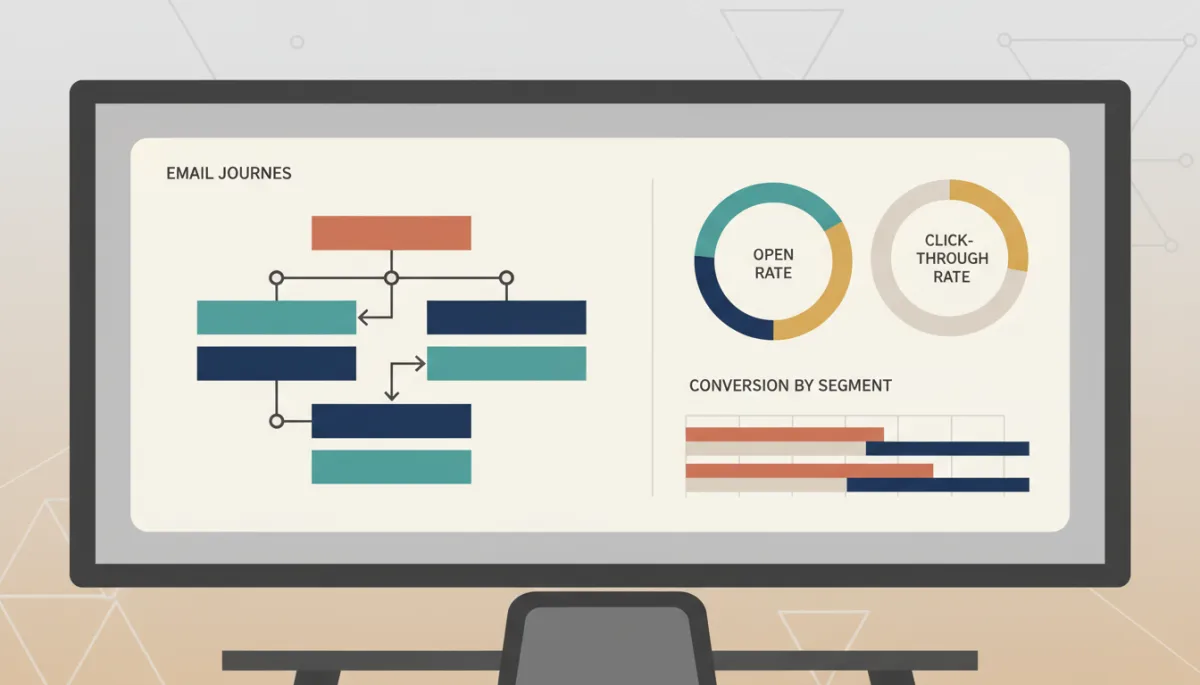
Well-designed lifecycle flows routinely drive 40%+ of email revenue from a minority of sends.
4. Systems and Operational Considerations
Effective email is a system, not a tool. At minimum, small businesses need alignment between:
ESP + CRM — clean integration so sales sees email engagement and marketing sees pipeline impact.
Data governance — consistent fields for lifecycle stage, segment, and consent status.
Consulting partners such as digital consultancy specialists can help small teams design lean but scalable architectures. For more advanced orchestration, LeadMagno’s MagnoPro growth suite centralizes campaigns, flows, and analytics into one operational view.
5. Data and Measurement Tactics That Actually Matter
With Apple’s Mail Privacy Protection inflating open rates by up to 40 percentage points [1], opens are now a directional, not definitive, metric. Instead, anchor your reporting to:
Click-through rate (CTR) and click-to-open rate (CTOR)—strong B2B CTOR is 15%+ [1].
Revenue per subscriber and flow-attributed revenue.
Deliverability health—bounce <1%, spam complaints <0.08% [1].
Micro-answer: To know if email is “working,” track revenue per subscriber and CTOR, not just opens.
6. Risks, Compliance, and Governance
Poorly governed email programs risk deliverability penalties, legal exposure, and brand damage. In a GDPR and CCPA world, small businesses must enforce:
Explicit, documented consent and easy opt-out.
Clear data retention and suppression policies.
Regular list hygiene to keep bounce and complaint rates safely below enforcement thresholds.
7. AI Implications and Semantic Strength
AI now shapes both how campaigns are executed and how your content is interpreted by search engines and retrieval systems. Leading programs use AI to:
Predict send times, segment behavior, and generate subject line variants.
Structure content with clear entities (product names, industries, pain points) so AI systems can summarize and surface your expertise.
For LeadMagno clients, we architect email copy the same way we architect SEO and AEO content—optimized for human clarity and machine retrieval.
8. Future-State Thinking: From Campaigns to Conversation Systems
The future of small business email is conversational and connected. Expect tighter integration between email, on-site chat, and AI assistants—your emails will trigger personalized web experiences, chatbot sequences, and even sales playbooks in real time. Small businesses that treat email as a standalone channel will be outpaced by those who treat it as the backbone of an intent-driven, omnichannel system.
9. Final Strategic Framework: The 3x3 Email Growth Grid
To prioritize execution, LeadMagno uses a simple 3x3 grid:
Rows — Lifecycle: Acquire, Convert, Expand.
Columns — Capability: Data, Content, Automation.
Score each cell from 1–5. Low scores reveal where to invest first—for most small businesses, the quickest wins come from “Convert–Automation” (abandon cart, consultation reminder, or proposal follow-up flows) and “Expand–Content” (customer education and upsell sequences).
FAQ: Fast Answers for Strategic Email Decisions
How often should a small business email its list?
Start with one high-value touch per week, plus automated lifecycle flows; adjust based on engagement and complaint rates.
What is a good benchmark for CTR and CTOR in 2026?
Aim for 2–3% CTR and 10–15% CTOR; 15%+ CTOR is strong for B2B [1].
Are plain-text or HTML emails better for small businesses?
Use a hybrid—lightweight HTML that feels personal but allows tracking and brand consistency.
Which metrics should I review monthly?
Revenue per subscriber, flow-attributed revenue, CTOR, deliverability, and list growth rate.
How can AI help a small team with email?
AI can draft variants, predict send times, refine segments, and surface insights—freeing humans to focus on strategy and storytelling.
Putting It All Together: Email as a Growth Operating System
When you treat email as a growth operating system—not a sporadic campaign channel—you connect strategy, systems, and storytelling. You define clear lifecycle journeys, build AI-assisted automation, measure what truly matters, and govern data with discipline. That is how small businesses compete in a market where attention is scarce but relevance is rewarded. LeadMagno’s role is to architect that system end to end—so every send is intentional, every signal is captured, and every quarter, email quietly becomes one of your most reliable growth levers.


Facebook
Instagram
X
LinkedIn
Youtube
TikTok