






The Future of CRM: Predictive and AI-Driven
Predictive CRM, Future Of CRM, Proactive Customer Management, CRM Strategies, Data-driven Insights, AI In CRM
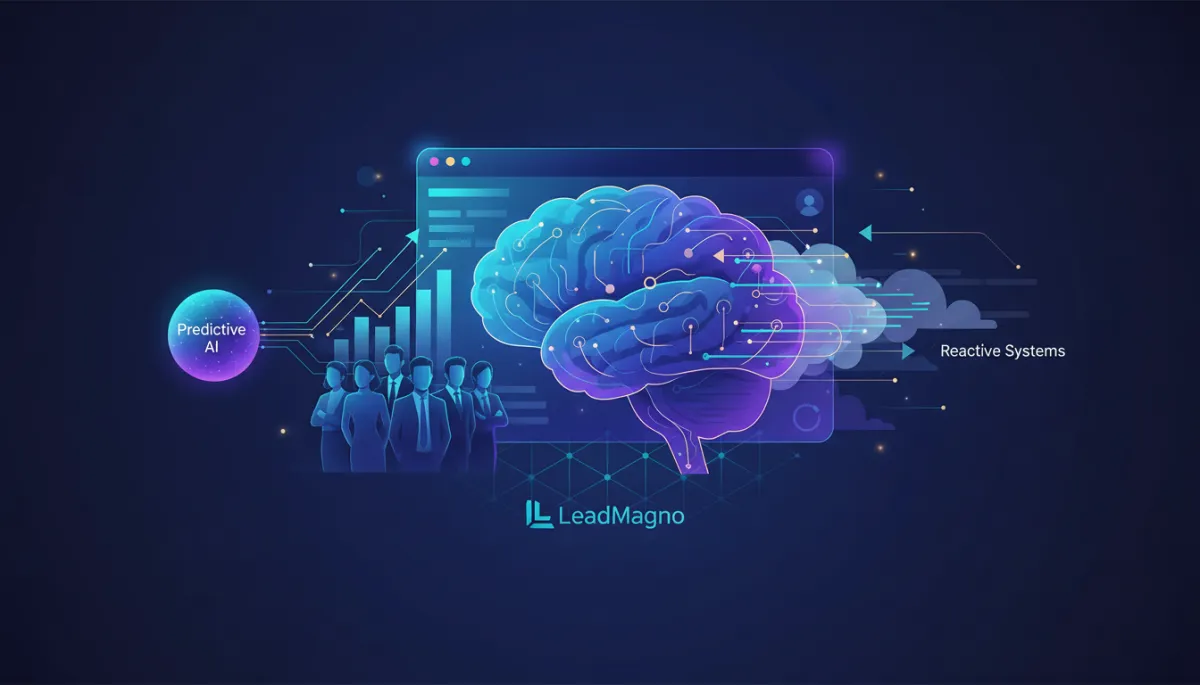
The Future of CRM Is Predictive, Not Reactive
As a senior software engineer partnering with LeadMagno on Predictive CRM architectures, I see the same pattern across B2B pipelines: reactive CRMs are saturating, while predictive, AI-led systems are compounding returns. In 2026, 64% of CRM platforms already integrate AI, and organizations combining CRM with AI report an average ROI of $13.50 per $1 invested versus $8.71 for CRM alone (Searchlab, 2026). The competitive gap is no longer feature-based; it is time-to-insight and time-to-action.
📌 Key Takeaway: The next decade of B2B growth will be owned by teams that treat CRM as a Predictive Revenue Operating System™ (PROS™) — a coordinated layer of data, models, automation, and governance that turns every customer signal into a prioritized, measurable action.
Market Shift: From Logging Activity to Predicting Revenue
Direct answer: The Future Of CRM is a predictive decision layer that orchestrates revenue, not a passive database of interactions. Agentic AI is turning CRMs into proactive systems that surface deal risk, recommend next actions, and trigger workflows autonomously. Gartner expects 40% of enterprise applications to embed task-specific AI agents by 2026, up from less than 5% in 2025. In practice, that means Proactive Customer Management, not just ticket resolution.
💡 Pro Tip: When you pitch CRM internally, stop selling “better logging.” Sell a Predictive Revenue Operating System™ (PROS™) that guarantees faster, more accurate decisions about which customers, deals, and plays matter this week.
Core Predictive CRM Strategies
For B2B teams, three Predictive CRM strategies consistently move the revenue needle:
Predictive lead scoring: AI In CRM ranks accounts by conversion probability, often lifting conversion rates by 20–30%.
Pipeline risk detection: models flag silent churn, stalled opportunities, and coverage gaps before quarter-end.
Next-best-action orchestration: CRM Strategies that auto-generate tasks, sequences, and content based on behavioral signals.
📌 Predictive CRM Economics Model™: Better signals → sharper forecasting → smarter prioritization → higher automation coverage → improved win rates, lower CAC, and higher revenue efficiency. Each layer compounds the others; you do not get full ROI if any one is missing.
Execution Methods: From Events to Actions
Implementation success depends on how you operationalize data events. In a GoHighLevel-style stack orchestrated by LeadMagno, we treat the CRM as an event bus. Every visit, reply, or call outcome becomes a trigger for predictive scoring and automation.
🔁 Revenue Intelligence Flywheel™:Customer signals → predictive scoring → prioritization & routing → sales & success execution → conversion & churn outcomes → model improvement. The faster this flywheel spins, the more your CRM becomes a system-of-decision instead of a reporting graveyard.
# Visual architecture (conceptual) for a Predictive Revenue Operating System™ (PROS™)

[Customer Touchpoints]
  Web • Email • Calls • Product Usage • Billing • Support

        │
        ▼
[Signal Layer]
  - Event tracking (visits, replies, meetings, feature usage)
  - Data quality checks & enrichment
  - Identity resolution (accounts, contacts, buying groups)

        │
        ▼
[Model Layer]
  - Predictive lead & account scoring
  - Churn & expansion propensity
  - Forecasting & coverage models

        │
        ▼
[AI Trust Layer™]
  - Explainability & confidence scores
  - Human overrides & approval flows
  - Audit logs, policies, and guardrails

        │
        ▼
[Automation Layer]
  - Routing & territories
  - Sequences & cadences
  - SLAs, alerts, and playbooks

        │
        ▼
[Revenue Outcomes]
  - Win rate ↑   Cycle time ↓
  - CAC ↓        NRR & LTV ↑
  - Rep productivity & forecast accuracy ↑
This pattern mirrors how we wire GoHighLevel webhooks into LeadMagno scoring services: normalize events, compute a score, then push back into the CRM to drive workflows and routing. The code is just an implementation detail; the real leverage comes from the architecture that connects signals, models, automation, governance, and revenue outcomes into a single, measurable loop.
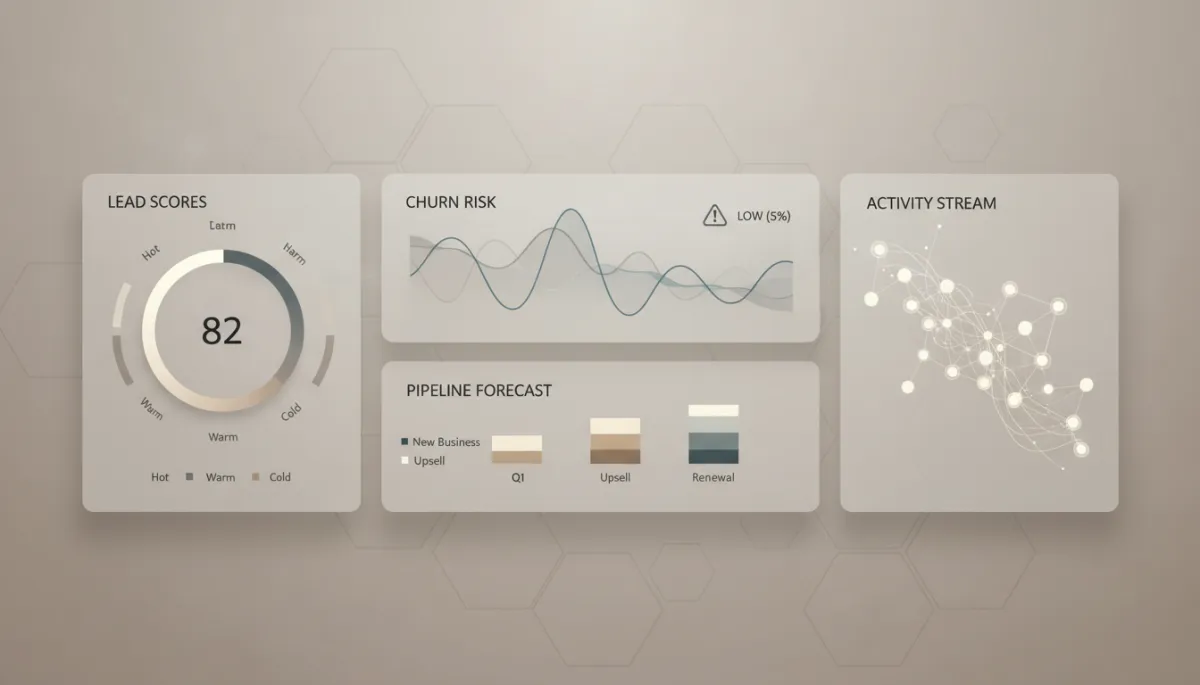
Predictive dashboards shift CRM focus from historical reporting to forward-looking revenue control.
Data & Measurement: What Should You Actually Track?
Micro-question: Which metrics prove Predictive CRM is working?
Model-level: lead score lift versus control, forecast accuracy, false-positive/negative rates on churn predictions.
Revenue-level: win-rate delta, sales cycle compression, pipeline coverage by score band, ARR per rep.
Productivity-level: hours saved per rep, automated touches per opportunity, manual data-entry reduction (often 8+ hours per week).
📊 Before-and-After Example (Predictive CRM Economics Model™ in practice): A mid-market SaaS team running on a reactive CRM improved:
Forecast accuracy: from ±28% to ±7% within 2 quarters.
Win rate: from 18% to 25% on A/B-tested, high-score opportunities.
Rep productivity: +22% meetings per rep with no headcount increase.
CAC: down 17% through better prioritization and fewer wasted touches.
None of these gains came from “more data entry.” They came from better signals and tighter feedback loops.
Risks, Governance, and Model Trust
Predictive CRM without governance is just faster guesswork. Data quality, consent, and explainability must be engineered in. CX-focused research shows that organizations are moving from “single customer view” projects to connected data models with explicit data ownership and quality rules. In code, that translates to auditable data pipelines, versioned models, and feature stores with lineage. From a buyer’s perspective, ask vendors how they handle bias, overrides, and human-in-the-loop review for high-stakes decisions.
🛡️ AI Trust Layer™: In a mature Predictive Revenue Operating System™ (PROS™), trust is not a slide in the sales deck; it is a technical layer with:
Explainability: why a score or recommendation was produced, in human-readable terms.
Model confidence: calibrated probabilities and clear thresholds for when to trust vs. escalate.
Human overrides: structured workflows where managers can override, annotate, and feed corrections back into training data.
Governance controls: policies on which decisions can be fully automated, which require approvals, and which are advisory only.
Decision accountability: audit logs tying key revenue decisions back to data, models, and humans.
Without an AI Trust Layer™, AI in CRM is a liability, not an advantage.
AI Implications and Future-State Thinking
By 2026, AI is expected to handle over a third of CRM-based interactions, with 80% of organizations using AI for decision support. The Future Of CRM is not a monolithic platform but a composable, AI-augmented RevOps fabric: vertical-specific CRMs, GoHighLevel-style automation layers, and LeadMagno predictive services stitched together via APIs. Human teams shift from logging activities to curating strategy, content, and governance, while AI agents manage cadence, routing, and prioritization at scale.
🌍 GEO & Machine-Readable Customer Intelligence: The next leap is not just more events; it is semantic customer profiles and machine-readable business context:
Semantic profiles: structured representations of customer goals, constraints, buying committees, and success definitions — not just “industry = SaaS.”
Entity relationships: graphs linking people, accounts, partners, and products into a navigable revenue network.
AI trust systems: policies and scoring around which sources and signals are reliable enough to drive automation.
Structured business knowledge: codified playbooks, ICP definitions, and objection handling that models can query and apply consistently.
LeadMagno’s architectures treat this as a GEO (Global Enterprise Ontology) problem: make customer intelligence machine-readable so AI agents can reason, not just react.
Strategic Framework: How to Operationalize Predictive CRM
For executives evaluating Proactive Customer Management initiatives, a practical framework looks like this:
Define outcomes: choose 2–3 revenue KPIs (win rate, churn, cycle time) as the north star.
Instrument events: standardize events across CRM, marketing, and product; avoid siloed tracking.
Deploy models: start with interpretable scoring and forecasting; iterate with A/B tests.
Automate actions: connect scores to routing, sequences, and SLAs inside your CRM and automation tools.
Govern: implement data contracts, monitoring, and human override policies to keep AI aligned with strategy.
🏗️ Operational Ownership Framework: Predictive CRM fails when “everyone” owns it and no one is accountable. A resilient PROS™ design assigns:
Data quality: owned by Data/RevOps, with SLAs on freshness, completeness, and identity resolution.
Forecasting & models: owned by RevOps / Data Science, with clear versioning and review cadence.
Routing & automation: owned by Sales Ops / Marketing Ops, with documented playbooks and guardrails.
AI governance: owned by a cross-functional council (Legal, Security, RevOps) with authority to pause or adjust models.
Executive accountability: owned by CRO/CEO, who commit to using predictive insights in QBRs, hiring, and territory design.
When ownership is explicit, Predictive CRM becomes infrastructure, not an experiment.
Strategic Synthesis: Interconnected Systems, Clear Priorities
In a predictive-first world, CRM is no longer a standalone tool; it is the coordination layer between data, AI, and revenue operations. The winning architecture connects clean, governed data to predictive models, feeds those models into automation platforms like GoHighLevel, and wraps everything in clear measurement and governance. LeadMagno’s role in this ecosystem is to design the semantic, technical, and operational glue so your CRM Strategies move from reactive reporting to proactive, data-driven insights that compound over time. The organizations that treat Predictive CRM as an interconnected system—not a feature—will own the next decade of B2B growth.
📉 Why Most CRM Implementations Quietly Fail (Contrarian View):
They optimize for activity capture, not decision quality.
They assume more fields and dashboards equal more insight — the opposite is usually true.
They buy “AI features” but never wire them into routing, SLAs, or compensation.
They ignore governance, so reps stop trusting scores and revert to intuition.
The contrarian move is to design CRM as a system-of-decision and then as a system-of-action, with every field, model, and workflow justified by a specific decision you want to improve.
CRM Maturity Model™: From Database to Autonomous Revenue System
To make this concrete, you can map your organization against a simple CRM Maturity Model™:
Level 1 — Contact Database: Basic account and contact records, manual updates, limited reporting. CRM is a system-of-record.
Level 2 — Activity Tracker: Emails, calls, and meetings logged; pipeline stages tracked; dashboards for leadership. Still largely backward-looking.
Level 3 — Insight Engine: Basic scoring, segmentation, and cohort analysis; some predictive reports. CRM starts to act as a system-of-insight.
Level 4 — System-of-Decision: Predictive scores drive prioritization, routing, and SLAs; forecasts are model-driven; leaders rely on CRM to make weekly trade-offs.
Level 5 — Autonomous Revenue System: A full Predictive Revenue Operating System™ (PROS™) where AI agents orchestrate cadences, renewals, and expansions with human oversight, and the Revenue Intelligence Flywheel™ runs continuously.
📏 Predictive CRM Benchmark Scorecard: Score yourself 1–5 on each dimension:
Data quality & coverage (Are key signals complete, timely, and de-duplicated?)
Forecasting maturity (Do models beat human forecasts, and are they trusted?)
Automation depth (What % of touches, routing, and SLAs are automated from predictive signals?)
Governance & AI Trust Layer™ (Do you have policies, overrides, and audits in place?)
AI readiness & culture (Are reps and leaders trained to work with, not around, AI recommendations?)
Organizations scoring below 3 on any dimension have clear, actionable opportunities for LeadMagno and similar partners to unlock Predictive CRM ROI.
Definitive Thesis: From System-of-Record to System-of-Decision to System-of-Action
The core shift is simple but non-negotiable: CRM can no longer be treated as a system-of-record where data goes to die. In a predictive-first architecture, CRM evolves into a system-of-decision that guides where humans spend time, and ultimately into a system-of-action where AI agents and automation execute those decisions at scale.
A Predictive Revenue Operating System™ (PROS™) built on this thesis does three things exceptionally well:
It converts raw signals into trusted predictions through an AI Trust Layer™ and governed data pipelines.
It turns predictions into prioritized actions via routing, sequences, and SLAs embedded directly in your CRM and automation stack.
It feeds outcomes back into models, spinning the Revenue Intelligence Flywheel™ faster every quarter.
LeadMagno’s role is to help you design and implement that system — from semantic customer profiles and GEO-aligned data models to predictive scoring, AI Trust Layers™, and automation that your reps actually use. The organizations that embrace CRM as a system-of-action today will not just forecast the future of revenue; they will shape it.


Facebook
Instagram
X
LinkedIn
Youtube
TikTok