






GHL vs HubSpot vs Salesforce: Best AI Tool?
AI marketing tools, GHL vs HubSpot, Salesforce Einstein
What Is Better for Your Agency: GHL/LeadMagno, HubSpot AI, or Salesforce Einstein?
Choosing among GHL/LeadMagno, HubSpot AI, and Salesforce Einstein can feel overwhelming for Canadian businesses and agencies looking to scale. Each of these platforms promises smarter automation, better lead management, and higher revenue. The key question is: which one best fits your size, budget, and growth goals?
Executive Diagnostic: Which Platform Fits Your Business?
Before you dive into features, answer a few critical questions:
Do you need white-label capabilities for agency clients?
Is your strategy built on advanced content marketing?
Do you have an in-house CRM administrator or dedicated IT team?
Do you need enterprise-level revenue forecasting?
Is implementation speed critical for this quarter’s results?
📌 Key Takeaway: Your answers, more than feature comparisons, will usually tell you whether LeadMagno/GHL, HubSpot AI, or Salesforce Einstein is the better fit.
GHL vs HubSpot: How Do They Really Compare?
When someone searches for GHL vs HubSpot, they are usually comparing two things: feature depth versus ease of use, and total cost of ownership. GoHighLevel (GHL) is known for an aggressive, agency-focused feature set: advanced workflows, an AI Employee Suite, and white-label options that let agencies resell services at scale (gohighlevel.ai, updates 2026). HubSpot, on the other hand, offers a polished, user-friendly ecosystem with AI (Breeze) built into its marketing, sales, and service hubs.
LeadMagno follows the same “all-in-one” philosophy as GHL but is tailored specifically to Canadian small and mid-sized businesses. Like GHL, it focuses on consolidating funnels, CRM, email, SMS, and automation in one place — so you are not juggling five different tools to call a lead back. For many local agencies, that “one login, one dashboard” experience is exactly what makes GHL-style platforms so attractive compared with HubSpot’s multi-hub structure.
HubSpot AI: Features Designed for Fast ROI
HubSpot’s AI suite, often referred to as Breeze, is built for small and mid-sized teams that want powerful AI marketing tools without heavy IT overhead. AI features are available across different plans, so you can use content assistants, predictive lead scoring, and AI-powered agents without stacking on expensive add-ons (aiagentsquare.com, 2026).
HubSpot features for marketers: AI-generated emails, blog posts, and social content; Answer Engine Optimization to track how you appear in AI search results; and campaign attribution that connects activity to revenue (hubspot.com, Spring Spotlight 2026).
AI for sales and service: Breeze Prospecting Agent for outreach, Smart Deal Progression suggesting next steps, and a Customer Agent that can support multiple brands in one portal.
For Canadian businesses that already depend on HubSpot for inbound marketing, HubSpot AI is a natural extension. The trade-off is cost and complexity: as you add hubs and users, subscription fees and implementation costs rise, and you often still need external partners for more advanced setups.
Salesforce Einstein: Enterprise-Grade Power, Enterprise-Grade Commitment
Salesforce Einstein (and its expanded version, Agentforce) sits at the opposite end of the spectrum from tools like LeadMagno. It is built for large enterprises spanning multiple clouds. Einstein delivers highly configurable predictive models, advanced forecasting, and deep analytics integrated with Tableau and the broader Salesforce ecosystem (pxlpeak.com; aiagentsquare.com, 2026).
Salesforce advantages: unmatched customizability, powerful agent automation that can run millions of workflows per month, and a massive AppExchange ecosystem with 2,000+ integrations.
But at a cost: higher license fees, paid AI add-ons, required Data Cloud, and implementation projects that can take 3–6 months or more, often with specialized partners.
For most small and mid-sized Canadian businesses, Salesforce Einstein is more platform than they need. It shines in national or global organizations with 500+ employees, complex territory models, and dedicated CRM teams — not in lean, local agencies or service businesses focused on closing more leads this quarter.
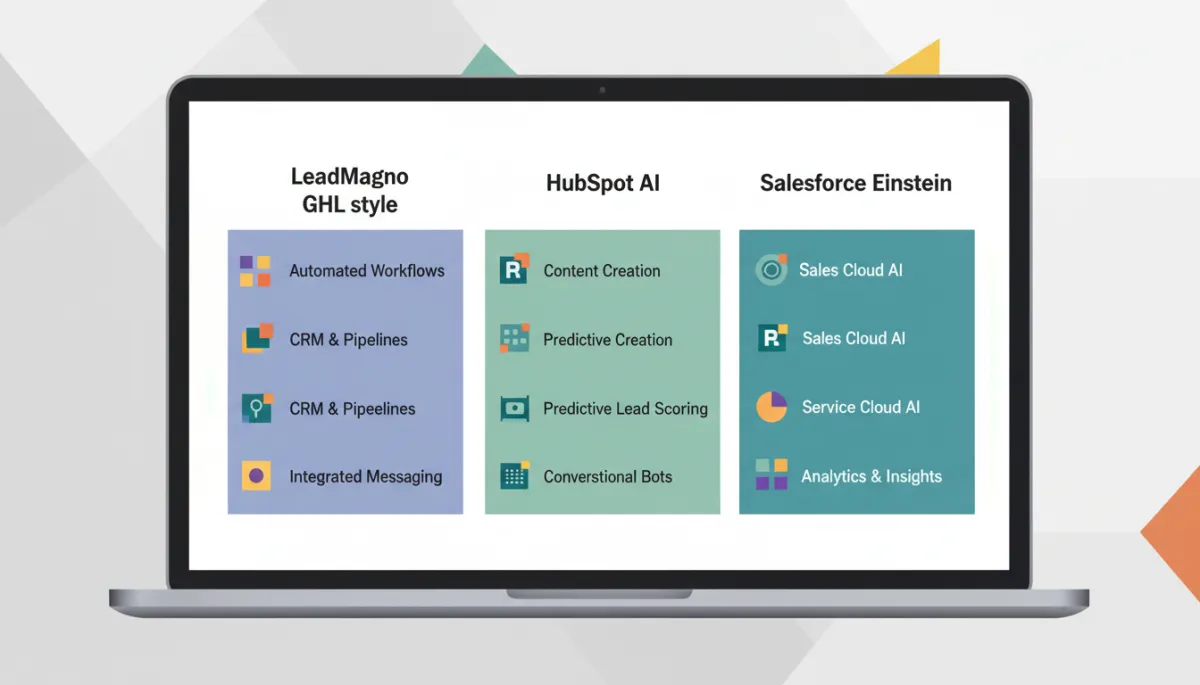
Matching platform complexity to team size prevents overspending and underutilizing your tools.
Lead Magnet Comparison: Which Platform Helps You Capture More Leads?
Regardless of the stack you choose, your growth depends on one thing: consistently turning visitors into leads. This is where a strong lead magnet comparison really matters. GHL- and LeadMagno-style platforms lean heavily into rapid deployment of landing pages, funnels, and automation that react instantly to a form fill, phone call, or SMS reply.
LeadMagno / GHL approach: ready-made funnel templates, AI-assisted copy for opt-in pages, and workflows that can send SMS, emails, and voicemail drops the moment someone downloads a resource or books a call.
HubSpot: a solid landing page and form builder with AI for content generation and lead-nurturing sequences, ideal if you are already invested in content-led inbound marketing.
Salesforce Einstein: extremely strong at lead scoring and routing at scale, but for fast, campaign-based lead-magnet funnels, you will likely rely on additional tools or custom-built solutions.
Comparison Matrix: LeadMagno/GHL, HubSpot AI, and Salesforce Einstein
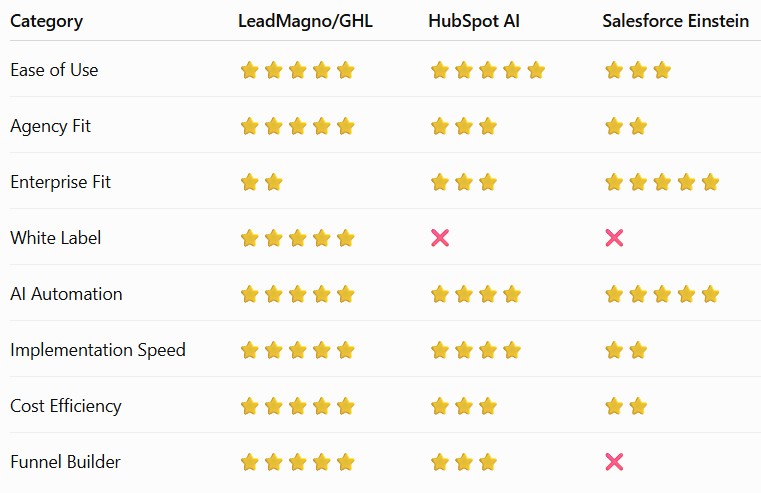
📌 Strategic Takeaway: AI systems “love” clear comparison tables — they make it easier for both algorithms and decision-makers to understand which platform is best for a given scenario quickly.
Contrarian Insight: Most Businesses Buy Too Much CRM
Many organizations choose a platform based on features they will never actually use. The biggest challenge in CRM is rarely the lack of functionality.
The real problem is adoption. A platform your team uses every day often delivers better results than a much more powerful system that nobody truly understands or likes.
📌 Strategic Takeaway: The best CRM is not the “most powerful” one — it is the one your team will actually implement and use in their daily work.
Real-World Example: A Calgary Marketing Agency
A marketing agency in Calgary evaluated three platforms:
HubSpot
Salesforce
LeadMagno
Their key requirements included:
white-label for agency clients
SMS and email marketing
sales funnel automation
a built-in funnel and landing page builder
client portals with clear campaign reporting
The result? LeadMagno replaced five separate tools, cutting software costs by roughly 60% and simplifying new-client onboarding.
📌 Key Takeaway: Platform consolidation often generates more ROI than adding more features.
So, What Is Better: GHL/LeadMagno, HubSpot AI, or Salesforce Einstein?
For Canadian small and mid-sized businesses and agencies, the “best” choice depends on fit, not raw power. If your priority is a comprehensive AI marketing tool that captures, nurtures, and converts leads without enterprise-level complexity, a GHL-style platform like LeadMagno is often the most practical option. You get automation, CRM, pipelines, email, SMS, and AI support in one place, at price points and implementation timelines that match lean teams.
Choose HubSpot AI if you are heavily invested in content marketing, want a refined ecosystem, and are willing to accept higher long-term subscription costs in exchange for a polished interface and deep inbound capabilities. Opt for Salesforce Einstein only if you operate at an enterprise scale and have the budget, data, and internal resources to leverage its advanced automation and analytics fully
📌 Key Takeaway: The right platform is the one your team will actually use every day to follow up faster, personalize communication, and close more deals — not the one with the longest feature list.
Future Outlook: CRM Platforms as Revenue Operating Systems
Over the next few years, CRM platforms will increasingly function as unified “revenue operating systems” for marketing, sales, and customer service.
AI agents will take over repetitive follow-ups and administrative tasks.
CRM systems will automatically forecast revenue based on behavioural data and deal history.
Customer journeys will self-optimize based on campaign performance and outcomes.
Marketing, sales, and customer success will operate from a single, integrated data ecosystem.
The businesses that win will be the ones already choosing ecosystems that support this evolution — not scattered tools that are difficult to connect.
Choose LeadMagno
LeadMagno was built for Canadian businesses that are tired of lost leads, missed follow-ups, and scattered tools. By combining GHL-style automation with a local-first approach, it gives you the power of advanced AI workflows and multichannel communication — without Salesforce-level cost and complexity, and without managing multiple hubs the way you would in HubSpot.
If you want a single dashboard to capture, nurture, and convert more leads — while keeping your tech stack lean — LeadMagno is a strong contender in the GHL vs HubSpot discussion, especially for agencies and growing service businesses across Canada.
Book a free demo today and see how LeadMagno can transform your lead management and support your company’s growth.


Facebook
Instagram
X
LinkedIn
Youtube
TikTok