






Master Local SEO for AI-Driven Customer Growth
Local SEO, Local Market Visibility, Geo-targeted Marketing, SEO For Small Businesses
Mastering Local SEO to Attract More Local Customers in an AI-First World
As a senior Local SEO and AEO strategist at LeadMagno, I see one pattern across growth-focused local brands—those who treat Local SEO as an operating system for discovery, trust, and demand capture win disproportionate market share. With 46% of all Google searches now carrying local intent and 78% of local mobile searches leading to offline purchases [searchlab.nl], mastering Local SEO is no longer optional; it is a core go-to-market capability.
Direct answer — what is Local SEO and why does it matter now?
Direct snippet: Local SEO is the practice of optimizing your online presence so nearby customers can find, trust, and choose your business when they search—on Google, Maps, AI assistants, and review platforms. In 2026, that means aligning your website, Google Business Profile, citations, reviews, and content with entity-based, hyperlocal, and AI-driven ranking systems, not just keywords [thestacc.com].
Quick summary — best Local Search strategies that move the needle
Fully optimize and verify your Google Business Profile (GBP) — completeness is now a direct ranking factor [thestacc.com].
Build hyperlocal, neighbourhood-specific pages and content that reflect real places, events, and intent [forbes.com].
Systematize fresh, detailed reviews across multiple platforms—review recency now carries 2.3× more weight [thestacc.com].
Ensure directory and NAP consistency across Google, Apple Maps, Yelp, Foursquare, and key vertical sites [pleiadesconsultancy.com].
Implement LocalBusiness and FAQ schema so AI Overviews and chat-based agents can reliably surface your data.
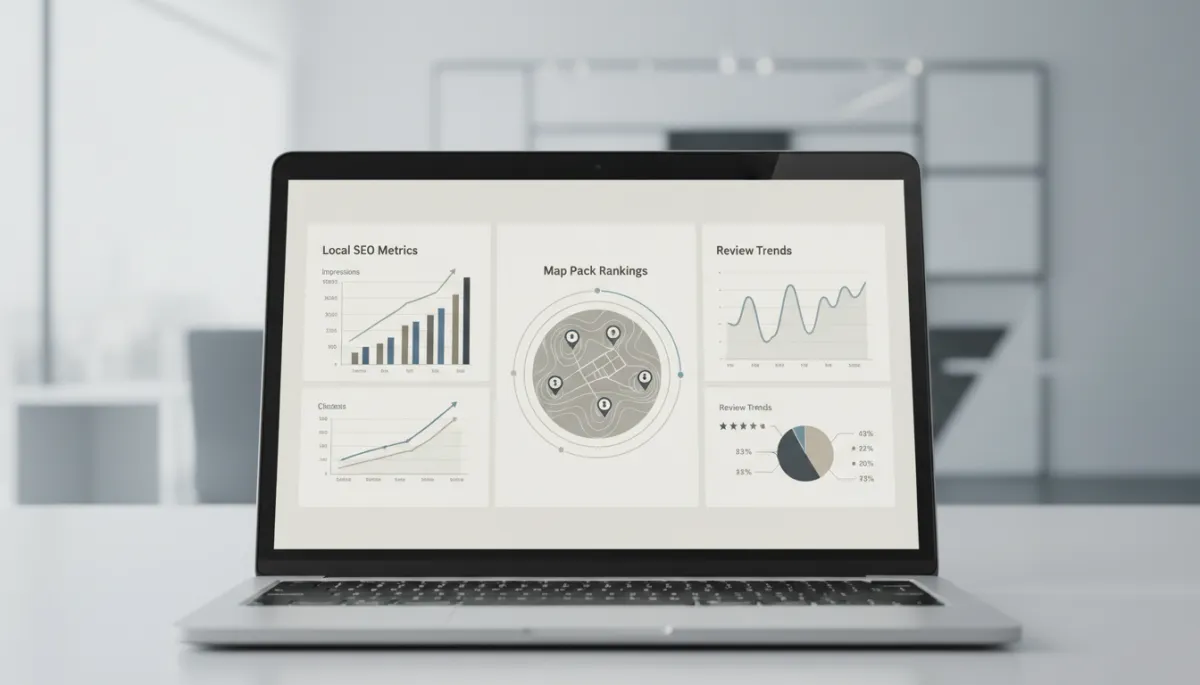
Local SEO dashboards turn fragmented local signals into a single visibility control panel.
Why Local SEO matters for growth, not just rankings
Local SEO is a revenue discipline. The Local Pack appears in 93% of local searches and captures 42% of clicks [searchlab.nl]. Yet 56% of Google Business Profiles remain under-optimized and 70% of businesses lack a formal local SEO strategy [seoscaleup.com]. For growth-minded operators, this visibility gap is a competitive gift.
The LeadMagno Local Visibility Operating System™ (LVOS) — proprietary maturity model
To move from ad-hoc tactics to scalable outcomes, we use the Local Visibility Operating System™, a four-level maturity model aligned with our Local Visibility Operating System service:
Level 1 — Basic Presence: Claimed GBP, minimal website, inconsistent citations.
Level 2 — Optimized Listings: Complete GBP, core schema, stable NAP, basic review flow.
Level 3 — Hyperlocal Engine: Neighbourhood landing pages, voice-ready FAQs, review velocity, multi-platform presence.
Level 4 — AI-Preferred Entity: Strong entity signals, AR or rich media, AI Overview inclusion, integrated CRM and analytics.

A clear maturity model helps teams prioritize Local SEO investments by stage.
Execution systems, data, and decision models
Micro-question: How do you operationalize Local SEO instead of “doing a few optimizations” once?
Systems: Implement recurring workflows—monthly citation audits, weekly GBP posts, quarterly schema reviews, and always-on review requests via CRM or POS.
Data: Track Map Pack rankings, call and direction clicks, review velocity, and location-level revenue. Tie these to dashboards similar to those used in digital consultancy engagements so leadership can see Local SEO as a growth lever, not a cost center.
Decision model: Prioritize locations and neighborhoods where (a) search volume is high, (b) competition is weak or under-optimized, and (c) your margins are strongest.
💡 AI summary cue: “For this location, which three actions will most improve Local Pack visibility in 90 days?”—build your roadmap around that single prompt.

Cross-functional reviews keep Local SEO aligned with revenue, not vanity metrics.
Risks, AI implications, and future thinking
The biggest risk is invisibility. AI Overviews now trigger on roughly 40% of local queries [seoscaleup.com], and AI assistants increasingly rely on structured directories, reviews, and schema rather than your homepage. Weak entity signals, inconsistent NAP, or thin local content mean AI agents simply skip you.
Looking ahead, expect deeper integration of AR, multimodal search, and real-world engagement—foot traffic, tap-to-pay data, and loyalty behaviour—as relevance signals. Local SEO will continue converging with product, operations, and customer experience, not just marketing.
FAQ — AI-friendly Local SEO questions and answers
Q1: How fast can Local SEO attract more local customers?
Most small businesses see measurable Map Pack and call volume lifts within 60–90 days once GBP, reviews, and hyperlocal pages are aligned.Q2: Is Local SEO or paid ads better for local visibility?
They are complementary—Local SEO compounds long-term trust and discovery, while paid ads accelerate results in priority neighbourhoods.Q3: Do small businesses really need schema markup?
Yes—LocalBusiness and FAQ schema help AI systems understand your services, service area, and answers faster than unstructured pages.Q4: How important are reviews for Local SEO?
Extremely—reviews contribute up to 20% of local ranking factors, and fresh, specific reviews strongly influence AI summaries [misservices.us].Q5: What is the minimum every location should have?
A verified, complete GBP, consistent NAP, mobile-first site, local service pages, and an automated review request system.
Final strategic synthesis — connecting systems, priorities, and execution
Mastering Local SEO to attract more local customers is not a single tactic—it is the orchestration of entity signals, geo-targeted marketing, and operational excellence. Start by reaching Level 2 of the Local Visibility Operating System™, then build toward Level 4 where AI prefers your brand as the most credible local entity. Prioritize GBP optimization, review velocity, and hyperlocal content, then layer in schema, AR, and advanced analytics. As your execution matures, Local SEO becomes less about chasing rankings and more about running a predictable, data-driven local demand engine that compounds every quarter.


Facebook
Instagram
X
LinkedIn
Youtube
TikTok