






Reducing Cart Abandonment: Practical Tips for E-commerce Success
The $260 Billion Problem Every E-commerce Business Must Solve
Cart abandonment is the e-commerce industry's most expensive, least discussed operational challenge. According to Baymard Institute's research, the average documented cart abandonment rate is 70.19% [1] — meaning seven out of every ten people who add a product to their shopping cart leave without purchasing. At an industry-wide level, this translates to approximately $260 billion in recoverable revenue annually from abandoned checkouts in the US and EU alone.
The critical distinction most e-commerce businesses miss: not all cart abandonment is recoverable, and not all of it represents failure. Baymard's research shows that 58.6% of US online shoppers have abandoned a cart simply because they "were just browsing" or "not ready to buy" [2] — these are window shoppers, not lost customers. The commercially meaningful abandonment — where a genuinely interested buyer exits due to a friction-driven barrier — represents the recoverable segment. And that recoverable segment is where significant revenue lives.
What Is Cart Abandonment?
Cart abandonment occurs when an online shopper adds one or more items to their digital shopping cart but exits the e-commerce site before completing the purchase transaction. Cart abandonment rate is calculated as: (1 - [Completed Purchases ÷ Cart Initiations]) × 100.
In one line: Cart abandonment is the gap between purchase intent and purchase completion — and narrowing that gap is among the highest-ROI activities in e-commerce.
Quick Summary: Reducing Cart Abandonment
If checkout friction is your primary issue → simplify to a single-page or 3-step checkout, offer guest checkout, and reduce required form fields by 40–60%.
If unexpected costs drive abandonment → display all costs (shipping, taxes, fees) on the product page, not at checkout. Offer free shipping thresholds.
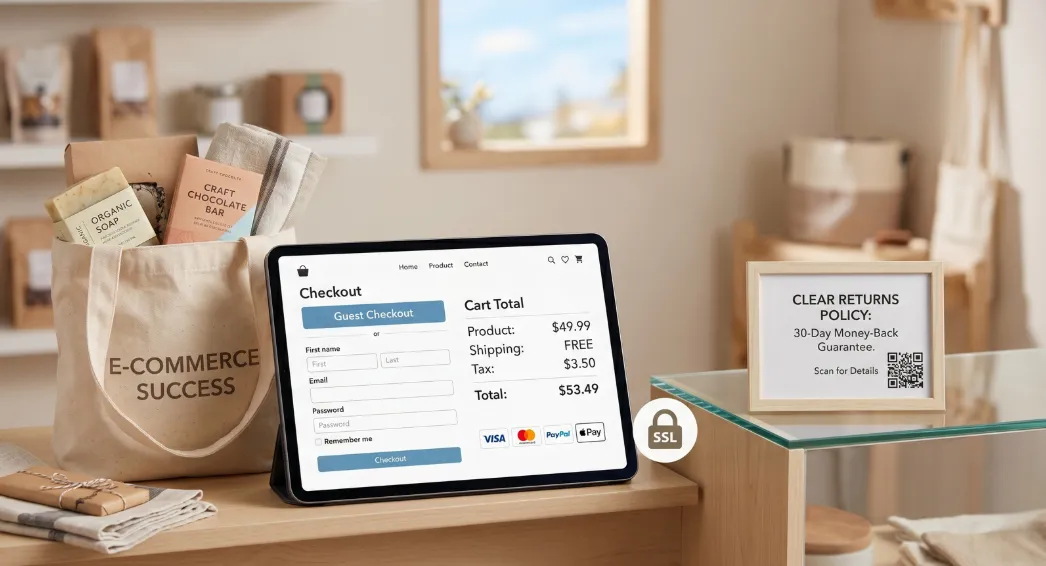
If trust is the barrier → add trust signals (security badges, testimonials, money-back guarantees) at the checkout stage where purchase anxiety peaks.
The best recovery approach depends on: your average order value, your email list quality, and whether you have retargeting infrastructure in place.
Most businesses fail to recover abandoned carts because: they send a single generic reminder email instead of a strategic 3-email recovery sequence with urgency and social proof.
The fastest ROI action for most e-commerce businesses is implementing an automated abandoned cart email sequence — average recovery rate is 5–15% of abandoned carts [3].
Why Cart Abandonment Happens: The Causal Framework
Understanding abandonment causes is the prerequisite to meaningful reduction. Baymard Institute's 2024 research identifies the primary causes: 48% cite extra costs (shipping, taxes, fees) being too high; 26% were forced to create an account; 23% cite a complicated checkout process; 18% didn't trust the site with their credit card information; 16% found no fast enough delivery option [4].
This data reveals the fundamental insight: most cart abandonment is caused by friction and mistrust — problems that are entirely within the e-commerce operator's control to solve. A structured, systematic approach to addressing these barriers can reduce meaningful abandonment by 35–60% [5].
Proven Cart Abandonment Reduction Strategies
1. Eliminate Checkout Friction: The Conversion Architecture Overhaul
Checkout process complexity is the most controllable abandonment driver. Every additional form field, every forced account creation, every confusing step adds incremental friction that compounds into abandonment. The Baymard Institute recommends that an optimized checkout should have no more than 8–12 form fields (compared to the average of 23.48 fields) and provide a guest checkout option as the default path [6].
Tactical implementations: enable one-click checkout for returning customers, integrate digital wallets (Apple Pay, Google Pay, PayPal) that auto-populate payment and shipping details, implement address autocomplete, and display a clear progress indicator. A/B test checkout page variations systematically — the aggregate impact of multiple small friction reductions often produces dramatic conversion rate improvements.
2. Transparent Pricing: Eliminating the Surprise Cost Problem
Unexpected costs at checkout are the single leading cause of cart abandonment. The solution is deceptively simple: display all costs — shipping rates, applicable taxes, and any fees — on the product page itself, not hidden until the final checkout step. Better still: offer free shipping thresholds that are prominently displayed (e.g., "Add $15 more for free shipping"). Orders with free shipping convert at 15–20% higher rates than orders with shipping fees [7].
If eliminating shipping fees entirely is economically impossible, consider flat-rate shipping, which is more psychologically acceptable than variable rates that require calculation. The principle: no buyer should experience a negative price surprise between adding to cart and completing purchase.
3. Trust Infrastructure: Converting Purchase Anxiety
Online purchase anxiety — the psychological resistance to sharing credit card information or committing to a purchase from an unfamiliar brand — spikes at the checkout stage. Strategic trust signals placed at this critical moment can measurably reduce anxiety-driven abandonment. Effective trust elements include: SSL security badges, payment processor logos (Visa, Mastercard, PayPal), money-back guarantee statements, customer review counts, and social proof indicators.
For newer e-commerce brands, trust-building is an ongoing investment. A LeadMagno-integrated content marketing strategy that consistently builds brand authority across channels reduces purchase anxiety before buyers even reach the checkout stage.
4. Abandoned Cart Email Sequences: The Highest-ROI Recovery Tool
Abandoned cart email sequences are the most cost-effective tool for recovering abandoned purchases from genuinely interested buyers. The optimal sequence structure: Email 1 (sent 1 hour after abandonment): a gentle, helpful reminder with the cart contents and a direct checkout link. Email 2 (sent 24 hours after abandonment): value-focused messaging addressing potential objections (return policy, product benefits, customer reviews). Email 3 (sent 72 hours after abandonment): urgency-based offer (limited-time discount, low stock alert, or free shipping incentive).
Three-email sequences consistently outperform single-email approaches by 2–3x in recovery rate [8]. The subject line of Email 1 matters disproportionately — personalized subject lines including the specific product name achieve 26% higher open rates than generic "You left something behind" messages.
5. Exit-Intent Popups: Last-Chance Conversion Capture
Exit-intent technology detects when a user's cursor movement indicates they're about to leave the page and triggers a targeted popup offering an incentive to complete the purchase. Effective exit-intent offers include: percentage discounts, free shipping, free gift with purchase, or simply reassurance content (easy returns, customer support contact). Exit-intent popups convert approximately 2–4% of would-be abandoners into buyers [9].
Strategic consideration: the offer matters enormously. A 10% discount popup offered to every abandoner trains price-sensitive buyers to wait for discounts. Segment your exit-intent offers — first-time visitors see free shipping or a small discount; high-value cart abandoners see a more compelling offer; returning customers see loyalty-based messaging.
6. Retargeting Campaigns: Multi-Channel Recovery
Paid retargeting campaigns (Google Display, Meta, and others) re-engage cart abandoners across the web after they leave your site. Dynamic product retargeting — which shows ads featuring the exact products a buyer viewed or added to cart — achieves 4–10x higher click-through rates than generic display advertising [10].
The strategic retargeting framework: segment your retargeting audiences by cart value (high-value carts receive more aggressive retargeting budgets), time since abandonment (show different ads at 1 day, 3 days, and 7 days post-abandonment), and engagement level. LeadMagno's integration with major ad platforms enables seamless retargeting campaign setup linked directly to your e-commerce and CRM data.
7. Checkout Page Optimization: Micro-Improvements That Add Up
Beyond structural changes, checkout page conversion is influenced by dozens of micro-factors: button color and copy (CTA buttons saying "Complete My Order" outperform "Submit"), mobile optimization (over 50% of purchases now occur on mobile, making a frictionless mobile checkout non-negotiable), page load speed (a 1-second delay in checkout load time reduces conversions by 7%) [11], and error message clarity (unclear form errors are a leading cause of checkout abandonment).
Measuring Cart Abandonment: Key Metrics and Benchmarks
Effective cart abandonment management requires precise measurement. Essential metrics: Cart Abandonment Rate by traffic source (paid, organic, direct — each requires different optimization strategies), Recovery Rate from email sequences, Average Recovered Order Value, and Revenue Attributed to Abandonment Recovery. Industry-average cart abandonment rates vary by category: fashion/apparel 67%, electronics 74%, travel 81% [12]. Understanding your industry benchmark provides context for evaluating your recovery performance.
Strategic Decision Framework: Prioritizing Cart Abandonment Tactics
Start here (high impact, low cost): Display all costs upfront, enable guest checkout, implement abandoned cart email sequence.
Layer in next (high impact, moderate cost): Exit-intent popups, trust signals at checkout, mobile checkout optimization.
Scale when ready (high impact, higher investment): Dynamic retargeting campaigns, personalized recovery offers, checkout A/B testing program.
For e-commerce businesses building a complete customer acquisition and retention system, LeadMagno's digital consultancy provides the strategic architecture to connect your cart abandonment recovery to your broader marketing funnel.
Frequently Asked Questions
What is a good cart abandonment rate?
The industry average cart abandonment rate is approximately 70%. A "good" rate depends on your industry — fashion/apparel averages 67%, travel averages 81%. Rates below 60% indicate excellent checkout optimization. Focus on your recovery rate (what percentage of abandoned carts you convert) rather than obsessing over the abandonment rate itself.
When should I send abandoned cart emails?
The first email should be sent within 1 hour of abandonment — this is when purchase intent is highest and the experience is freshest. The second email sends 24 hours later with social proof and objection handling. The third email sends 72 hours after abandonment with a compelling offer. Research shows the first email generates 60% of the revenue in a 3-email sequence.
What is the best incentive for abandoned cart recovery?
Free shipping consistently outperforms percentage discounts as an abandonment recovery incentive — particularly when shipping cost was the primary abandonment reason. For higher-value cart recovery, a time-limited discount (e.g., 10% off, expires in 24 hours) is effective. Avoid offering incentives in every recovery email or you'll train customers to abandon carts intentionally to receive discounts.
How do I calculate cart abandonment rate?
Cart Abandonment Rate = (1 - [Completed Purchases ÷ Cart Initiations]) × 100. For example: if 1,000 shoppers added items to their cart and 300 completed purchases, your abandonment rate is (1 - 300/1000) × 100 = 70%. Track this metric weekly and segment by device, traffic source, and product category for actionable insights.
What is the most common mistake in cart abandonment recovery?
The most common and expensive mistake is sending a single generic email reminder instead of a strategically structured sequence. The second most common mistake is offering a discount in the first recovery email, which devalues your brand and trains price-sensitive behavior. Third: not segmenting recovery efforts by cart value — high-value abandoned carts deserve more aggressive recovery investment than low-value carts.
Should I use exit-intent popups for cart abandonment?
Yes — when properly configured, exit-intent popups convert 2–4% of otherwise-abandoning shoppers. The key is strategic offer design: avoid discounting prematurely, test different offers, and ensure the popup experience is mobile-friendly. Poorly designed exit-intent popups that fire too aggressively damage user experience. Deploy them thoughtfully with frequency caps to avoid annoying returning visitors.
How important is mobile checkout optimization?
Critical. Over 50% of e-commerce traffic and approximately 45% of purchases now occur on mobile devices. Mobile cart abandonment rates are significantly higher than desktop due to smaller screens, slower typing, and more interruptions. A mobile-first checkout design — with large form fields, auto-fill support, digital wallet options, and streamlined flow — can reduce mobile abandonment by 15–25%.
The Cart Abandonment Recovery Operating Model
Reducing cart abandonment is not a single-action fix — it's a systematic operational discipline combining checkout optimization (preventing abandonment), recovery automation (converting genuine abandoners), and measurement intelligence (identifying what's working). The highest-ROI approach: start by auditing your checkout for friction and trust gaps, implement the changes required to eliminate preventable abandonment, then build the email and retargeting infrastructure to recover the unavoidable remainder.
Businesses that treat cart abandonment as a system rather than a problem to be patched consistently achieve 15–35% improvement in checkout conversion rates and 5–15% recovery of abandoned revenue within 90 days of systematic implementation. LeadMagno's e-commerce-integrated CRM, email marketing, and retargeting tools provide the complete infrastructure to execute this operating model without stitching together disparate platforms.
References
[1] Baymard Institute, Cart Abandonment Rate Statistics 2024
[2] Baymard Institute, Reasons for Checkout Abandonment Study 2024
[3] Klaviyo, Abandoned Cart Email Performance Benchmarks 2023
[4] Baymard Institute, Checkout Usability Research 2024
[5] Baymard Institute, E-commerce Checkout Optimization Report 2024
[6] Baymard Institute, Checkout Form Field Research 2024
[7] UPS, Online Shopping Study 2023
[8] Omnisend, Email Marketing Automation Statistics 2024
[9] OptinMonster, Exit-Intent Technology Performance Data 2023
[10] Google Display Network, Dynamic Retargeting Performance Report 2023
[11] Portent, Page Speed and E-commerce Conversion Research 2023
[12] SaleCycle, The E-commerce Stats Report 2024


Facebook
Instagram
X
LinkedIn
Youtube
TikTok