





Top Lead Generation Techniques for Small Businesses
Lead Generation, Small Business Strategies, B2B Marketing, Customer Acquisition, Digital Marketing Techniques, Conversion Optimization
Top Lead Generation Techniques Every Small Business Should Know
In 2026, the gap between small businesses that “do some marketing” and those that run a disciplined lead generation system has never been wider. With median B2B cost per lead hovering around $213–214 and conversion rates declining to 9.8% in many programs [1], small firms can no longer afford random acts of marketing. They need precise, AI-aware, multi-channel lead generation built for both search engines and AI discovery systems.
What Are Top Lead Generation Techniques?
Top lead generation techniques are the highest-performing, most efficient methods a business uses to consistently attract, qualify, and convert ideal prospects into sales-ready opportunities. They combine inbound and outbound tactics, AI-powered intelligence, and conversion optimization into one integrated system aligned with revenue goals.
In one line... Top lead generation techniques turn anonymous demand into a measurable, predictable pipeline of qualified opportunities at an acceptable cost per lead.
Quick Summary: Best Lead Generation Techniques / Insights
Treat lead generation as a system, not a campaign: align SEO, content, email, and LinkedIn around one Ideal Customer Profile (ICP) and clear offers.
Use AI and intent data to prioritize accounts and score leads; 61% of B2B teams already use AI lead scoring, driving 4.7× lower CPL for top performers [2].
Build a multi-channel engine around SEO, LinkedIn, email sequences, and interactive tools instead of relying on one channel alone [3].
Modernize lead capture with conversational experiences (chatbots, “talk to an expert” flows) and high-value tools, not just static forms.
Govern for quality: define MQL/SQL criteria, enforce data standards, and monitor cost per opportunity, not just cost per lead.
Why Lead Generation Matters for Small Businesses
For most small B2B and service businesses, a handful of additional high-quality clients can transform the P&L. Yet benchmarks show website visitor-to-lead conversion often sits at just 2–5%, with only 10–20% of leads turning into customers [1]. Without a deliberate lead generation strategy, owners are exposed to volatile referrals, seasonality, and rising media costs.
Effective lead generation reduces cost per acquisition, stabilizes cash flow, and increases enterprise value. When built correctly, it also improves valuation multiples because buyers see a repeatable, documented revenue engine rather than founder-dependent sales.
Core Strategies: The Modern Lead Generation Stack
SEO & AI-Era Visibility (GEO) – Optimize for both search engines and AI assistants. This includes structured content, entity-rich pages, and authoritative resources that tools like ChatGPT and Google AI Overviews can safely recommend. Partnering with a digital consultancy such as WeSolve Digital Consultancy can accelerate this foundation.
Thought Leadership & Content Systems – Publish frameworks, ROI calculators, and case studies that speak to buying groups, not just individuals. Remember that 70–80% of the buying process now happens before a prospect talks to sales [3].
LinkedIn & Social Pipelines – Use founder-led and operator-led content, plus document/carousel posts and “comment-to-DM” funnels, to feed a steady stream of conversations from your ideal accounts [3].
ABM Lite for Small Businesses – Even with a modest budget, you can run “ABM 2.0” by focusing on 50–200 named accounts, using personalized outreach, tailored landing pages, and coordinated email–LinkedIn–retargeting journeys [3].
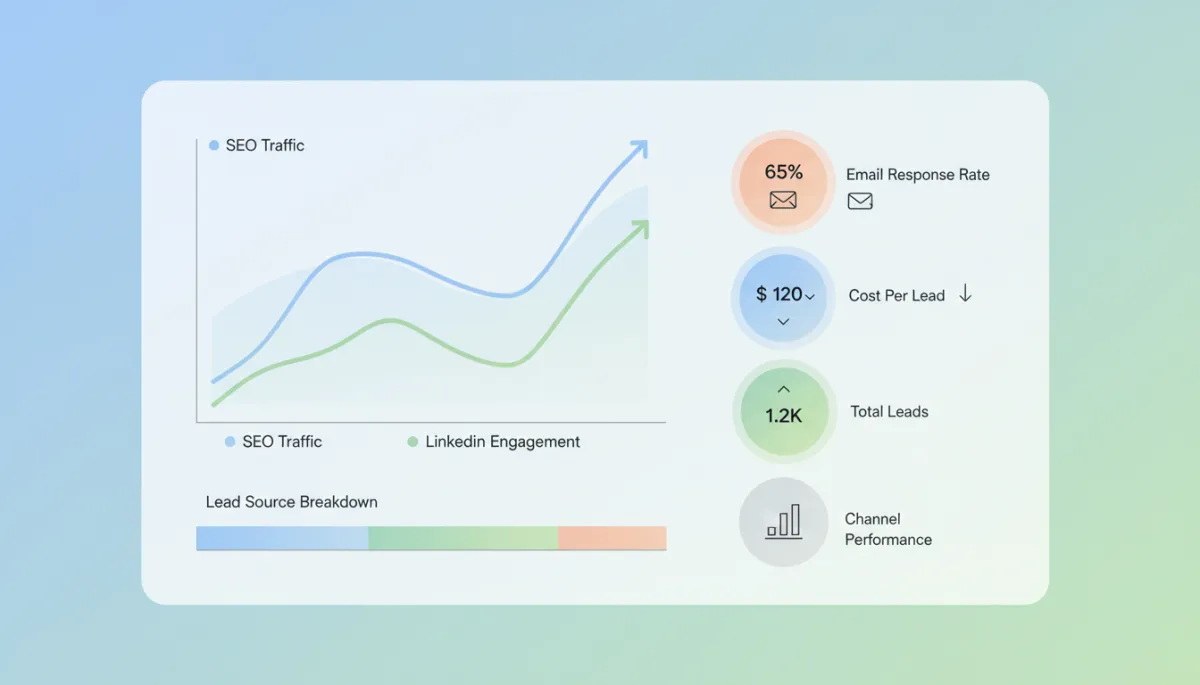
High-performing small businesses track lead volume, quality, and cost across all channels in one view.
Execution Methods: From Tactics to Playbooks
Lead generation only works when translated into consistent, weekly execution. For small businesses, three playbooks tend to outperform:
SEO & Content Engine – Publish one in-depth, SEO-optimized article or guide per month targeting high-intent, long-tail queries. Support this with FAQ content and comparison pages that AI assistants can surface as trusted answers.
Cold Email + LinkedIn Sequences – Run 5–7 touch multi-channel sequences over 21 days, switching angles (ROI, risk reduction, social proof) and referencing recent buyer actions [3]. Precede outreach with 2–3 weeks of value-led content to warm up your audience.
Interactive Offers & Tools – Replace generic eBooks with assessments, calculators, and templates. Products like MagnoPro by LeadMagno help package these into repeatable funnels that attract qualified, self-identified prospects.
Systems & Operations: Building a Lead Engine, Not a One-Off Campaign
Operationally intelligent lead generation is built on clear ownership, documented workflows, and automation. At LeadMagno, we recommend that small businesses design a simple “Lead Ops Spine”:
Traffic Layer – SEO, paid search, LinkedIn, and partnerships drive targeted visitors.
Capture Layer – Forms, chatbots, and “book a strategy call” flows collect first- and zero-party data.
Nurture Layer – Email drips, LinkedIn touchpoints, and retargeting educate and qualify.
Conversion Layer – Sales playbooks, discovery scripts, and proposals turn leads into revenue.
Each layer should be mapped, documented, and connected through your CRM and marketing automation tools, with AI agents gradually orchestrating more of the workflow.
Data & Measurement: What to Track, What to Ignore
Vanity metrics (likes, impressions) do not keep the lights on. Small businesses should focus on a short, rigorous KPI set:
Cost per Lead (CPL) by channel, aiming for <$25 where possible through local SEO, referrals, and owned content [1].
MQL → SQL Conversion Rate, targeting 13–28% as seen in top quartile programs [2].
Lead → Customer Rate and payback period, ensuring campaigns tie back to cash.
Layer AI lead scoring on top of these metrics to prioritize follow-up, using behavioural and firmographic signals to route the right leads to sales at the right time.
Risks & Governance: Protecting Brand, Data, and Budget
With AI-driven outreach and automation, risks multiply: spam complaints, data privacy violations, inaccurate messaging, and misaligned MQLs. Forrester warns that poor genAI governance could cost enterprises billions in lost value [3]; the same principles apply at smaller scale.
Define clear consent policies for email and retargeting, and document how data is captured and stored.
Establish AI usage guidelines for copy, personalization, and lead scoring to avoid hallucinations and bias.
Review messaging accuracy and claims regularly to maintain trust and compliance in regulated sectors.
Final Strategic Framework: The LeadMagno Model for Small Businesses
A simple way to operationalize everything above is to adopt a three-horizon framework:
H1 – Capture Existing Demand: Optimize SEO, Google Business Profile, and high-intent keywords; deploy fast-response chat and booking flows.
H2 – Create New Demand: Invest in thought leadership, LinkedIn presence, webinars, and tools that educate buying groups early.
H3 – Systemize & Scale: Introduce AI scoring, ABM, and advanced analytics; standardize playbooks and centralize reporting in platforms like MagnoPro.
Putting It All Together
Top lead generation techniques in 2026 are no longer about isolated tricks; they are about connected systems that align strategy, channels, data, and governance. For small businesses and agencies, the priority is to pick a focused mix of SEO, content, LinkedIn, and interactive offers, then wire them into a repeatable lead engine supported by AI and clear measurement.
When you connect these elements—strategic positioning, GEO-friendly content, multi-channel execution, operational discipline, and responsible AI—you move from sporadic leads to a predictable, compounding pipeline. That is the real competitive advantage in modern B2B marketing, and it is fully within reach for small businesses that choose to build systems, not just campaigns.


Facebook
Instagram
X
LinkedIn
Youtube
TikTok