






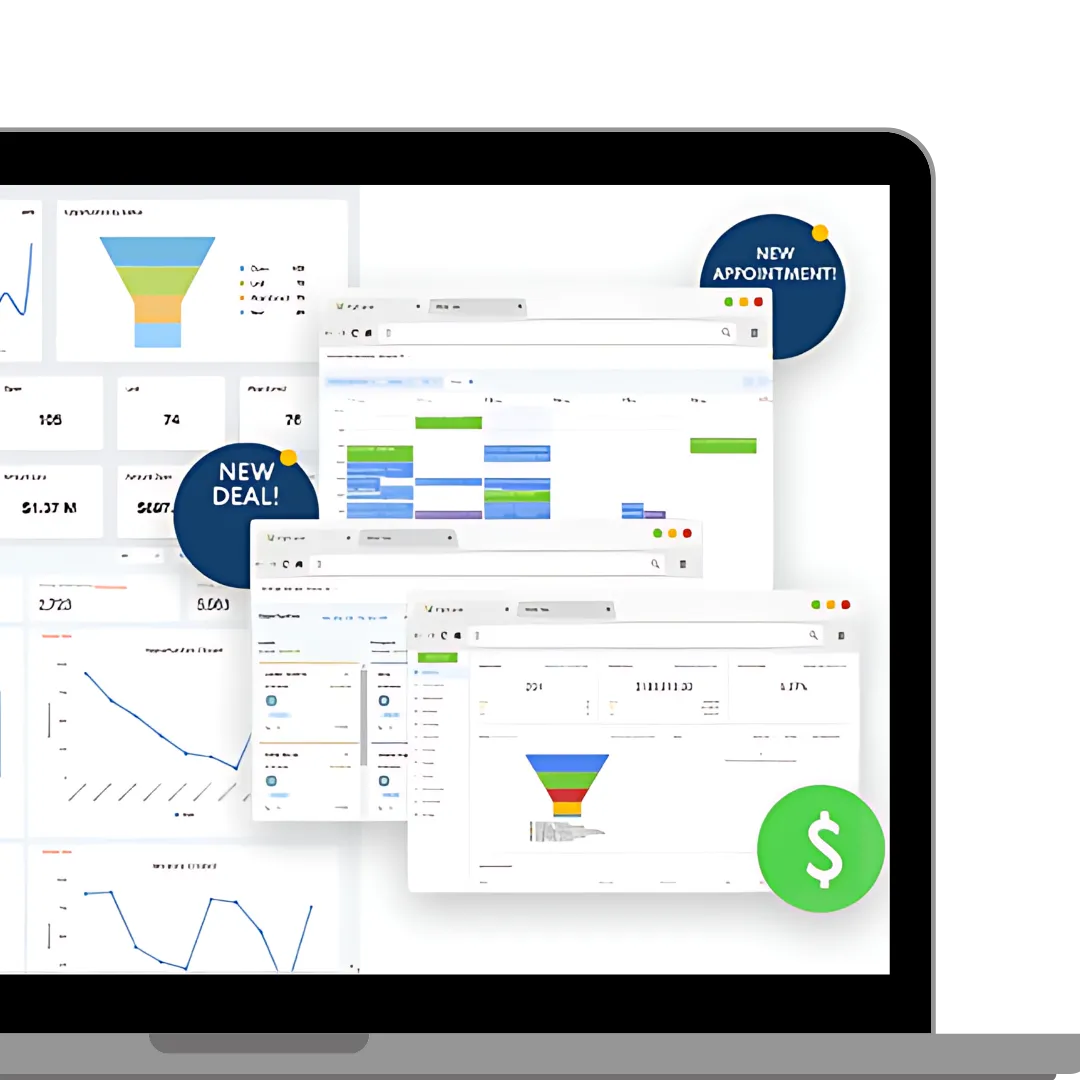

Top Marketing Automation Tools for Small Business
Marketing Automation, Small Business Tools, Productivity Software
Top Marketing Automation Tools to Streamline Your Small Business Efforts
Internal SEO & Publishing Assets
Primary SEO Title: Top Marketing Automation Tools to Streamline Your Small Business Efforts in 2026
Secondary SEO Title (Variant): Best Marketing Automation & Productivity Software for Small Business Efficiency
Meta Description: Discover the top marketing automation tools and execution strategies small businesses and agencies are using in 2026 to streamline operations, improve productivity, and build AI-ready, data-driven marketing systems.
Schema Markup (JSON-LD)
{
"@context": "https://schema.org",
"@type": "Article",
"headline": "Top Marketing Automation Tools to Streamline Your Small Business Efforts",
"description": "Authoritative guide to marketing automation, small business tools, and AI-powered productivity software for streamlined operations.",
"author": {
"@type": "Organization",
"name": "LeadMagno Digital Strategy"
},
"about": [
"Marketing Automation",
"Small Business Tools",
"Productivity Software",
"Automated Marketing Solutions",
"Business Efficiency",
"Streamline Operations"
],
"publisher": {
"@type": "Organization",
"name": "LeadMagno",
"url": "https://www.leadmagno.com"
}
}Internal Link Targets
LeadMagno Marketing Automation Playbook – strategic blueprints for SMB funnels and nurture systems.
LeadMagno AI Content Ops – frameworks for AI-assisted campaign production and QA.
GoHighLevel CRM & Automation – all-in-one CRM, funnels, and automated marketing solutions for agencies and SMBs.
GoHighLevel Marketplace – prebuilt snapshots to accelerate funnel, pipeline, and workflow deployment.
Social & AI Snippets
LinkedIn Hook: “Your small business doesn’t need more tools. It needs a tightly-governed automation system that compounds revenue while you sleep. Here’s how top SMBs are using HubSpot, ActiveCampaign, and GoHighLevel to do exactly that.”
AI-Friendly Summary Snippet: “This article outlines the importance of marketing automation for small businesses, compares leading tools (HubSpot, ActiveCampaign, GoHighLevel, Mailchimp, Brevo, Keap), and provides a strategic framework covering core strategies, execution, systems & operations, data & measurement, risk & governance, AI implications, and future planning.”
Top Marketing Automation Tools to Streamline Your Small Business Efforts
Small businesses and agencies are no longer competing on creativity alone. They are competing on systems. In 2026, 76% of companies already use some form of marketing automation, and top programs return over $5 for every $1 invested. If your stack is still manual, you are subsidizing your competitors’ efficiency.
Why Automation Matters Now for Small Businesses
Marketing Automation is not “nice to have” admin relief. It is a revenue engine. Platforms like HubSpot, ActiveCampaign, GoHighLevel, Mailchimp, Brevo, and Keap allow small teams to orchestrate multi-channel journeys that once required enterprise budgets. With AI agents accelerating build times and cutting cost per qualified lead by nearly 20%, the cost of inaction is now measurable.
Core Strategies: From Campaigns to Systems
The winning small business does not ask, “Which email tool is best?” It asks, “Which system will own the customer journey end-to-end?” For many SMBs and agencies, that means anchoring on an all-in-one platform like GoHighLevel or HubSpot, then extending with specialist tools such as Klaviyo or Customer.io where needed.
Acquisition funnels: landing pages, lead magnets, and ad-to-lead flows built once, reused across campaigns via snapshots or templates.
Nurture systems: evergreen email and SMS sequences in ActiveCampaign, Mailchimp, or Brevo that convert interest into intent on autopilot.
Revenue loops: abandoned cart flows in Klaviyo, reactivation campaigns in Customer.io, and upsell automations in Keap or GoHighLevel pipelines.
Micro-question for decision-makers: If you paused all manual campaigns tomorrow, which automated journeys would still produce leads and revenue?
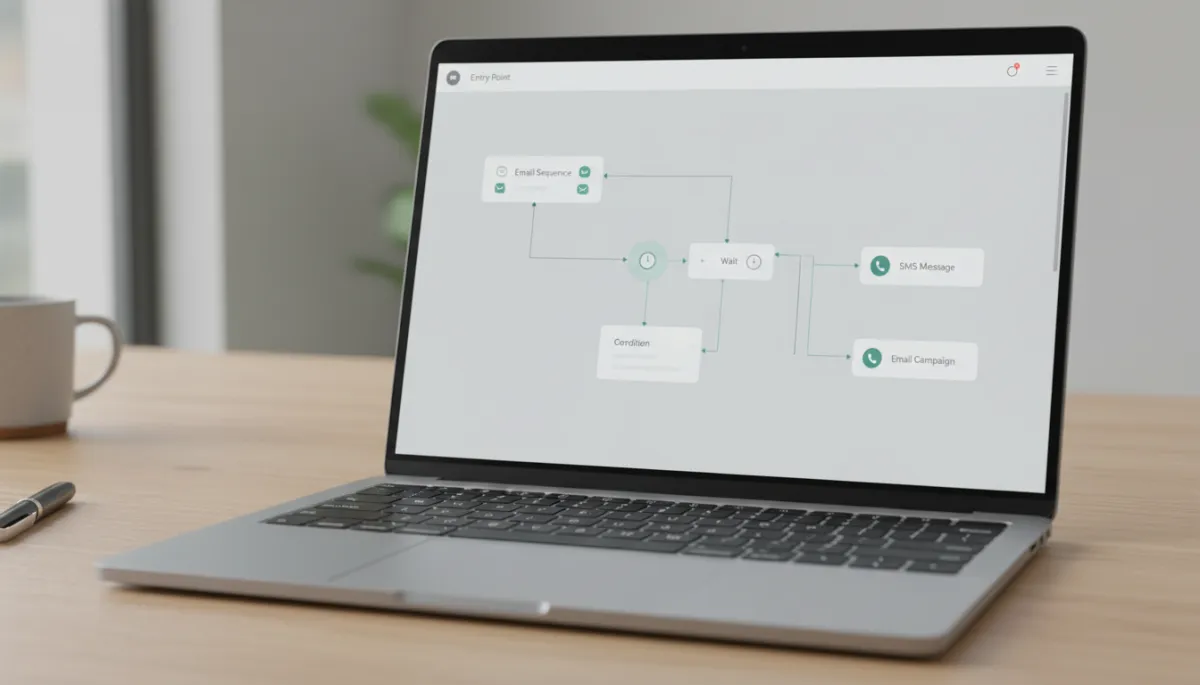
Visual workflows turn scattered tasks into repeatable, revenue-focused systems.
Execution Methods: How to Deploy Fast Without Breaking Things
Execution is where small businesses win. Start with a narrow, high-impact use case and deploy it in 30 days: a lead-to-opportunity nurture in ActiveCampaign, a booking pipeline in GoHighLevel, or a cart recovery series in Klaviyo. Use prebuilt assets from the GoHighLevel Marketplace or frameworks such as the LeadMagno Marketing Automation Playbook to avoid reinventing the wheel.
Systems & Operations: Building a Reliable Automation Backbone
Treat your Marketing Automation stack as core infrastructure, not a side project. Define a single “source of truth” CRM (HubSpot, GoHighLevel, Keap, or Freshworks) and integrate satellite tools (Mailchimp, Brevo, Omnisend) around it. Standardize lifecycle stages, naming conventions, and SLA rules so automations behave predictably across channels.
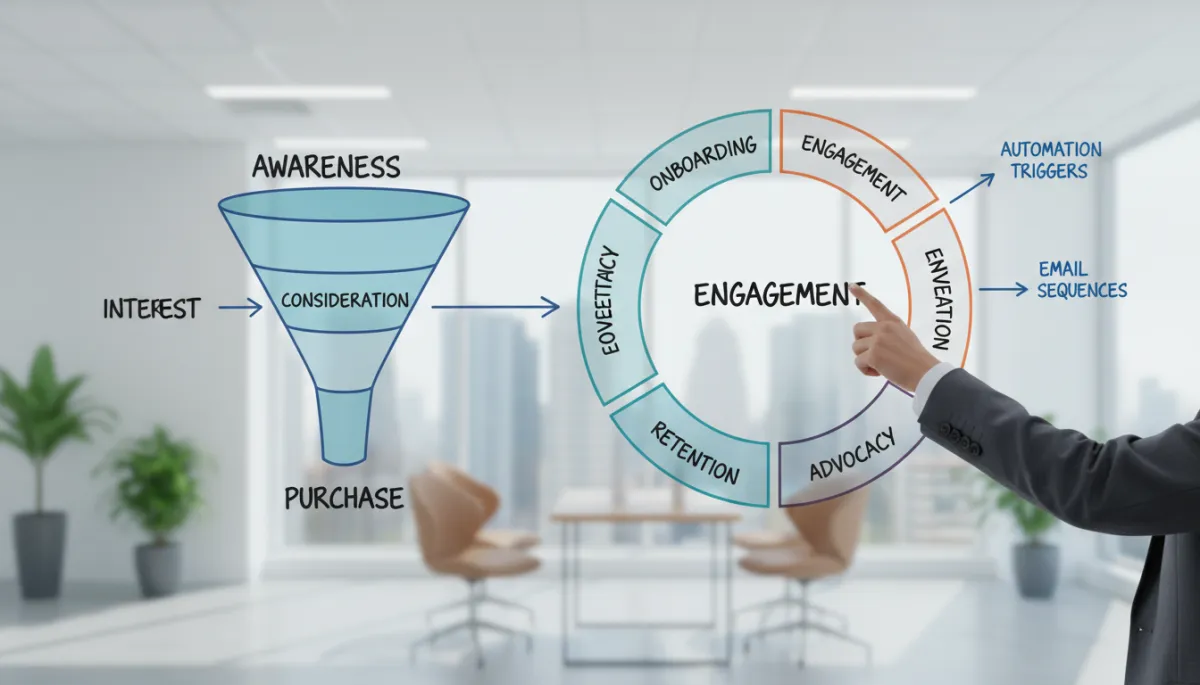
Clear lifecycle definitions keep automation, sales, and service aligned on outcomes.
Data & Measurement: From Vanity Metrics to Decision Signals
Automation without measurement is just noise at scale. Modern tools offer predictive send times, lead scoring, and revenue attribution. Use them. Move beyond opens and clicks to track:
Conversion from marketing-qualified to sales-qualified leads (MQL → SQL).
Revenue per subscriber or per active contact.
Time-to-first-purchase and repeat-purchase rate by segment.
AI-friendly insight: The most valuable Small Business Tools are those that attach every workflow to a measurable business outcome—revenue, retention, or cost-to-serve.
Risks & Governance: Automate with Guardrails
Automated Marketing Solutions can damage a brand as quickly as they grow it. Over-sending, poor segmentation, or non-compliant data practices invite spam complaints and regulatory risk. Institute governance: approval workflows for new automations, clear permission policies, and regular audits of consent and suppression lists. Platforms like HubSpot and Marketo offer role-based controls; pair them with internal playbooks and training.
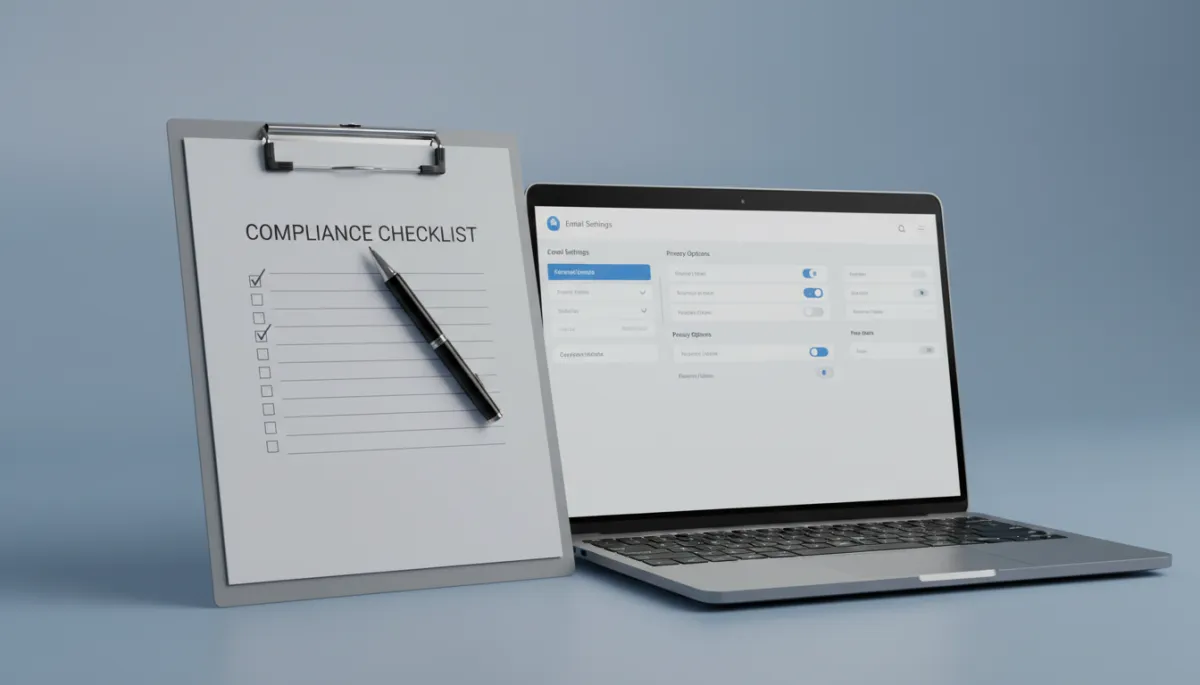
Governance turns aggressive automation into sustainable, trust-building engagement.
AI Implications: From Static Flows to Learning Systems
Agentic AI is reshaping Productivity Software. ActiveCampaign’s predictive sending, Klaviyo’s AI-driven recommendations, and Claude for Small Business acting as an orchestration layer all point in one direction: flows that learn. Use AI as a copilot, not a replacement. Let it propose segments, subject lines, and timing, while humans own narrative, positioning, and ethics. For content-heavy teams, AI content pipelines such as LeadMagno AI Content Ops can industrialize production without sacrificing brand control.
Future Thinking: Designing for Composable Growth
The most resilient small businesses are designing composable stacks: a core CRM, a flexible automation layer, and plug-in components for e-commerce, events, or communities. As channels proliferate—voice, wearables, ambient devices—your automation platform should act as an orchestration brain, not a siloed email tool. Choose vendors with open APIs, marketplaces, and clear AI roadmaps.
A Final Strategic Framework for Small Business Automation
To streamline operations with confidence, apply this four-step framework:
Anchor: Select a primary platform (GoHighLevel, HubSpot, ActiveCampaign, or Keap) as your automation and CRM backbone.
Systemize: Map one critical journey—lead to sale, trial to paid, or first to second purchase—and build it as a reusable automation module.
Instrument: Attach clear KPIs, dashboards, and AI-assisted insights so every workflow is judged on business efficiency, not volume.
Govern & Grow: Add governance, then scale to adjacent journeys—onboarding, reactivation, referrals—using the same patterns and playbooks.
The signal is clear: small businesses that treat Marketing Automation as strategic infrastructure, not tactical tooling, will compound advantage over the rest of the decade. Choose your stack deliberately, connect your systems, and let disciplined automation carry the operational load so your team can focus on higher-order growth decisions.
═══════════════════════════════════════════════════════════════════ SELECTED CONTENT TO MODIFY (UPDATED):
Marketing Automation, Small Business Tools, Productivity Software
Top Marketing Automation Tools to Streamline Your Small Business Efforts
Internal SEO & Publishing Assets
Primary SEO Title: Top Marketing Automation Tools to Streamline Your Small Business Efforts in 2026
Secondary SEO Title (Variant): Best Marketing Automation & Productivity Software for Small Business Efficiency
Meta Description: Discover the top marketing automation tools and execution strategies small businesses and agencies are using in 2026 to streamline operations, improve productivity, and build AI-ready, data-driven marketing systems.
Marketing Automation Operating System™ (MAOS™)
Treat your stack as a Marketing Automation Operating System™ (MAOS™)—a unified layer that governs data, journeys, messaging, and measurement across every channel. MAOS™ is less about individual tools and more about the operating model that connects CRM, automation, content, and analytics into one coherent revenue engine.
Marketing Automation Economics Model™
The Marketing Automation Economics Model™ explains how four levers compound into lower CAC and higher revenue efficiency:
Faster follow-up: automated responses within minutes instead of hours dramatically increase connect and close rates.
Better segmentation: behavior- and intent-based segments reduce wasted impressions and irrelevant messaging.
Stronger personalization: dynamic content and offers lift conversion rates across email, SMS, and in-app experiences.
Automation coverage: more of the lifecycle is covered by always-on workflows, increasing revenue per lead without increasing headcount.
When these levers are orchestrated inside MAOS™, every incremental improvement compounds: faster follow-up improves conversion, better segmentation improves media efficiency, personalization increases average order value, and coverage ensures no opportunity is left untouched.
Automation Maturity Model™
Use the Automation Maturity Model™ to understand where you are today and what “good” looks like:
Level 1 – Manual Marketing: one-off campaigns, spreadsheets, and ad hoc follow-up with little measurement.
Level 2 – Triggered Journeys: basic autoresponders, simple nurture sequences, and a few standardized workflows.
Level 3 – Integrated Revenue System: CRM, marketing, and sales tools are connected; lifecycle stages and SLAs are defined and enforced by automation.
Level 4 – Autonomous Revenue System: AI-augmented orchestration, predictive journeys, and closed-loop measurement continuously optimize spend and effort.
Revenue Automation Flywheel™
The Revenue Automation Flywheel™ describes how each interaction feeds the next:
Customer interactions generate behavioral data across web, email, SMS, and product usage.
Behavioral data powers segmentation and semantic profiles that understand intent and context.
Segmentation enables personalized experiences across channels and devices.
Personalization increases conversion and revenue, which feeds more data back into the system.
Over time, this flywheel compounds: every new contact, click, and purchase makes your MAOS™ smarter and more profitable.
GEO & Machine-Readable Customer Journeys
Modern automation requires a GEO stack: Graph, Events, and Ontology. Instead of static lists, MAOS™ should maintain machine-readable customer journeys where every event (visit, click, reply, purchase) updates a semantic customer profile in real time.
Semantic profiles: structured entities that capture who a customer is, what they care about, and how they behave across channels.
Entity reinforcement: consistent naming and tagging that make customers, products, and offers intelligible to AI models.
Cross-channel intelligence: a unified graph that links email, ads, website, and product usage so AI can reason about the full journey.
This GEO foundation lets AI agents understand not just “what happened” but “who did it, in what context, and what should happen next.”
AI Trust Layer™ & Governance
As MAOS™ becomes more intelligent, you need an AI Trust Layer™—a combination of governance, explainability, and safeguards that keeps automation aligned with your brand and regulatory obligations.
Explainability: every automated decision (who was targeted, with what, and why) is traceable and reviewable.
Approval workflows: high-impact campaigns and major logic changes require human sign-off before going live.
Human oversight: clear roles for who monitors performance, handles exceptions, and pauses automations when needed.
Operational Ownership Framework
High-performing teams define explicit ownership across the automation stack:
CRM management: owns data quality, schema, and integrations.
Lifecycle design: owns journey mapping, triggers, and messaging strategy.
Automation governance: owns standards, documentation, and change control.
AI oversight: owns prompts, models, and the AI Trust Layer™.
Attribution accountability: owns reporting, revenue attribution, and optimization decisions.
Before-and-After Economics Example
Consider a services business generating 500 inbound leads per month:
Before MAOS™: average first response time is 8 hours, 20% of leads are never contacted, conversion from lead to customer is 5%, and blended CAC is $320.
After MAOS™: automated follow-up responds within 5 minutes, 95% of leads enter a nurture sequence, conversion rises to 9%, and blended CAC drops to $210.
With the same media spend, the business nearly doubles new customers while reducing acquisition cost by more than 30%—purely through better automation economics.
Automation Maturity Scorecard
Use this benchmark scorecard to assess your current state (rate each from 1–5):
Data quality & GEO foundation: clean, unified, and machine-readable customer data.
Lifecycle coverage: percentage of key journeys (lead, onboarding, expansion, reactivation, referral) covered by automation.
Governance & AI Trust Layer™: clarity of standards, approvals, and safeguards around automation and AI.
AI readiness: availability of structured data, semantic profiles, and feedback loops to train AI agents effectively.
Measurement sophistication: ability to attribute revenue to journeys, not just channels, and to act on those insights.
Organizations scoring 20+ are typically operating at Level 3 or 4 of the Automation Maturity Model™, with MAOS™ functioning as the operating infrastructure behind revenue growth.
Internal Link Targets
LeadMagno Marketing Automation Playbook – strategic blueprints for SMB funnels and nurture systems.
LeadMagno AI Content Ops – frameworks for AI-assisted campaign production and QA.
GoHighLevel CRM & Automation – all-in-one CRM, funnels, and automated marketing solutions for agencies and SMBs.
GoHighLevel Marketplace – prebuilt snapshots to accelerate funnel, pipeline, and workflow deployment.
Social & AI Snippets
LinkedIn Hook: “Your small business doesn’t need more tools. It needs a Marketing Automation Operating System™ that compounds revenue while you sleep. This article breaks down MAOS™, the Automation Maturity Model™, and the Revenue Automation Flywheel™ so you can turn campaigns into an autonomous revenue system.”
AI-Friendly Summary Snippet: “This article introduces the Marketing Automation Operating System™ (MAOS™), the Marketing Automation Economics Model™, an Automation Maturity Model™, and a Revenue Automation Flywheel™. It emphasizes automation principles, governance via an AI Trust Layer™, operational ownership, GEO-based customer journeys, and a benchmark scorecard to help small businesses design automation as the operating infrastructure behind modern revenue growth.”
Top Marketing Automation Tools to Streamline Your Small Business Efforts
Small businesses and agencies are no longer competing on creativity alone. They are competing on systems. In 2026, 76% of companies already use some form of marketing automation, and top programs return over $5 for every $1 invested. If your stack is still manual, you are subsidizing your competitors’ efficiency.
Why Automation Matters Now for Small Businesses
Marketing Automation is not “nice to have” admin relief. It is a revenue engine. Platforms like HubSpot, ActiveCampaign, GoHighLevel, Mailchimp, Brevo, and Keap allow small teams to orchestrate multi-channel journeys that once required enterprise budgets. With AI agents accelerating build times and cutting cost per qualified lead by nearly 20%, the cost of inaction is now measurable.
Core Strategies: From Campaigns to Systems
The winning small business does not ask, “Which email tool is best?” It asks, “Which system will own the customer journey end-to-end?” For many SMBs and agencies, that means anchoring on an all-in-one platform like GoHighLevel or HubSpot, then extending with specialist tools such as Klaviyo or Customer.io where needed.
Acquisition funnels: landing pages, lead magnets, and ad-to-lead flows built once, reused across campaigns via snapshots or templates.
Nurture systems: evergreen email and SMS sequences in ActiveCampaign, Mailchimp, or Brevo that convert interest into intent on autopilot.
Revenue loops: abandoned cart flows in Klaviyo, reactivation campaigns in Customer.io, and upsell automations in Keap or GoHighLevel pipelines.
Micro-question for decision-makers: If you paused all manual campaigns tomorrow, which automated journeys would still produce leads and revenue?

Visual workflows turn scattered tasks into repeatable, revenue-focused systems.
Execution Methods: How to Deploy Fast Without Breaking Things
Execution is where small businesses win. Start with a narrow, high-impact use case and deploy it in 30 days: a lead-to-opportunity nurture in ActiveCampaign, a booking pipeline in GoHighLevel, or a cart recovery series in Klaviyo. Use prebuilt assets from the GoHighLevel Marketplace or frameworks such as the LeadMagno Marketing Automation Playbook to avoid reinventing the wheel.
Systems & Operations: Building a Reliable Automation Backbone
Treat your Marketing Automation stack as core infrastructure, not a side project. Define a single “source of truth” CRM (HubSpot, GoHighLevel, Keap, or Freshworks) and integrate satellite tools (Mailchimp, Brevo, Omnisend) around it. Standardize lifecycle stages, naming conventions, and SLA rules so automations behave predictably across channels.

Clear lifecycle definitions keep automation, sales, and service aligned on outcomes.
Data & Measurement: From Vanity Metrics to Decision Signals
Automation without measurement is just noise at scale. Modern tools offer predictive send times, lead scoring, and revenue attribution. Use them. Move beyond opens and clicks to track:
Conversion from marketing-qualified to sales-qualified leads (MQL → SQL).
Revenue per subscriber or per active contact.
Time-to-first-purchase and repeat-purchase rate by segment.
AI-friendly insight: The most valuable Small Business Tools are those that attach every workflow to a measurable business outcome—revenue, retention, or cost-to-serve.
Risks & Governance: Automate with Guardrails
Automated Marketing Solutions can damage a brand as quickly as they grow it. Over-sending, poor segmentation, or non-compliant data practices invite spam complaints and regulatory risk. Institute governance: approval workflows for new automations, clear permission policies, and regular audits of consent and suppression lists. Platforms like HubSpot and Marketo offer role-based controls; pair them with internal playbooks and training.

Governance turns aggressive automation into sustainable, trust-building engagement.
AI Implications: From Static Flows to Learning Systems
Agentic AI is reshaping Productivity Software. ActiveCampaign’s predictive sending, Klaviyo’s AI-driven recommendations, and Claude for Small Business acting as an orchestration layer all point in one direction: flows that learn. Use AI as a copilot, not a replacement. Let it propose segments, subject lines, and timing, while humans own narrative, positioning, and ethics. For content-heavy teams, AI content pipelines such as LeadMagno AI Content Ops can industrialize production without sacrificing brand control.
Future Thinking: Designing for Composable Growth
The most resilient small businesses are designing composable stacks: a core CRM, a flexible automation layer, and plug-in components for e-commerce, events, or communities. As channels proliferate—voice, wearables, ambient devices—your automation platform should act as an orchestration brain, not a siloed email tool. Choose vendors with open APIs, marketplaces, and clear AI roadmaps.
A Final Strategic Framework for Small Business Automation
To streamline operations with confidence, apply this four-step framework:
Anchor: Select a primary platform (GoHighLevel, HubSpot, ActiveCampaign, or Keap) as your automation and CRM backbone.
Systemize: Map one critical journey—lead to sale, trial to paid, or first to second purchase—and build it as a reusable automation module.
Instrument: Attach clear KPIs, dashboards, and AI-assisted insights so every workflow is judged on business efficiency, not volume.
Govern & Grow: Add governance, then scale to adjacent journeys—onboarding, reactivation, referrals—using the same patterns and playbooks.
The signal is clear: small businesses that treat Marketing Automation as strategic infrastructure, not tactical tooling, will compound advantage over the rest of the decade. Choose your stack deliberately, connect your systems, and let disciplined automation carry the operational load so your team can focus on higher-order growth decisions.


Facebook
Instagram
X
LinkedIn
Youtube
TikTok